
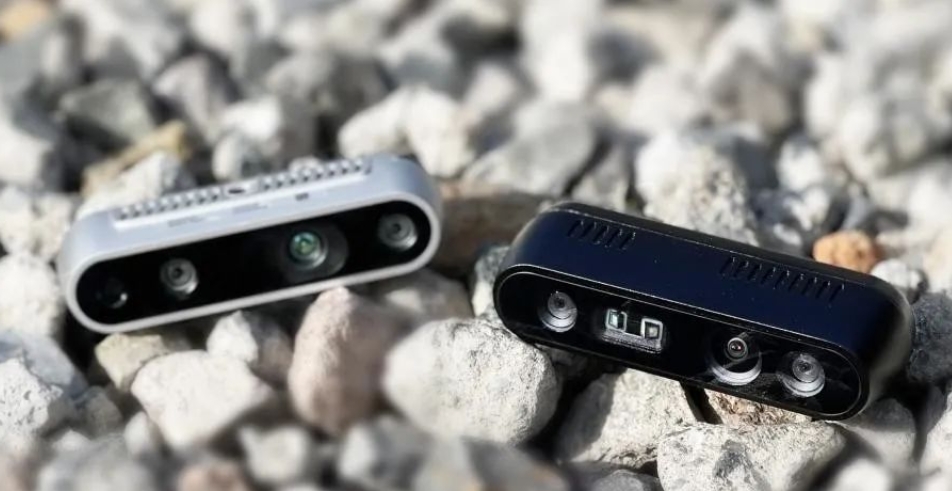
Product Background: The Feynman M1 is an integrated, domestically produced 3D+AI depth camera launched by NextVPU. Powered by the proprietary NE-D163A vision SoC and utilizing an active binocular speckle structured light scheme, it integrates depth computation, image ISP, and NPU AI inference directly into the camera body. Positioned to compete with the Intel RealSense D435 series, it targets edge-side perception scenarios such as humanoid robots, mobile robots, AR/VR, contactless access control, and industrial vision. Drawing on official technical white papers, third-party comparative tests, and real-world industry applications, this article provides a comprehensive analysis of this perception hardware—designed for physical AI—covering hardware specifications, architectural design, actual performance, strengths and weaknesses, and industrial value.
I. Product Positioning: Packing Depth Computation and AI Processing Power into the Camera Itself
Traditional depth cameras are generally “bare-bones sensors”: they output only raw image data, leaving depth calculation, object detection, and semantic segmentation to an external host CPU or GPU. This places a heavy computational burden on the host and results in high system-wide power consumption, bulkiness, and deployment costs.
The Feynman M1’s core differentiator: The camera features a built-in, full-fledged vision SoC. Depth map generation, point cloud preprocessing, and AI model inference are all performed locally on the device. It directly outputs depth maps, point clouds, and AI recognition results, eliminating the need for a backend host to handle heavy computational tasks.
- Core Controller: Proprietary NE-D163A vision SoC, integrating a DEP (Depth Geometry Engine), DSP (Vision Acceleration Unit), and NPU (Neural Network Acceleration Unit). It provides native hardware acceleration for binocular stereo matching, point cloud filtering, and VSLAM operators.
- Sensor Suite: Includes binocular IR modules, an IR speckle projector, a global shutter RGB color camera, and a 6-axis IMU. Hardware-level frame synchronization across multiple sensors ensures the alignment of timestamps for images, depth data, and pose information. – Physical Specifications: Dimensions of 89.8 × 25 mm; USB 3.0 Type-C interface supporting simultaneous power delivery and data transmission; power consumption ranges from 2W to 3.8W, dynamically adjusting based on the size of the AI model being run; lightweight design suitable for onboard deployment on robots.
- Output Specifications: 720P @ 30fps depth map with a depth hole rate as low as 0.2%; 90° diagonal field of view; supports operation in both indoor and high-intensity outdoor lighting environments; provides a comprehensive SDK supporting custom AI model deployment and multi-device synchronization/expansion; industrial version offers optional aviation-grade Ethernet connectors to withstand harsh factory environments.
- Competitive Positioning: Benchmarked against the Intel RealSense D435i; designed as a domestic alternative to address pain points such as high host computing resource consumption and poor performance in bright outdoor light found in traditional solutions.
II. Architecture Analysis: Active Stereo Vision + Onboard SoC for Integrated Perception and Computing
1. Active Stereo Speckle Structured Light Imaging Pipeline
The Feynman M1 utilizes an active stereo vision approach. An infrared projector emits a random speckle pattern, which is captured by dual infrared cameras. Hardware-based stereo matching is performed by the on-chip DEP (Depth Engine Processor), with depth calculation completed directly on the chip rather than relying on the host CPU.
Compared to standard passive stereo vision, active speckle projection overcomes imaging issues caused by low light, textureless walls, or featureless flat surfaces. Compared to pure ToF (Time-of-Flight) cameras, the stereo vision solution offers higher Z-axis accuracy and superior resistance to multipath interference.
2. NE-D163A SoC: A Tri-in-One Vision Processing Engine
The chip integrates three distinct hardware acceleration units with clearly defined roles:
- DEP (Depth Geometry Engine): Handles stereo matching, depth filtering, and hole filling at the hardware level. It outputs high-quality depth maps directly, significantly reducing CPU load. Official comparative tests show a depth hole rate of 0.2% under identical conditions—outperforming the 1% rate of comparable overseas products—and a higher proportion of valid point cloud data. 2. DSP Vision Acceleration Engine: Accelerates image preprocessing, point cloud denoising, and distortion correction while providing hardware acceleration for key VIO/VSLAM operators, thereby reducing the computational load for robot localization and mapping.
- NPU AI Inference Unit: Runs CNN-based AI models locally on the camera, enabling direct execution of object detection, human recognition, gesture recognition, and obstacle classification. It outputs bounding boxes and semantic results, meaning the host system only needs to receive the processed data rather than handling raw image streams.
Core Design Philosophy: Process data locally and output only valid results to minimize the bandwidth and computational overhead associated with raw image transmission. This is a critical capability for resource-constrained embedded robot motherboards.
3. ISP and Optical System: Enhanced Adaptability to Bright Outdoor Light
Many consumer-grade depth cameras on the market fail in daylight because their infrared speckle patterns are overwhelmed by sunlight, rendering depth maps unusable and limiting them to indoor use. The Feynman M1 employs an optical filter design combined with a self-learning ISP pipeline to suppress interference from intense ambient light. It supports outdoor depth acquisition in brightness levels up to 100,000 lux, expanding the robot’s operational scope. Additionally, it supports HDR (High Dynamic Range) imaging, ensuring stable image quality in low-light and backlit environments.
III. Real-World Scenario Performance (Public Comparative Tests and Industry Deployment Data)
Scenario 1: Indoor Static Environment – Detecting Objects Lacking Texture
Standard passive stereo cameras often fail over large areas when facing low-texture objects like white walls or solid-colored tabletops. Thanks to speckle projection, the Feynman M1 generates complete depth point clouds. Compared to the RealSense D435, it exhibits fewer depth voids at wall and box edges and provides more complete edge contour reconstruction, making it ideal for warehouse obstacle avoidance and indoor mapping.
Scenario 2: Outdoor Bright Light Environment
In outdoor scenes with direct sunlight, many structured-light cameras suffer from widespread depth map failure. The Feynman M1 maintains usable depth output, though the signal-to-noise ratio drops in long-range scenes, and accuracy degrades significantly beyond 5 meters. It is best suited for short-to-medium-range robot perception rather than long-distance ranging. ### Scenario 3: Onboard Robot VSLAM and Edge AI
This is the product’s greatest advantage. In traditional solutions, the camera outputs raw images while the mainboard CPU handles depth calculation, SLAM, and AI recognition; this maxes out the load on mid-range embedded boards, often leading to dropped frames or stuttering.
The Feynman M1 performs depth calculations internally and runs detection models locally. The mainboard receives only point cloud data and AI detection results, significantly reducing the load on the robot’s main controller—making it ideal for humanoid robots, quadruped robots, and mobile inspection robots. It enables integrated output for obstacle recognition, human detection, and distance measurement.
Scenario 4: AR/VR 3D Reconstruction and Seamless Access Control
It provides synchronized output of global shutter RGB, depth, and IMU data, supporting real-time 3D scene reconstruction. For access control, liveness detection and distance assessment are performed at the edge; data does not need to be uploaded to a host system, thereby reducing overall system complexity.
Limitation Note: This is a short-to-medium-range sensing device with an optimal operating range of 0.1–4 meters; it is unsuitable for long-range detection beyond 5 meters. In scenarios involving high-speed, violent vibration, point cloud noise may increase, requiring algorithmic filtering compensation.
IV. Core Product Highlights
- Internal Depth and AI Processing: Significantly Reduces Backend Host Load
This is the key differentiator of the Feynman series. Most depth cameras on the market are merely image sensors that offload all computation to the host system. Feynman integrates hardware for depth calculation and AI inference, enabling 3D sensing and AI recognition even on low-compute embedded boards. This drastically lowers the total system BOM cost, making it particularly suitable for robots and IoT devices. - Indoor/Outdoor Compatibility: Overcoming the “Indoor-Only” Limitation of Traditional Structured Light
Optimized optics and ISP support operation in bright outdoor light, expanding the operational scope of mobile robots beyond indoor factory or office environments. - Low Hole Rate and Excellent Point Cloud Quality
Powered by a hardware depth engine, the device maintains a high ratio of valid point clouds in low-texture scenes, reducing the need for post-processing repair algorithms and lowering development effort. 4. Fully domestic solution with open SDK and support for secondary development
Everything from the master control chip to the optical assembly is domestically produced. An SDK is provided, allowing customers to deploy custom AI models. The system supports multi-unit hardware synchronization; the standard version connects via USB, while the industrial version supports aviation connectors and Gigabit Ethernet ports, covering both consumer and industrial product lines. - Low power consumption and compact size, suitable for onboard deployment
With a total power consumption of 2–3.8W and a compact form factor, the unit can be directly mounted on humanoid robots, drones, and inspection equipment without imposing an excessive power load.
V. Objective Shortcomings and Current Limitations
- Optimal operating range is concentrated at short-to-medium distances; long-range performance is limited
Designed for short-to-medium range perception (0.1–4 meters), depth accuracy and signal-to-noise ratio drop significantly beyond 5 meters; it cannot replace LiDAR for large-scale, long-range detection. - On-device NPU computing power has limits; unsuitable for massive models
The onboard NPU targets lightweight CNN-based detection and segmentation networks, making it suitable for object detection as well as human body and gesture recognition; it cannot run large-parameter models, so complex AI tasks still require an external host. - Stability is limited in scenarios involving high-speed, violent motion
Although equipped with IMU hardware synchronization, conditions involving violent shaking or high-speed movement lead to increased point cloud noise. Fusion compensation via upper-level SLAM algorithms is required, making it better suited for standard mobile robots rather than high-speed moving equipment. - Ecosystem maturity lags behind established overseas products
Intel RealSense benefits from years of open-source community development and native support for numerous open-source projects; Feynman requires developers to perform secondary adaptation using the SDK, offers fewer open-source sample resources than competitors, and has a slightly steeper learning curve. - Industrial version costs are significantly higher than the consumer version
The consumer USB version is aimed at prototype development; industrial models—which meet requirements for dust/vibration resistance and feature aviation connectors and Ethernet ports—come at a significantly higher procurement cost.
VI. Industry Insights: In the Wave of Physical AI, Perception Hardware is Moving Toward “Upward Computation”
The past paradigm for 3D vision hardware: sensors handled only image acquisition, while all computation was offloaded to a backend host. Feynman represents the future direction of a new generation of sensing hardware: shifting depth processing and AI inference directly onto the sensor unit itself, transforming the sensor from a mere “eye” into a device with basic “brain-like” capabilities.
In the fields of Physical AI and humanoid robotics, embedded computing power is a perpetually scarce resource. If a camera can handle depth computation and obstacle recognition, the robot’s mainboard can dedicate its processing power to large models, motion control, and path planning.
While similar products are emerging across the industry, many rely on external third-party NPU modules. In contrast, Feynman utilizes a self-developed SoC with native integration of the depth engine and NPU, enabling hardware-level synergy between depth processing and AI—a distinctive strategic path for domestic vision chip manufacturers.
It is not a replacement for LiDAR; rather, the two technologies are complementary. LiDAR excels at long-range detection, whereas 3D+AI cameras like Feynman excel at semantic perception, object recognition, and detailed 3D reconstruction at short-to-medium ranges.
VII. Summary and Outlook
The Feynman M1 is not merely a depth camera; it is an integrated, edge-based 3D sensing and computing unit. Its primary competitive advantage lies in embedding depth processing and lightweight AI inference directly into the camera body, thereby freeing up computing resources on the host system. It also overcomes the limitation preventing traditional structured-light cameras from functioning outdoors, offering a highly integrated, domestically produced solution for humanoid robotics, mobile inspection, AR, and smart access control.
Of course, there are clear limitations: it focuses on short-to-medium-range sensing, supports only lightweight AI models at the edge, and its open-source ecosystem is still maturing. As the humanoid robotics and embodied AI industries boom, this type of integrated “sensor-plus-local-computing” hardware is poised to become a key trend in the robotics sensing sector.
In short: The Feynman M1 is a domestic “machine eye” for the era of Physical AI. By moving computation into the camera, it lowers the barrier to deploying 3D sensing in robots—though users must recognize the limits of its operating range and computing power, utilizing it in tandem with LiDAR for a complementary approach.
Related reading: In-Depth Review of Bites 2 Lite Smart Pet Camera · DJI Osmo Pocket 4 · Vinabot AI Photo Frame for Remembering Deceased Friends