
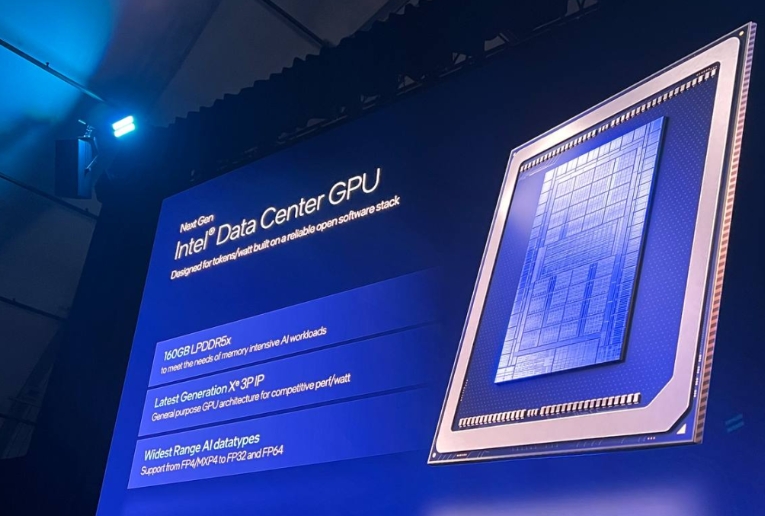
Background: Full technical details were officially revealed at Hot Chips 2026. Codenamed “Crescent Island,” this is an Intel data center GPU in PCIe form factor designed for inference with large-scale AI agent models. Customer sampling is scheduled for the second half of 2026, with small-scale delivery by year-end. It focuses on massive memory capacity, air-cooled deployment, and low-cost inference, rather than the large-model training market. This article provides a comprehensive analysis of this AI inference hardware—covering product positioning, architectural design, hardware specifications, strengths and weaknesses, and industry value—based on official Intel technical documentation, public Hot Chips presentation slides, and analyses from overseas semiconductor media.
I. Product Positioning: Bypassing the HBM “Red Ocean” to Target Cost-Effective Agent Inference
In the current cloud AI market, high-end training and ultra-high-throughput inference are largely dominated by solutions relying on HBM (High Bandwidth Memory). HBM faces tight supply and persistently high costs; furthermore, many existing data centers support only air cooling, making the retrofitting required for liquid cooling prohibitively expensive in terms of infrastructure.
Instead of competing head-on with high-end HBM-based cards for training performance, Intel’s Crescent Island targets massive concurrent inference, Mixture-of-Experts (MoE) models, and long-context AI agent workloads. Its core objectives are to increase token output per watt and reduce the Total Cost of Ownership (TCO) for deployment.
The product’s scope is clearly defined: all hardware units for 3D graphics and ray tracing have been eliminated, allowing transistor resources to be fully dedicated to matrix computation and cache systems. While it supports inference and can handle lightweight HPC tasks, it is not intended to be a primary card for model training.
- Product Form Factor: Standard PCIe 5.0 x16 accelerator card with a 350W TDP. It features native air cooling, allowing for installation in traditional servers without requiring data center infrastructure upgrades.
- Memory Configuration: The standard reference model comes with 160GB of LPDDR5X memory; ODM-customized versions can be expanded up to 480GB, which stands out as the hardware’s key selling point. – Timeline: Sample delivery to key customers in the second half of 2026; small-scale delivery by the end of 2026; large-scale commercial deployment in 2027.
- Software Ecosystem: Built on oneAPI and IPEX-LLM; compatible with mainstream frameworks like PyTorch; features an open software stack rather than a closed, proprietary ecosystem.
II. Architecture Analysis: Xe3P – A Microarchitecture Re-engineered for Inference and Agent Workloads
Crescent Island is based on the all-new Xe3P architecture. The chip is divided into four compute slices, totaling 32 Xe-cores and 256 third-generation XMX matrix acceleration engines, along with 32MB of unified shared L2 cache—significantly increasing cache capacity and reducing the overhead associated with repetitive data movement.
Key Architectural Improvements
- Upgraded XMX Engine with 16-Deep Systolic Array
Compared to the 4-deep array in the previous-generation Xe architecture, the XMX matrix unit depth has been increased to 16 layers. This significantly enhances matrix tiling and processing capabilities, specifically optimizing for next-generation Agent inference workloads such as MoE (Mixture of Experts) models and Speculative Decoding. It also provides native support for high-frequency mathematical functions used in inference (e.g., sigmoid, tanh), thereby reducing software operator overhead. - Expanded Register and Local Storage Capacity
The register file per Xe-core has been increased to 1MB, and the shared L1 local memory to 512KB. This drastically reduces register spills during inference and minimizes frequent access to external VRAM, improving KV Cache read/write efficiency and supporting ultra-long context scenarios. - Bold Choice: LPDDR5X Instead of HBM
This is Crescent Island’s most controversial design decision: abandoning the industry-standard HBM (High Bandwidth Memory) in favor of mature, consumer-grade LPDDR5X memory chips.
The trade-off is that memory bandwidth is significantly lower than HBM4-based solutions; however, the benefits include massive memory capacity, lower bill-of-materials (BOM) costs, and a supply chain unconstrained by HBM production capacity. Additionally, memory subsystem power consumption is kept in check, enabling the implementation of a 350W air-cooled solution. >
Design Logic: For large model inference—particularly multi-turn Agent conversations—VRAM capacity often takes precedence over bandwidth in many scenarios. As long as model weights and the KV Cache fit entirely within VRAM, the bandwidth bottleneck becomes less critical; this makes the architecture highly suitable for online service scenarios involving long contexts and massive-parameter MoE models.
- Full-Precision Support
Native support spans the full precision range from FP4/MXFP4, FP8, and FP16 up to FP64. FP4 quantization further expands effective VRAM capacity, enabling the deployment of trillion-parameter models on a small number of cards while retaining scientific computing capabilities—allowing a single card to handle both inference and lightweight HPC tasks.
III. Performance and Use Case Analysis (Based on official metrics; independent third-party benchmarks are not yet available)
Crescent Island has not yet released comprehensive, standardized benchmark scores; all evaluations here are based on architectural features, official strategic positioning, and industry projections.
Key Use Cases
- Agent Services with Long Contexts and Large KV Caches
With up to 480GB of massive VRAM, a single card can accommodate a large KV Cache, reducing data migration overhead between cards. For instance, a 1.6-trillion-parameter MoE model can be deployed using just four cards with FP8 quantization, making it ideal for high-frequency, multi-turn Agent conversations. The Xe3P’s XMX hardware includes targeted optimizations for emerging inference tasks such as speculative decoding and expert model switching. - Scalable Inference Clusters for Existing Air-Cooled Data Centers
Featuring a 350W air-cooled PCIe form factor, these cards can be installed directly into existing servers without requiring liquid cooling retrofits, significantly lowering infrastructure modification costs for cloud providers and AI service providers. The Total Cost of Ownership (TCO) advantage becomes increasingly pronounced as the cluster scales up. - Cost-Sensitive “Token-as-a-Service” (TaaS) Operations
While HBM supplies are tight and expensive, the LPDDR5X supply chain is mature and abundant. With reductions in both per-card procurement costs and total system power consumption, the primary target customers are inference service providers focused on optimizing the cost per token. ### Limitations - High-Concurrency Prefill Throughput Limited by Bandwidth
LPDDR5X bandwidth is significantly lower than that of HBM4. When workloads experience massive spikes in Prefill (input preprocessing) demands, bandwidth becomes a bottleneck, resulting in a throughput gap compared to high-end cards utilizing HBM. - Completely Unsuitable for Large-Scale Training
The architecture is optimized for inference and lacks the high bandwidth and massive interconnect capabilities required for training scenarios; training tasks still require pairing with other high-end acceleration hardware.
IV. Product Highlights
- Massive 480GB Memory: A “Capacity Monster” for Inference
Among current mainstream AI acceleration hardware, the custom 480GB memory configuration stands out. A single card can handle massive models and vast KV Caches, reducing multi-card interconnect overhead and simplifying cluster deployment. - Air-Cooled PCIe: Compatible with Legacy Data Centers, Lowering Adoption Barriers
Many enterprise and cloud provider data centers lack liquid cooling infrastructure—a necessity for the high power consumption typical of high-end HBM cards. Crescent Island’s 350W air-cooled design lowers the infrastructure threshold for deploying AI computing power, allowing existing servers to be directly upgraded with AI capabilities. - Open Software Stack: Breaking Free from Closed-Source Lock-in
Leveraging the oneAPI ecosystem and compatibility with mainstream AI frameworks, developers avoid being locked into proprietary SDKs. This reduces migration costs and offers greater appeal to enterprise customers. - Differentiated Supply Chain Strategy: Avoiding HBM Capacity Constraints
HBM has become a capacity bottleneck for the entire AI industry. In contrast, LPDDR5X is a mature, mass-produced memory technology with a more stable supply, facilitating large-scale cluster expansion without being constrained by high-end memory production limits. - Balancing Inference with Lightweight High-Performance Computing (HPC)
With full FP64 support, a single card can handle both large-model inference and specific scientific computing tasks, offering superior hardware versatility. ## V. Objective Limitations and Potential Risks - Inherent Bandwidth Disadvantage of LPDDR5X; Capped Performance Ceiling
The trade-off for high capacity is bandwidth; when handling high-concurrency prefill workloads, performance is significantly weaker than that of HBM-based platforms. It is not a direct, all-around substitute for high-end HBM cards but rather a complementary solution for specific scenarios; it should not be blindly benchmarked against the peak performance of the Blackwell or GB series. - Lack of Large-Scale Production Validation; Questionable Software Stack Maturity
Xe3P is a brand-new architecture with no track record of large-scale data center deployment. For AI acceleration hardware, the silicon is only half the equation; drivers, operator optimizations, and inference framework compatibility determine actual token throughput. The software stack requires time to mature and be validated. - Absence of Public, Independent Third-Party Benchmarks
Currently, all performance analysis is based on architectural projections and vendor marketing. There are no samples in circulation and no third-party tests; real-world metrics—such as latency, concurrency, and stability—can only be verified once samples are delivered. - Positioned as Inference-Specific Hardware; Cannot Independently Support a Full AI Workflow
If an enterprise has both training and inference needs, it still requires additional training chips, which increases the complexity of the cluster architecture.
VI. Industry Implications: The Inference Market Diverges into Two Paths
Historically, the AI compute market chased higher bandwidth and higher theoretical performance, betting entirely on HBM. Crescent Island represents an alternative path: prioritizing memory capacity, deployment costs, and supply chain stability, while sacrificing some peak bandwidth to gain a TCO (Total Cost of Ownership) advantage.
OpenAI’s Jalapeño ASIC and Groq’s inference chips pursue a path of extreme specialization; NVIDIA and AMD continue to dominate the high-end segment, using HBM for both training and inference; meanwhile, Intel’s Crescent Island represents a flanking maneuver by a general-purpose GPU vendor, targeting existing data centers and cost-sensitive inference customers.
It will not disrupt the high-end HBM market, but it will capture a significant share of the cloud inference market. For customers who do not require extreme peak bandwidth but need to run large models, agents, and long-context workloads—without investing heavily in liquid cooling retrofits—this solution is highly attractive. This also offers a reference point for domestic inference chips: the competition among AI chips is no longer solely about raw computing power benchmarks; factors such as memory capacity, data center compatibility, supply chain stability, software ecosystems, and Total Cost of Ownership (TCO) are becoming increasingly critical dimensions of competition.
VII. Summary and Outlook
Crescent Island is a piece of hardware with a clear strategic focus. It does not aim for all-around versatility or to compete in the training market; instead, it trades HBM for LPDDR5X to achieve massive memory capacity, air-cooling friendliness, and a controllable supply chain, specifically targeting the real-world pain points of large model inference in the era of AI agents.
Its success hinges not on specifications on paper, but on two factors: first, whether the oneAPI software stack can fully unlock the potential of the Xe3P hardware; and second, whether it can deliver on the promise of a “lower cost per token” in real-world production clusters.
If actual performance following sampling meets expectations, it will become a significant alternative in the inference market; conversely, if software optimization falls short, the hardware’s advantage of massive memory capacity will be difficult to leverage. Crescent Island represents just one component of Intel’s inference strategy; a subsequent HBM-based solution—codenamed “Jaguar Shores”—will address high-end training and ultra-high-bandwidth inference needs, creating a comprehensive product portfolio that balances high-end and mainstream offerings.
In a nutshell: Crescent Island is not a replacement for HBM-equipped flagship cards, but rather a cost-effective challenger designed for existing data center infrastructure and AI agent-based large model inference. Its true battleground is not the benchmark leaderboard, but the cost-efficiency analysis of real-world online workloads.
Related reading: dynabook 2026 AI Business Laptop Lineup Review · Microsoft Project Solara Deep Dive · NVIDIA RTX Spark