
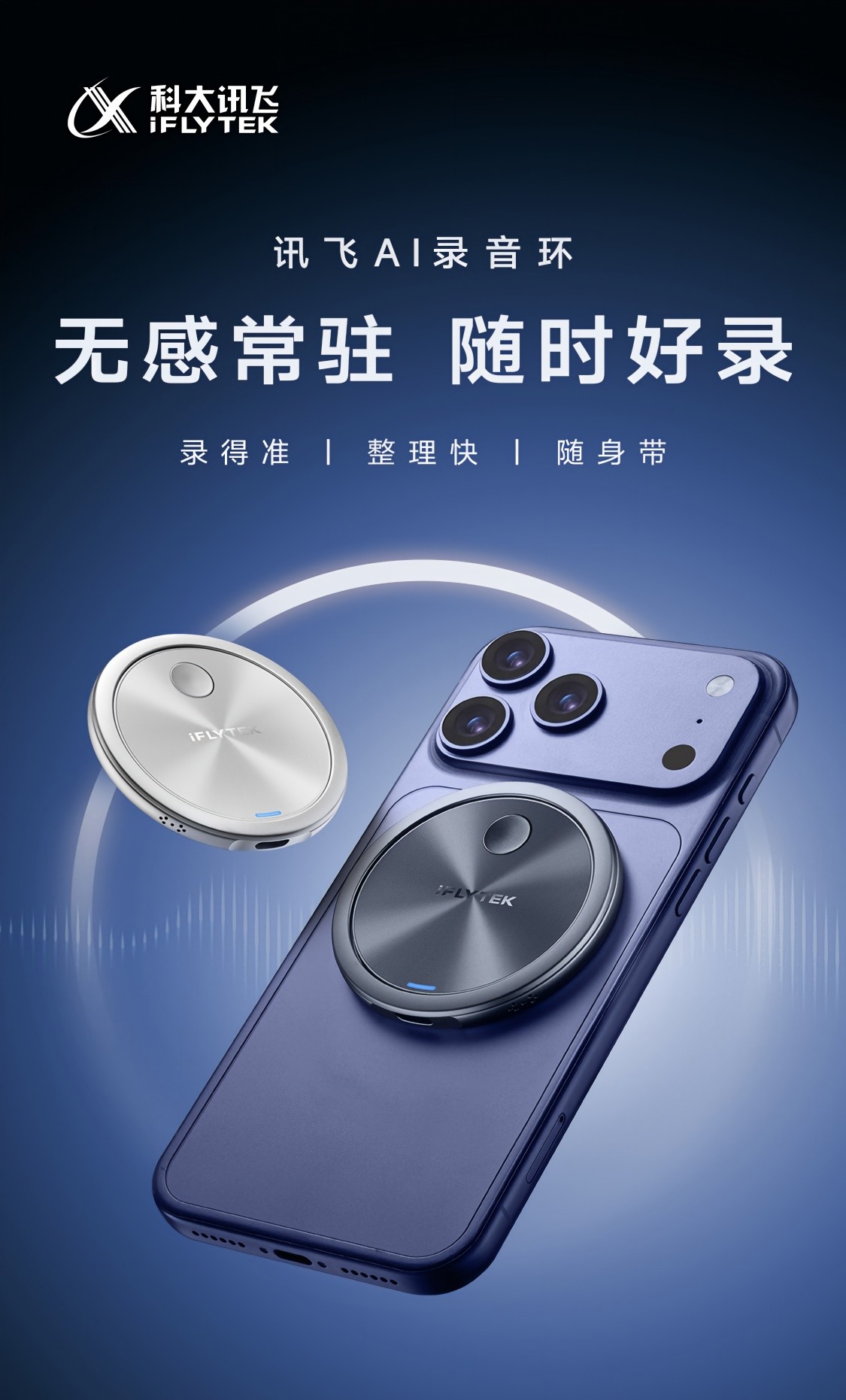
iFLYTEK, the Hefei, China speech-recognition specialist behind one of China’s largest ASR engines, opened preorders October 21, 2026 for the Listening Member Edition of its AI Recording Ring: a ring-shaped magnetic recorder that clips to a smartphone’s back instead of hanging from a lapel or sitting on a desk. The standard edition went on sale October 19; the in-window event is the member preorder, which bundles one year of unlimited transcription from the iFLYTEK Listening app. Member edition ¥1099; standard edition ¥1299, sold via iFLYTEK’s official mall and major Chinese e-commerce platforms. Battery rating and weight are unpublished.
Overview and positioning
The Recording Ring solves a narrow but common problem: capturing meetings, interviews, phone calls, training, study, and stray ideas into usable notes without a separate dictaphone or dedicated wearable. iFLYTEK’s answer is a puck-like magnetic disc that lives on the phone back, rotates to aim its microphones, and hands recordings off over Wi-Fi 6 rather than Bluetooth. The target user is a Chinese professional who records high-volume spoken content daily and wants fast, accurate Chinese transcription over standalone hardware freedom.
Market and industry background
Ambient AI recording has moved through three generations: handheld dictaphones, Bluetooth pins and pendants, and phone-mounted accessories. The promise has shifted from “record the meeting” to “record, transcribe, separate speakers, and summarize in one pass,” pitting hardware against the ASR cloud behind it. In China that advantage sits largely with incumbents like iFLYTEK, whose self-developed models have powered transcription for decades; Western makers such as PLAUD compete mainly through companion apps and wearables.
How it compares
- Against the PLAUD NotePin, which clips to clothing and streams over Bluetooth: the Ring stays on the phone back and shifts bulk files over Wi-Fi 6, claimed ~30x faster. Both still need a phone, an app, and cloud transcription.
- Against a smartphone’s built-in recorder, which is free: the native app lacks a dedicated multi-mic array, on-device noise reduction, speaker separation, and one-pass summaries.
- Against handheld recorders from Sony or Zoom, which store locally and work phone-free: the Ring has no screen or standalone playback, so it cannot replace an off-grid field recorder.
Specifications
- Company: iFLYTEK, Hefei, China.
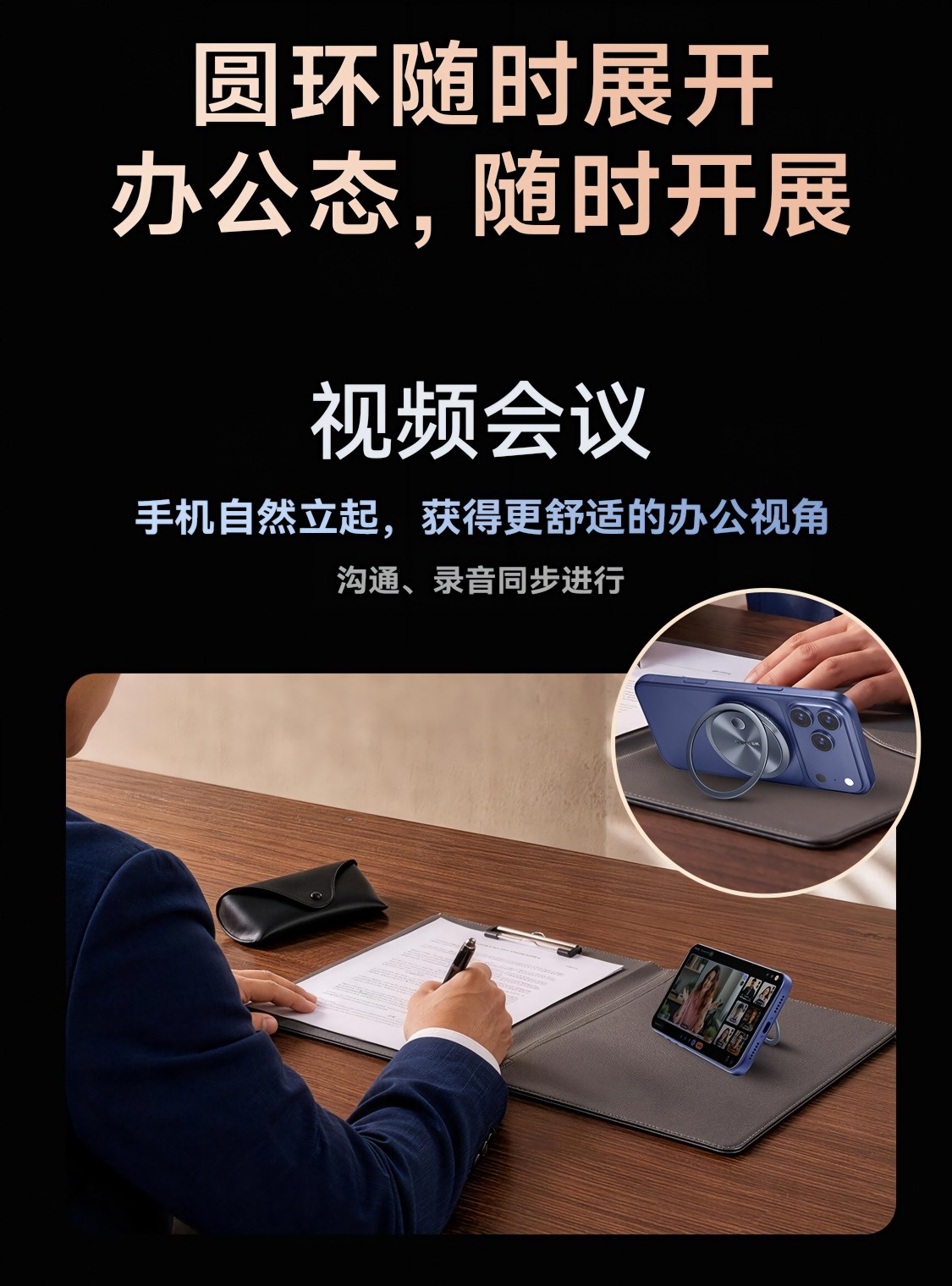
- Form: ring-shaped magnetic unit on the phone back; the stand rotates to aim the mic and set support height.
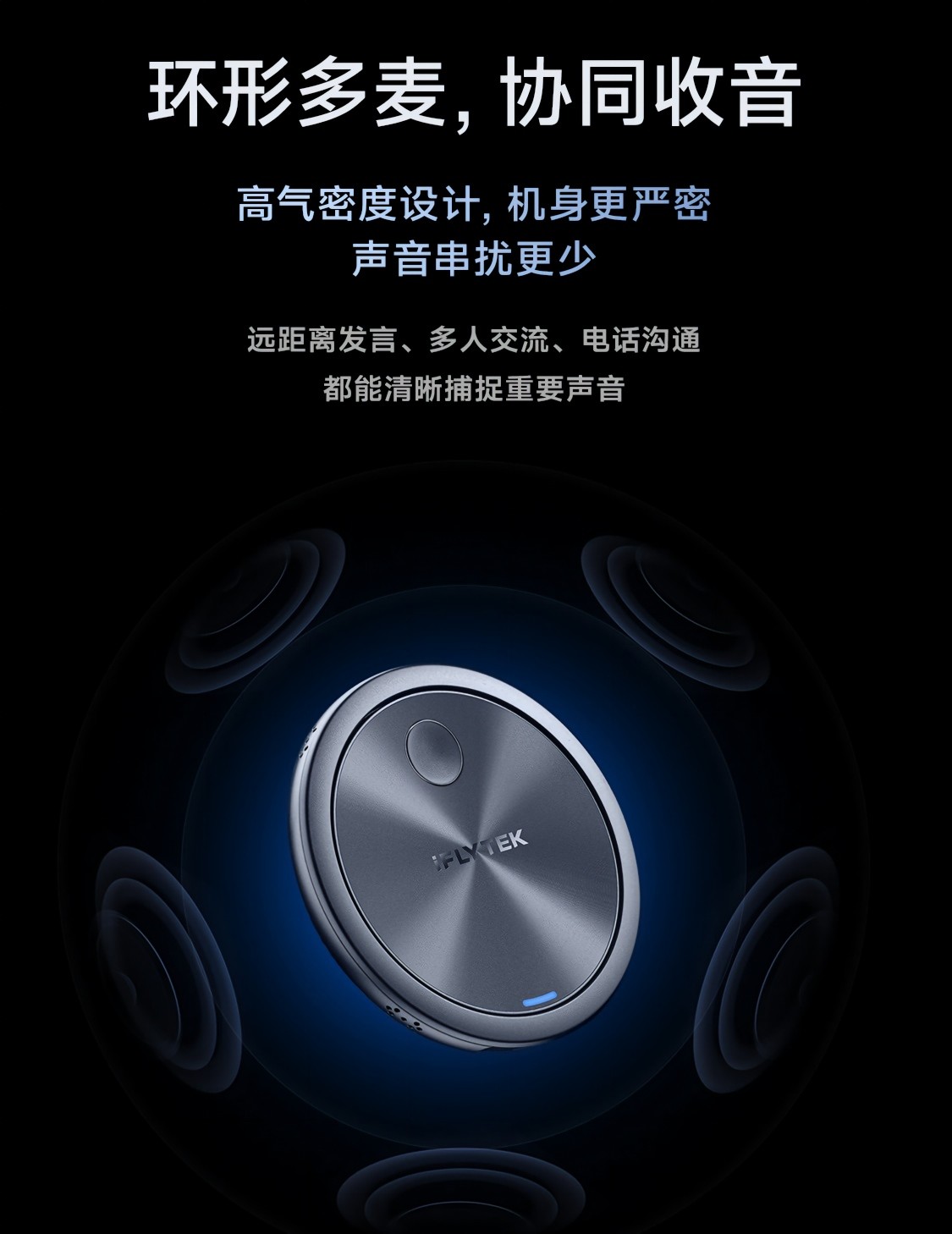
- Mics: 4 omnidirectional mics in a ring for 360-degree pickup, plus 1 bone-conduction mic for calls; on-device noise reduction.
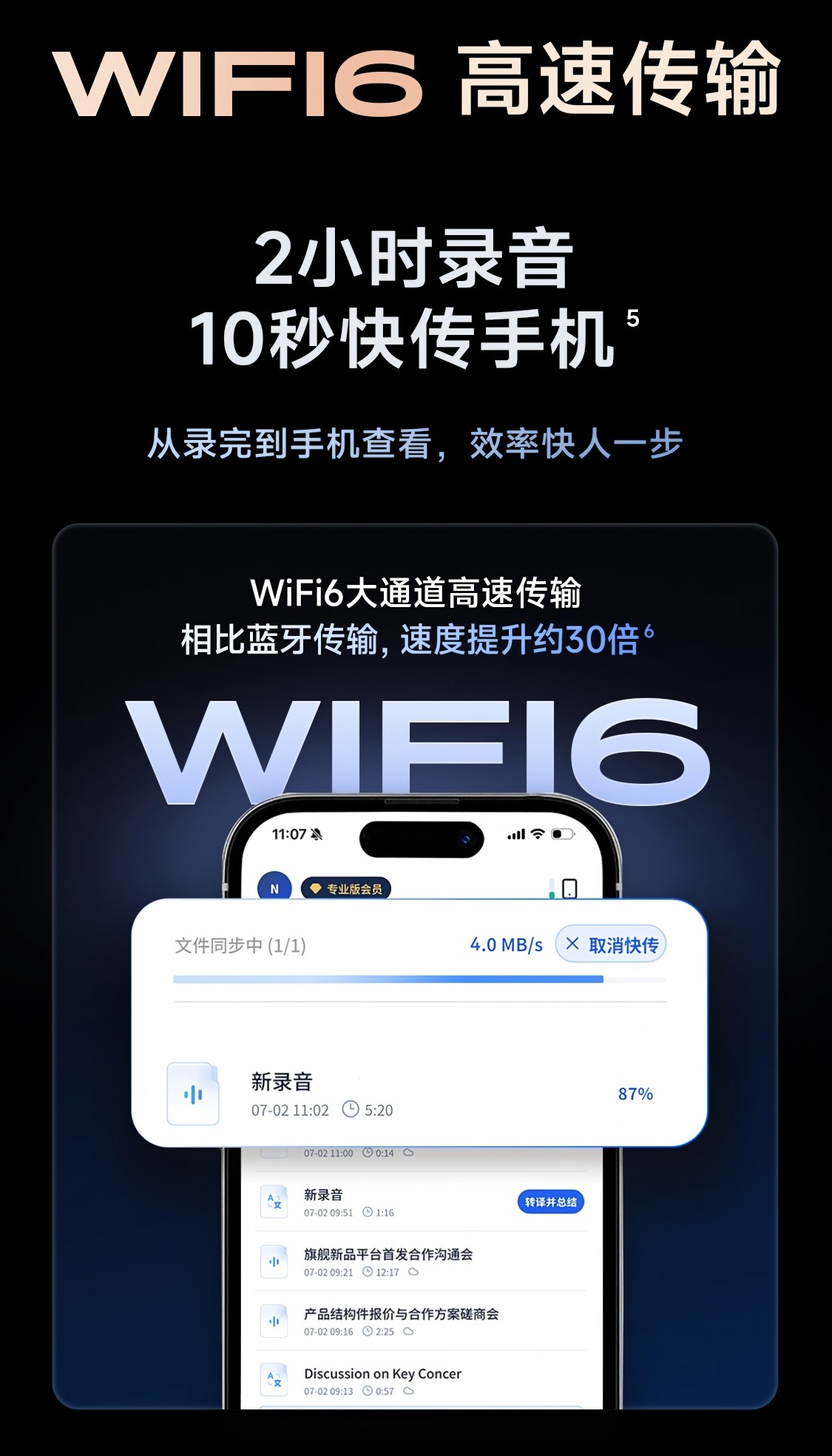
- Transfer: Wi-Fi 6, claimed about 30x faster than Bluetooth; 2 hours of recording reach the phone in about 10 seconds and transcribe in about 2 minutes.
- Recognition: self-developed ASR model, 200+ dialects, speaker diarization, 16 industry lexicons, claimed 98.6% Mandarin accuracy.
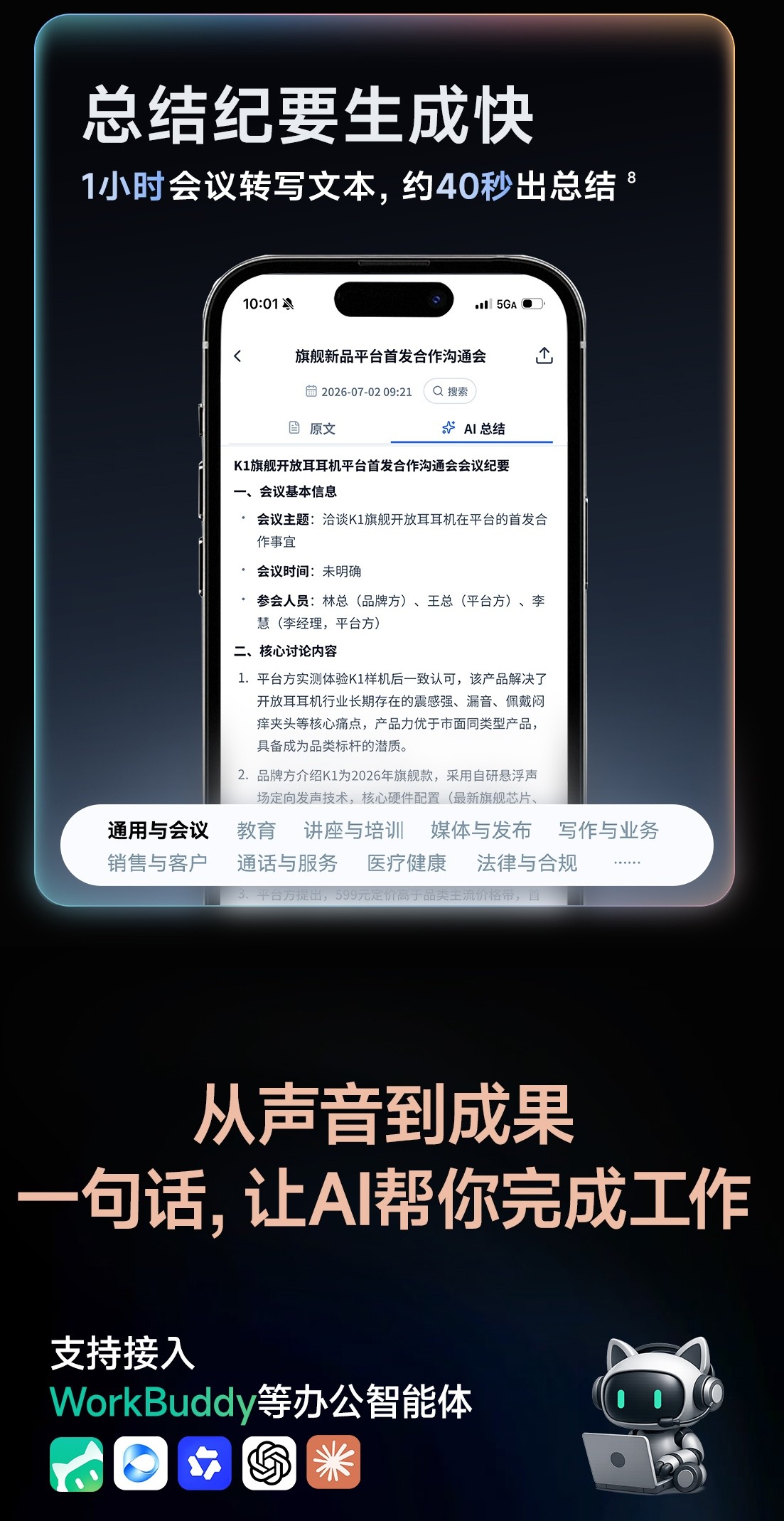
- Summarization: 1-hour meeting summarized in about 40 seconds; connects to WorkBuddy, Claude, and other office agents.
- Price: standard ¥1299; Listening Member Edition ¥1099 with 1-year unlimited transcription.
- Availability: member preorders opened October 21, 2026; standard edition on sale since October 19.
- Not disclosed: weight, battery capacity, battery life, chipset.
Pros
- Wi-Fi 6 bulk transfer removes the slow Bluetooth bottleneck on long recordings.
- The 4+1 mic array, dedicated bone-conduction call mic, and on-device noise reduction target noisy rooms and phone calls.
- The self-developed ASR stack brings 200+ dialects, speaker separation, and 16 industry lexicons beyond generic smartphone recorders in Chinese.
- Fast pipeline: 10-second transfer, 2-minute transcription, 40-second summary for an hour of meeting.
- Agent hooks into WorkBuddy and Claude feed the transcript straight into downstream AI work.
Cons and shortcomings
- Ecosystem lock-in: value depends on the Listening app and its transcription subscription; the ¥1099 member price only pays off against the included year of unlimited transcription, and renewal may carry the real cost.
- Battery life and weight are undisclosed, a serious gap for an always-on device; buyers cannot judge charging frequency.
- No standalone screen or operation: without the phone or app, the Ring is a mute disc rather than a recorder.
- The 98.6% accuracy and 200+ dialect claims come from iFLYTEK itself and are not independently verified; noisy-room dialect performance could fall short.
- Chinese-language-centric: lexicons, dialect support, and agent workflow target Mandarin and Chinese industry vocabulary, with little documented value elsewhere.
Who it is for
This Ring is built for Chinese professionals who record all day, run back-to-back meetings and interviews, and want a transcript and summary before the coffee gets cold. It suits salespeople, consultants, journalists, lawyers, and students already inside the Listening ecosystem. It is less compelling for English-first users, offline-recorder buyers, or anyone unwilling to tie notes to one vendor’s app.
Verdict
The iFLYTEK AI Recording Ring is a credible take on ambient capture that trades wearable freedom for a permanently mounted, fast-transfer design, and its strongest card is the mature Chinese ASR engine behind it rather than the hardware itself. Until iFLYTEK publishes battery life, weight, and independent accuracy benchmarks, it remains a bet on the ecosystem: a strong buy for heavy Mandarin transcribers already committed to Listening, and a cautious skip for everyone outside that bubble.