
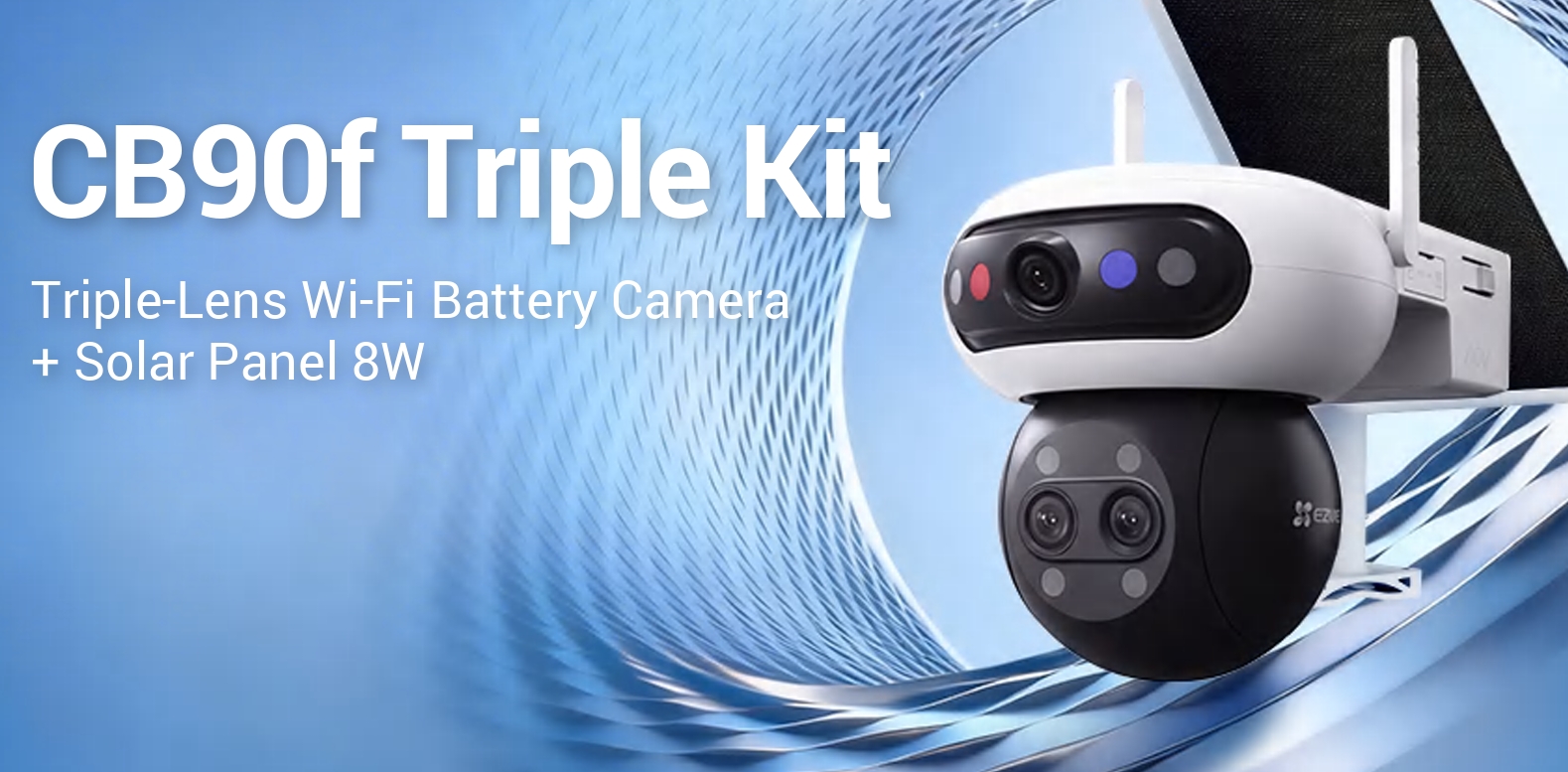
Traditional outdoor surveillance has long faced a dilemma: wide-angle lenses offer a wide field of view but blur distant details; telephoto lenses capture details clearly but have limited coverage. Camera-and-PTZ (PTZ) systems often require two devices working together, resulting in high wiring and setup costs. The EZVIZ H90F offers an integrated solution, combining three 5MP lenses and three independent pan-tilt mechanisms into a single unit. This allows a single device to simultaneously output panoramic and close-up zoom views. The wide-angle lens provides overall perception, while the telephoto lens zooms in to track the target, integrating “panoramic observation + detailed evidence collection” into a single hardware device.
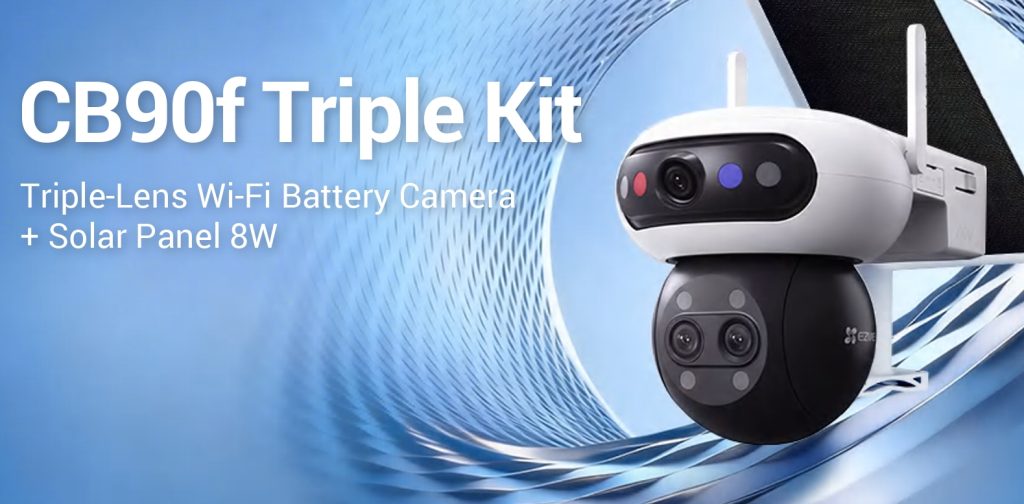
Targeting scenarios without WiFi or requiring long-distance monitoring, such as villa courtyards, farms, shop entrances, construction sites, and orchards, the H90F supports both WiFi and 4G dual-SIM networks. Primarily designed for long-distance, wired security, it is a key new outdoor AI hardware product from EZVIZ in 2026.
IT Home ## Hardware Appearance and Structural Design
The entire unit features an integrated PTZ camera design with a white engineering casing. It is IP67 dustproof and waterproof, adaptable to outdoor environments ranging from -20℃ to 50℃, and can operate stably in sun, rain, and snow. Suitable for outdoor wall mounting.
- Lens Configuration: Triple 5MP Lens System. The three lenses have distinct functions:
- Top Wide-Angle Lens: Provides a wide field of view for full-range panoramic scanning, capturing a large area of the scene;
- Center Auxiliary Sensing Lens: Supplements ambient light and shadow;
- Bottom Spherical Zoom Lens: Supports hybrid zoom, responsible for target zooming, close-up tracking, and independent gimbal rotation.
- Independent Triple Gimbal Drive: Unlike ordinary dual-gimbal PTZ cameras, the top lens allows for horizontal fine-tuning, while the bottom PTZ allows for 324° horizontal and 90° vertical rotation. Multiple lenses can point in different directions without being forced to share the same viewpoint, supporting simultaneous dual-view output. The mobile app allows simultaneous previewing of the panoramic view and zoomed-in close-up view.
**Ezviz – Image Quality Output: Single-channel up to 3K (2880×1620) resolution, infrared night vision + dual-light full-color fill light, infrared range up to 50 meters at night, fill light enables color images at night.
- Network: WiFi + 4G dual SIM full network compatibility, built-in data plan, supports automatic switching between networks, remote viewing is possible even without broadband; the official app data plan is unlimited, cloud storage service is available for an additional fee.
- Storage: Supports up to 512GB SD card local storage, optional Ezviz cloud storage.
- Audio: Two-way voice intercom, built-in speaker and microphone, supports sound and light alarms, emits sound and light deterrence when abnormal targets are detected.
- Power Supply: Standard DC power supply, can also be equipped with a solar panel kit for off-grid operation, suitable for outdoor, orchard, and other scenarios where wiring is inconvenient.
The biggest hardware highlight is the independent control of three pan-tilt units. The wide-angle lens is responsible for “seeing,” while the zoom PTZ camera is responsible for “seeing clearly.” Users don’t need to manually zoom in and out; the AI algorithm automatically manages the lens.
Core AI Functionality Testing
1. Triple-Camera Linkage + Point-and-Watch, AI Automatic Tracking
The H90F’s core capability comes from edge-side AI algorithm linkage: the wide-angle lens continuously scans the entire monitoring area. When AI identifies a person or vehicle, the lower-mounted zoom PTZ camera automatically turns to the target location, automatically zooming in to capture details, achieving “panoramic discovery and close-up tracking.”
The app supports “point-and-watch” interaction: clicking anywhere in the panoramic view will automatically rotate the zoom lens and zoom in on that point.
Real-world testing experience:
- Smooth human recognition and tracking at a distance of 20-30 meters; the camera follows the person smoothly as they walk.
- The lab-specified human detection distance is 50 meters, but in reality, the recognition distance is affected by lighting and obstacles, and may be reduced in complex environments.
- When multiple targets appear simultaneously, the device prioritizes locking onto the target that triggers the alarm first; other targets are only recorded in panoramic view, not in multiple close-up shots simultaneously.
2. AR Preset Point Patrol
Unlike ordinary patrol, it supports simultaneous near and far-field patrol. The device can memorize multiple sets of positions and zoom levels. During patrol, it not only rotates the angle but also automatically switches the zoom level, allowing for panoramic views of some points and automatic zoom-in for details of others. Suitable for large-scale patrols and security in factories, courtyards, and orchards.
3. Precise AI Detection of Humans/Vehicles, Filtering Invalid Alarms
On-device local AI recognition distinguishes between people and vehicles, filtering false alarms caused by swaying leaves and changes in light and shadow. After an event is triggered, the app pushes an alarm message along with a captured screenshot. It supports custom area detection, allowing you to define warning zones; alarms are only pushed when the user enters the designated area, reducing unnecessary message bombardment.
4. Dual-View Simultaneous Preview
The mobile app can simultaneously display a wide-angle panoramic view and a zoomed-in close-up view, allowing you to see both the overall picture and details on one screen. This eliminates the need to switch between views, enabling you to view the overall situation of the yard while simultaneously viewing a close-up of a person at the entrance. This is highly practical for shops and large courtyards.
5. 4G Network Available When No Broadband
For scenarios without broadband, such as rural areas, orchards, construction sites, and the wilderness, it features built-in dual 4G SIM cards with dual-link backup. It automatically switches to the other SIM card when the signal is weak, ensuring the device remains online. Please note that data usage only applies to app previews; cloud storage playback and value-added services require additional payment.
Summary of Advantages and Disadvantages
✅ Advantages
- Integrated design with three cameras and three pan-tilt units, achieving both panoramic and close-up monitoring effects on a single device, reducing equipment procurement and cabling costs;
- Excellent AI-powered tracking and point-and-see interactive experience, wide-angle target detection, and automatic zoom tracking, lowering the barrier to manual operation;
- IP67 high protection rating, supports dual SIM dual network (WiFi/4G), can be used offline with solar panels, suitable for numerous outdoor scenarios without broadband;
- Dual-screen preview, full-color night vision, two-way audio, and comprehensive security features including sound and light alarms;
- Local on-device AI processing, recognition and alarms do not rely entirely on the cloud, local recording continues to function even when offline.
⚠️ Limitations and Limitations
- The overall size is relatively large, requiring ample space for installation; the triple-gimbal mechanical structure poses a risk of mechanical wear and tear during long-term outdoor use.
- The stated 50-meter human detection range is based on an ideal laboratory environment. In real-world conditions, obstacles, backlighting, rain, and snow will reduce the recognition distance.
- “Unlimited data” is only available for app previews; cloud storage and playback data are not included in the free range and require additional payment.
- When multiple targets simultaneously enter a scene, only close-up tracking of a single target is possible; other targets are only recorded in a panoramic view.
- Hybrid zoom is a digital hybrid magnification; details may be lost at extremely long distances, as it is not optical zoom.
- The device has relatively high power consumption; pure solar power requires a high-power solar panel, and battery life will be strained on cloudy or rainy days.
Suitable and Unsuitable Users
✅ Suitable for: Villas, farmhouses, orchards, livestock farms, construction sites, and shop entrances; users requiring wide-area monitoring while capturing clear facial and vehicle details; those without broadband access and requiring 4G connectivity; those who prefer an all-in-one solution and don’t want to deploy multiple cameras.
❌ Unsuitable for: Indoor spaces; those needing simple front door monitoring; those with limited budgets and no option for wall mounting; those seeking pure optical zoom.
Competitive Perspective
Most camera-based PTZ cameras on the market use a dual-lens, dual-panel design. The H90F upgrades to a triple-lens, triple-panel architecture, enhancing its all-around sensing capabilities. Compared to a separate two-camera solution, it’s simpler to deploy but has a more complex mechanical structure; compared to a regular monocular zoom camera, its advantage lies in maintaining a panoramic view without losing the overall field of view when zooming.
Summary
The Ezviz H90F triple-lens camera essentially compresses the two requirements of “panoramic perception + detailed evidence collection” into a single hardware unit. It solves the pain point of traditional surveillance systems where “large areas are unclear, and clear areas are small,” relying on multi-lens AI linkage to achieve wide-angle target finding and telephoto detail capture.
It’s not a lightweight home security camera; it’s more geared towards outdoor security hardware for medium to large-scale scenarios. If you have a large yard or open space and lack broadband access, the H90F is a product worth considering in an integrated solution; however, you should rationally consider the wear and tear of the mechanical pan-tilt unit, data plan restrictions, and environmental limitations of long-distance recognition.
Related reading: In-Depth Review of Bites 2 Lite Smart Pet Camera · DJI Osmo Pocket 4 · Vinabot AI Photo Frame for Remembering Deceased Friends