
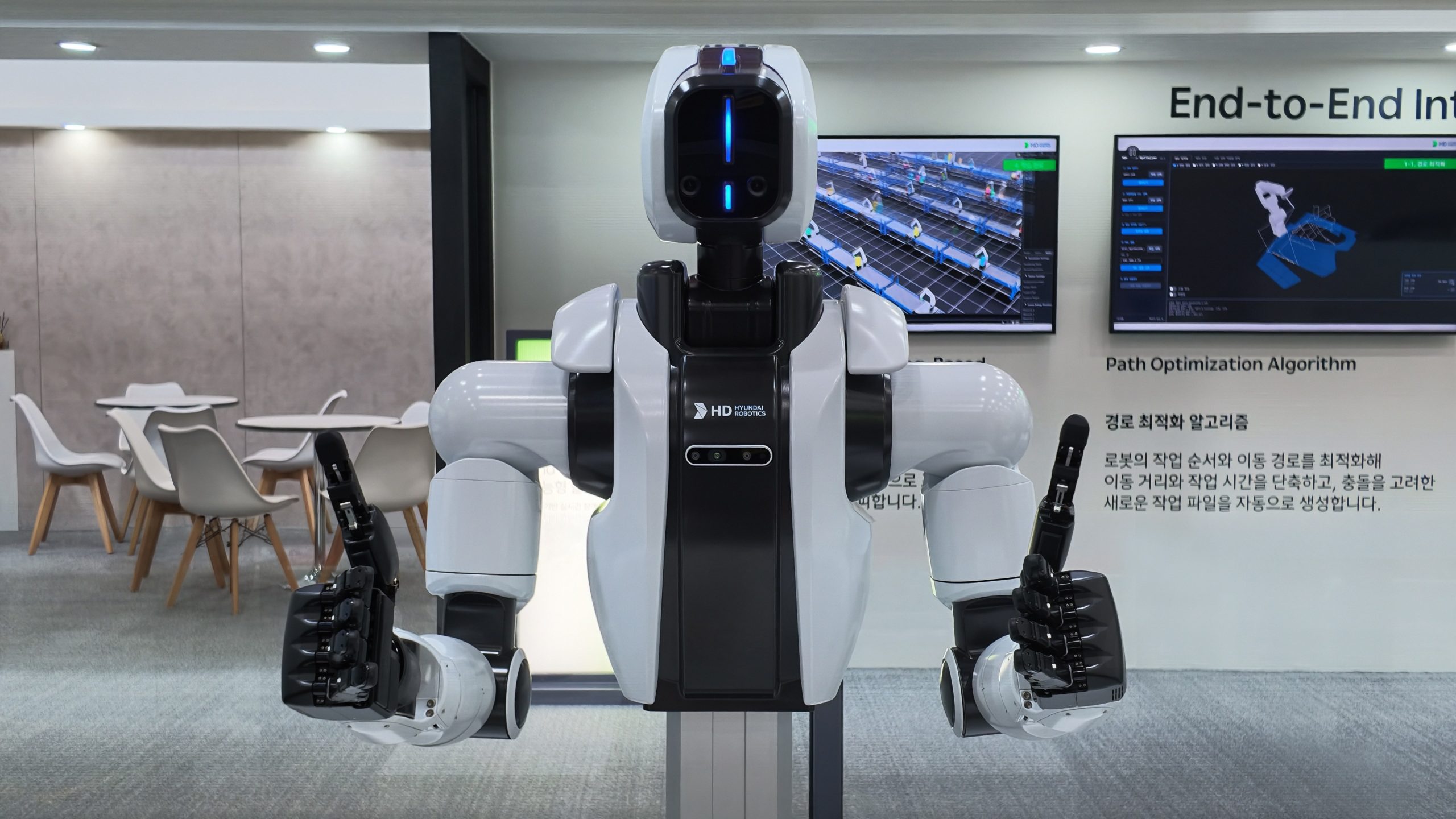
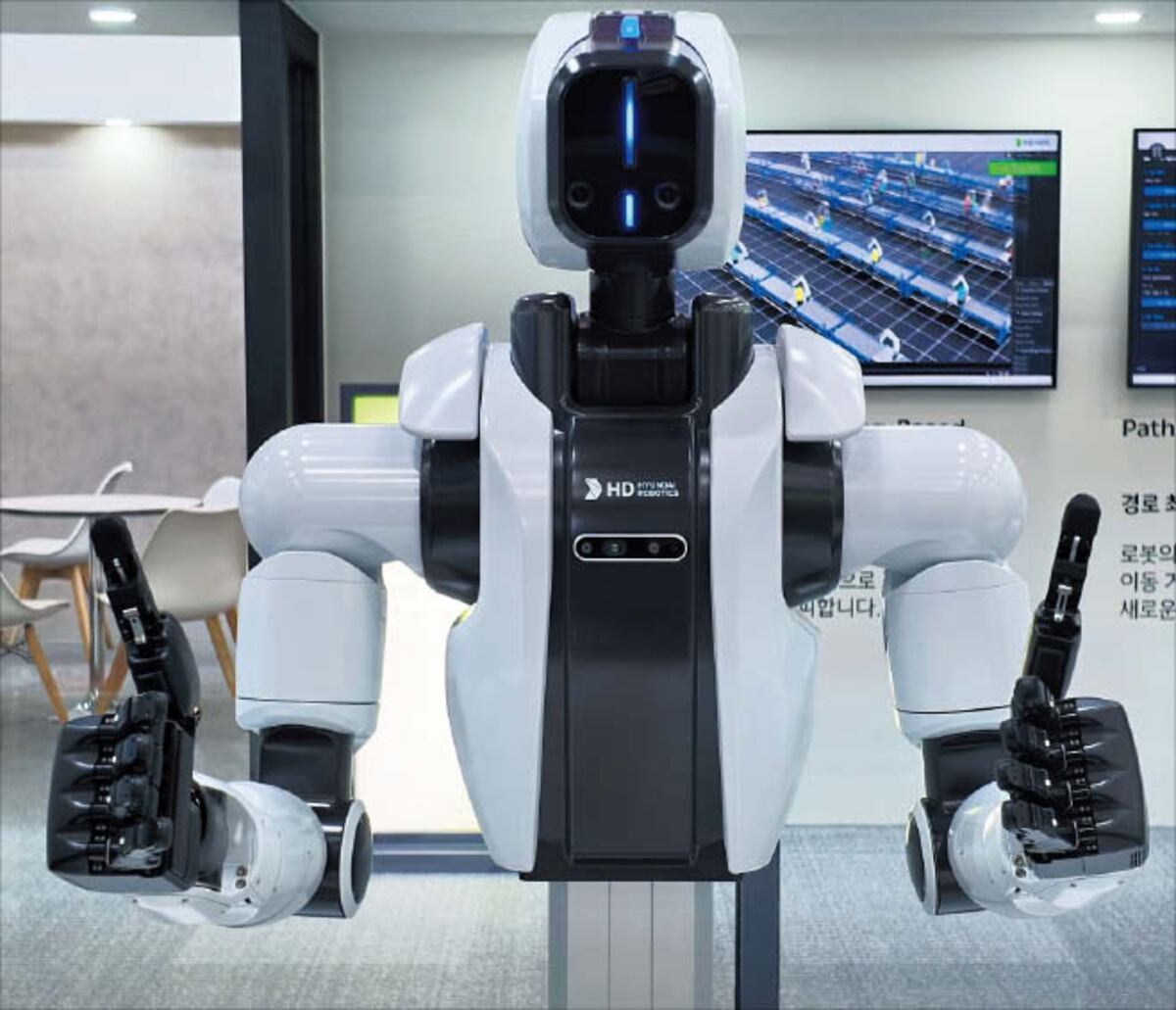
HD Hyundai Robotics unveiled its self-developed intelligent dual-arm robot on October 21, 2026, the opening day of the FIX 2026 Future Innovation Technology Expo at EXCO in Daegu, South Korea. The development-stage prototype is an upper-body humanoid with two five-fingered dexterous arms, built around a self-developed Robot Foundation Model for physical AI. It is not for sale: no product name, price, chip, battery, weight, or ship date has been disclosed.
Overview and Positioning
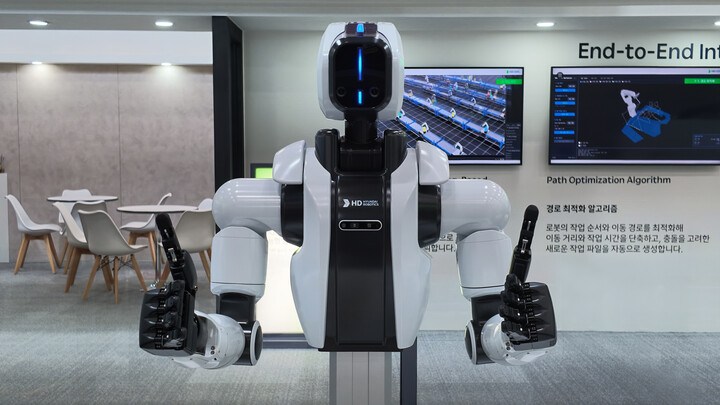
Shown on the HD Hyundai Robotics booth, the white-and-black torso mounts two arms, each ending in a five-finger hand that can grip and manipulate objects without step-by-step programming. The company targets factory floor tasks, starting with bundling and assembly, before moving toward welding and painting. Rather than chasing a walking humanoid first, the roadmap puts a wheeled mobile platform under the torso, with bipedal walking a later goal. This is an industrial R&D project aimed at HD Hyundai’s automotive and shipbuilding ecosystem, not a consumer gadget.
Market Background
Industrial humanoids have shifted from locomotion demos to work-cell automation. Boston Dynamics, Fourier Intelligence, and Agibot all pitch general-purpose humanoids that can move around a plant, but the near-term commercial pressure is repeatable dexterity in fixed or semi-fixed stations. A foundation model that perceives the scene and generates its own motions promises to cut the programming burden behind every new task, which is the expensive part of deploying robots today.
How It Compares
- Against Boston Dynamics’ Atlas biped and Spot quadruped, built first for mobility and dynamic motion, the Hyundai prototype skips legs entirely and concentrates payload and dexterity on two fixed arms.
- Against Fourier’s GR-1, a bipedal general-purpose humanoid aimed at broad lab and service tasks, HD Hyundai’s machine is a narrow industrial upper-body aimed at bundling, assembly, welding, and painting.
- Against Agibot’s A2 family, positioned as a bipedal platform for flexible factory use, this prototype stays stationary on a stand at launch, with a wheeled chassis planned before any walking ambition.
Specifications
- Structure: upper-body dual-arm torso, five-finger dexterous hands on each arm
- Payload: 7 kg per arm
- Working radius: 630 mm per arm
- AI: self-developed Robot Foundation Model; perceives the environment and generates motions without step-by-step programming
- Sensing upgrade: planned force and tactile sensors via Aidin Robotics, in which HD Hyundai Robotics took an equity stake
- Roadmap: wheeled mobile platform first, bipedal walking later; bundling and assembly first, then welding and painting
- Chip, battery, weight, price, availability: not disclosed; prototype only
Pros
- Two five-finger hands with a 7 kg per-arm payload match real assembly and handling loads.
- A self-developed foundation model that generates motions from scene perception could slash per-task programming time.
- The Aidin Robotics equity stake gives a clear route to force and tactile sensing upgrades.
- The staged roadmap, wheeled base before legs, is a pragmatic alternative to bipedal vaporware.
- HD Hyundai’s automotive and shipbuilding lines offer a built-in testbed for pilot deployment.
Cons
- Prototype only: no commercial name, price, or delivery date exists.
- Upper-body design with no legs yet limits where it can operate.
- Foundation-model claims are unproven; smooth scene-to-motion generation was demonstrated as a concept rather than a verified production capability.
- Chip, battery, and weight are undisclosed, so energy use and endurance cannot be assessed.
- It is industrial R&D, unavailable to consumers or small integrators.
- Korean press coverage is thin on detail, and the demo setup at the booth is not a production cell.
Who It Is For
This robot matters to factory automation planners, system integrators, and HD Hyundai’s own automotive and shipbuilding operations that need dual-arm assembly and handling. Consumers should look elsewhere: there is no retail product, and the machine targets structured industrial stations.
Verdict
HD Hyundai’s dual-arm prototype reads as a disciplined industrial bet: two dexterous arms, a foundation model for motion generation, and a wheeled-first roadmap instead of a rushed biped. Until the company publishes specs, a price, and a ship date, it remains a credible showcase of intent rather than a buyable product. Follow it for bundling and assembly pilots inside the Hyundai ecosystem.