
Amidst the booming “sleep economy,” a multitude of sleep-aid products have flooded the market—ranging from smart bands to sleep-inducing speakers—yet most remain limited to “passive monitoring” or “general acoustic playback.” NextSense SmartBuds takes a different approach by packing clinical-grade EEG technology into a pair of true wireless earbuds, aiming to bridge the gap between passive monitoring and active intervention through a closed-loop system of “EEG monitoring plus acoustic intervention.” Is this “world’s first AI-powered sleep EEG earbud”—founded by former Google X executive Jonathan Berent—a piece of cutting-edge tech or just an overpriced gimmick? After two weeks of hands-on testing, here is my honest review.
I. Design and Fit: Ultra-slim, but side sleepers beware
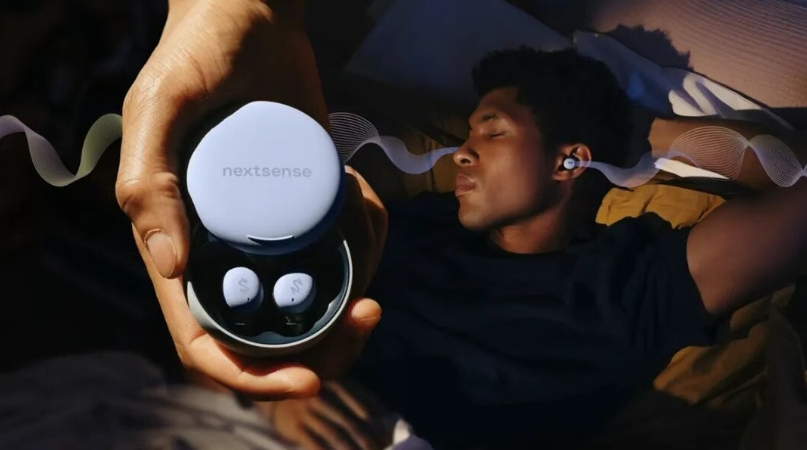
SmartBuds feature a compact design with incredibly lightweight earbuds and a premium fabric-finished charging case. The earbuds themselves are ultra-slim (less than 3mm thick) and fit snugly within the ear canal; they are excellent for back sleepers and exert minimal pressure on the ear when lying on one’s side.
However, there is a catch: to accommodate six clinical-grade EEG sensors, the earbuds are slightly thicker than standard TWS models. For side sleepers, the earbud pressing against the pillow creates a noticeable sensation of a foreign object—and even audible friction sounds—which can disturb sleep. While the manufacturer recommends wearing just one earbud when sleeping on your side, maintaining that position throughout the night is difficult; this represents the product’s biggest compromise regarding comfort.
II. Core Technology: Clinical-grade EEG monitoring + AI closed-loop intervention
The core strength of SmartBuds lies in their “hard tech” capabilities. Each earbud integrates six clinical-grade dry electrodes that capture brainwaves via the ear canal, delivering a 1000Hz sampling rate and 24-bit high-precision EEG monitoring—performance levels approaching those of clinical hospital equipment. Unlike traditional “pedometer-style” sleep monitoring—which infers sleep stages based on wrist movement and heart rate—SmartBuds directly capture the brain’s “slow-wave activity” (a key marker of deep sleep), allowing for precise differentiation between light sleep, deep sleep, and wakefulness.
Regarding intervention, SmartBuds employ a “closed-loop” approach. When the AI algorithm detects that the user has entered deep sleep (N3 stage), the earbuds automatically play “pink noise” synchronized with the brain’s slow-wave rhythms. This auditory stimulation gently encourages the brain to generate more slow waves, thereby enhancing deep sleep. Conversely, when light sleep or an impending awakening is detected, the audio adjusts accordingly to avoid disrupting the user’s rest.
III. Real-World Experience: Impressive Data, Subjective Comfort
- Data Monitoring and Feedback: Precise and Intuitive
The companion app features a highly intuitive interface that provides detailed breakdowns of sleep stage durations, sleep efficiency, and brainwave activity. For data enthusiasts and those with sleep anxiety, this clear feedback offers reassurance by allowing them to visualize their sleep quality. - Sleep-Aid Effectiveness: Helpful for Anxiety-Induced Insomnia, but Not a “Quick Fix”
For individuals struggling with sleep onset or anxiety-related insomnia, the acoustic intervention provided by SmartBuds offers genuine support, helping the brain transition quickly into sleep and reducing the time it takes to fall asleep. However, improving sleep is a complex physiological process; the product cannot resolve issues like “waking up unrefreshed” caused by life stress, diet, or underlying health conditions. It functions more as a sleep monitor and an assistive tool rather than a magic cure-all for instant rejuvenation. - Sound Quality and Noise Reduction: Competent but Not a Highlight
As earbuds designed primarily for sleep, SmartBuds do not prioritize high-fidelity audio. While the pink or white noise sounds decent, the music playback experience is merely average—functional but unremarkable. Additionally, the product lacks Active Noise Cancellation (ANC); it relies on sound masking to block external noise, meaning its effectiveness against severe environmental noise is limited. IV. Costs and Barriers: A High-Threshold “Subscription” Model
SmartBuds are priced at $399 (with an early-bird price of $249), placing them in the premium tier of consumer headphones. Notably, the product employs a “hardware plus consumables” subscription model. Because EEG sensors are extremely sensitive to contact quality, the company launched the “Fresh Fit” subscription service ($14.99/month); this service ships new silicone ear tips and conductive wingtips monthly to ensure signal integrity. While this helps maintain hygiene and signal accuracy, it also introduces long-term, hidden costs.
V. Summary: Who Is It For—and Who Is It Not For?
Target Audience: Individuals with ample budgets who sleep on their backs, prioritize precise sleep data, and suffer from anxiety-induced insomnia. If you are willing to pay for “cutting-edge technology” and “accurate data”—and can tolerate the sensation of a foreign object in your ear—SmartBuds offer a novel sleep-aid experience.
Not Recommended For: Side sleepers (due to a poor fit/comfort experience), those on a limited budget, audiophiles with high standards for sound quality, or anyone expecting a “one-night cure” for insomnia.
NextSense SmartBuds represent a promising step toward bringing consumer-grade Brain-Computer Interface (BCI) technology into the mainstream. They reveal the truth about sleep through data and offer a scientifically grounded approach to intervention. However, in the real world of sleep, technology serves only as an aid; a healthy routine and the right mindset remain the best remedies for insomnia.