
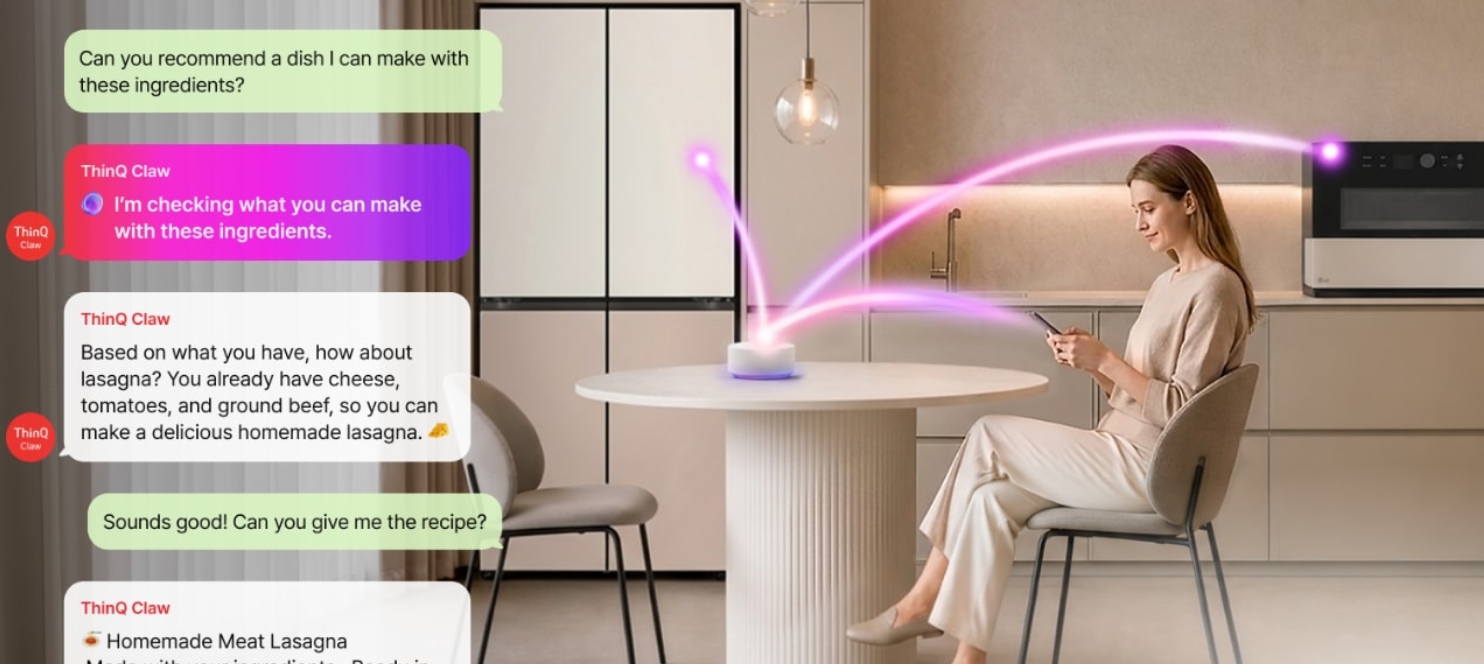
Traditional smart homes have long been trapped in a vicious cycle: connecting devices to the network is easy, but true “intelligence” is difficult. Users need to manually set numerous scenes, conditions, and timing rules, essentially making them just advanced remote controls. At IFA 2026 in Berlin, LG presented the ThinQ Claw AI Home solution, attempting to completely rewrite the interaction paradigm of smart homes with a large-scale intelligent agent, transforming “human-adapted devices” into “home understanding humans.”
Hardware Components: ThinQ ON Hub as the Core, Open Ecosystem as the Foundation
The entire ThinQ Claw AI Home is not a single hardware box, but a whole-house AI system combining hardware and software:
- ThinQ ON AI Home Hub: The hardware itself, the computing power carrier of the entire system, and the operating platform for the ThinQ Claw AI agent. It handles local + hybrid cloud inference, multi-device protocol scheduling, and environmental sensor data aggregation, essentially acting as the brain of the entire house.
- Multi-Source Sensing Kit: Temperature, humidity, human presence, and light sensors collect environmental data from the home space, providing real-world data for AI. 3. Ecosystem Compatibility Base: Based on the Homey platform acquired by LG, it’s not limited to LG’s own appliances and supports third-party IoT device access, breaking down brand barriers and ensuring compatibility with mainstream IoT protocols. This is its biggest difference from many closed-ecosystem AI home devices.
- Interaction Entry Point: The ThinQ Claw intelligent agent can be accessed from multiple terminals, including the ThinQ App chat interface on mobile phones, voice speakers, and TVs.
ThinQ Claw is an AI Agent running on top of the ThinQ ON hub. Hardware is the carrier; its core competitiveness lies in its context-aware, large-scale home model orchestration capabilities.
Core Experience: Say Goodbye to Commands, Describe Life Scenarios Through Chat
Most smart home devices on the market receive isolated commands: “Turn on the air conditioner,” “Sweep,” “Turn off the lights.” Once the needs become vague and contextualized, the system fails.
ThinQ Claw’s biggest innovation is conversational contextual interaction. It eliminates the need to write automation scripts or set trigger conditions. Users describe their plans using natural language, and AI automatically breaks down cross-appliance task chains.
ThinQ Claw’s biggest innovation is conversational contextual interaction. It eliminates the need to write automation scripts or set trigger conditions. Users describe their plans using natural language, and AI automatically breaks down the task chain across appliances.
Real-world Demonstration Scenarios
- Scenario 1: “Friends are coming over for dinner tonight.”
After interpreting the user’s intent, ThinQ Claw automatically executes a series of actions: adjusting the living room air conditioner temperature and optimizing the air purifier setting; preheating the oven; retrieving recipes from existing ingredients in the refrigerator; switching the lights to a guest-friendly mode; and having the robot vacuum pre-clean the living room. All actions are autonomously programmed by AI, requiring no user intervention with individual devices.
- Scenario 2: “I’m going on a trip next week.”
After reading this information, the system automatically shuts off unnecessary appliances, lowers the refrigerator’s power consumption, disables all house lighting automation, activates security monitoring, and provides energy efficiency optimization suggestions. It can also synchronize travel information with the calendar.
The kitchen scenario is a key area of focus for LG: it reads information about the ingredients in the refrigerator, combines this with family dietary preferences and dietary restrictions, automatically recommends recipes, and simultaneously schedules preset cooking parameters for appliances such as the microwave and oven, directly implementing the recipes at the hardware execution level.
It can memorize long-term family habits: family members’ schedules, temperature preferences, and dietary tastes. The longer it’s used, the more closely the recommendations and automated actions align with the family’s actual habits. It also supports integration with third-party services like calendars, directly translating external schedules into home actions—something traditional timed automation can’t do.
Hybrid Local and Cloud Architecture: A Trade-off Between Privacy and Intelligence
ThinQ ON’s central hub employs a hybrid inference scheme: device status and raw sensor data are processed locally first; complex intent understanding and large model generation tasks are handled by calling the cloud.
The advantages are: fast device linkage response speed and no complete transmission of raw home environment data; however, it is highly dependent on the network. In offline states, the Claw advanced intelligent agent’s capabilities are limited, retaining only basic device control.
Compared to other domestic whole-house AI solutions, LG’s solution has the advantage of cross-brand openness, not forcing users to replace all their appliances with LG; however, its shortcomings are equally apparent: limited local computing power, and complex multi-device tasks still rely heavily on cloud support.
Highlights Summary
- Paradigm Upgrade: From Command Control to Contextual Intelligent Agents 1. No longer relying on rigid IFTTT-style rules: AI understands human plans and autonomously generates multi-device workflows, lowering the barrier to entry for smart home use. Ordinary users don’t need to study complex scene settings.
- **Open Ecosystem: Based on the Homey platform, it can connect to third-party brand IoT hardware, avoiding the need for a single brand of hardware throughout the house. Existing appliances can also partially enjoy AI capabilities.
- **Deep Integration with Life Scenarios: Task chains are designed for real-life family activities, including kitchen meals, family gatherings, leaving home, and sleep, going beyond just turning lights and air conditioning on and off.
- **Long-Term Learning Mechanism: Continuously learns family living habits to achieve personalized home services, rather than a uniform preset mode.
Existing Shortcomings and Issues to be Verified (Exhibition Prototype Stage)
- **Product Not Yet Commercially Available: Currently, it’s only a prototype demonstrated at the IFA exhibition. Pricing and release date have not been announced, and actual performance in real-world applications is unknown. The smooth performance shown in the exhibition does not equate to performance in a real-world home environment.
- Complex Family Fault Tolerance Needs Testing: In multi-member families with multiple members and conflicting needs and commands, how AI will prioritize is the biggest challenge for such family smart agents, requiring further validation in real-world homes.
- Network Dependence Issues: Advanced Agent capabilities become ineffective after network outages, limiting local independent operation.
- Reduced Capabilities of Third-Party Devices: LG’s own appliances can fully utilize all capabilities; third-party hardware will likely only be able to perform basic operations like turning on/off and adjusting speeds, with limited deep integration capabilities.
- Unknown Domestic Compatibility: Currently targeting the European market, a domestic version is not yet confirmed. Calendar, service ecosystem, and voice semantics are optimized for overseas environments.
Competitive Product Comparison
Table
| Product | Core Concept | Closed / Open |
| — | — | — |
| LG ThinQ Claw AI Home | AI intelligent agent understands life plans, automatically orchestrates home appliance tasks | Open, supports third-party IoT |
| Xiaomi AI Cube | Local large model hub, Miloco proactive intelligence | Leaning towards Xiaomi ecosystem |
| Huawei Xiaoyi Claw | Intelligent agent perception and linkage within the HarmonyOS system | Primarily HarmonyOS smart home ecosystem |
Summary: The next direction for smart homes, but still far from maturity
LG ThinQ Claw AI Home represents a very clear direction for the smart home industry: the next competition in smart homes is no longer about whether devices can connect to the internet, but whether the system can understand people’s lives and translate natural language-based thoughts into coordinated actions across all devices in the house.
It breaks free from the involution of “making more smart hardware,” focusing on the AI orchestration layer, allowing existing devices to participate in the smart experience. This approach is highly valuable. However, we need to be clear that this solution is currently still in the prototype stage shown at exhibitions. Realizing the ideal scenario requires addressing real-world pain points such as multi-user conflicts, network outages causing performance degradation, and compatibility with third-party devices.
If it is officially implemented in the future, this solution will be more suitable for users who value an open ecosystem, don’t want to replace all their appliances, and are tired of manually setting up numerous automated scenarios; however, at this stage, it can only serve as an industry trend indicator and is not suitable as a purchasing reference.
Related reading: LG PuriCare Hydro Tower Max · FSL Xiaoban AI Voice Night Light · Google Home Gemini Preview