
Unlike traditional camera-based facial recognition for fatigue detection, which relies on yawning or closed eyes, this product uses non-invasive EEG signals as the core judgment basis, combined with multimodal sensing, to achieve early detection of mental fatigue and attention deficit in workers.
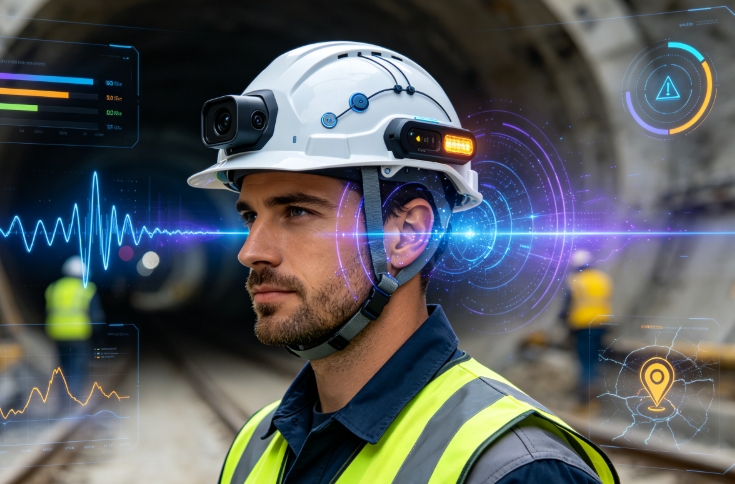
I. Hardware: Intelligent Upgrades to a Traditional Safety Helmet
The outer shell uses industrial standard ABS safety helmet material, meeting basic impact protection requirements. The device adds an EEG sensing module, multi-signal sensors, an IMU posture module, and a 4G/wireless communication unit to the standard safety helmet design. The total weight is approximately 310g, a minimal increase compared to a standard safety helmet, making it suitable for workers to wear for extended periods.
The core acquisition unit is a flexible dry electrode EEG sensor, requiring no conductive gel. Signal acquisition is completed within 30 seconds of being properly fitted, solving the pain points of cumbersome wearing and long preparation times of traditional EEG devices, and adapting to the rapid shift work habits on construction sites.
With an IP65 protection rating, it can withstand construction dust and rain splashes, making it suitable for humid and dusty environments such as open-air construction sites, underground mines, and tunnels. It features a built-in high-capacity battery, providing 8-10 hours of continuous operation on a full charge, covering the entire duration of a single shift. It supports wired fast charging, allowing for centralized charging management by work teams.
The hardware sensing matrix employs a multimodal fusion architecture:
- EEG Acquisition: Captures frontal brain waves, distinguishing between cognitive states such as focus, fatigue, drowsiness, and microsleep, even identifying latent fatigue when eyes are open.
- Vital Signs: Simultaneously collects heart rate and blood oxygen levels to assess physiological abnormalities such as exhaustion and hypoxia.
- 9-Axis IMU Posture Sensing: Recognizes falls, impacts, violent shaking, and prolonged immobility.
- Positioning Module: Utilizes BeiDou + GPS dual-mode positioning for electronic fencing and personnel location tracking.
- Audible, Visual, and Vibration Alarm Unit: The helmet features a built-in buzzer and vibration module, directly alerting the worker to any risk trigger.
Note: The physiological data output by this device is for operational safety reference only and is not equivalent to medical diagnostic equipment.
II. AI Algorithm and Business Capabilities: Brainwave-Driven Active Safety Warning
This is the biggest difference between this hardware and most smart safety helmets on the market. Traditional smart safety helmets mostly rely on cameras to recognize facial movements, which are easily interfered with by masks, strong light, backlight, and helmet visors, resulting in a high false alarm rate. This product uses brainwave signals as the core source for fatigue judgment, and then integrates heart rate, posture, and environmental data for comprehensive AI judgment.
Core AI Functions
- Graded Fatigue Warning The edge AI analyzes brainwave rhythms in real time. When the brain shows signs of fatigue, decreased attention, or drowsiness, a graded warning is issued before the worker closes their eyes or yawns. 1. Level 1 Vibration Alert: This alerts workers to adjust their posture. When the risk escalates, an audible and visual alarm sounds, and the data is simultaneously uploaded to the backend safety management platform. Managers can remotely intervene, enabling proactive risk management rather than addressing problems after an accident occurs.
- Automatic Fall and Impact Alarm: When the IMU detects a violent impact or a person falling and failing to regain their posture within a certain timeframe, an alarm is automatically triggered, and location information is simultaneously pushed to the management backend. This addresses the pain point of rescuing personnel who are lost or in distress in mines or tunnels.
- Personnel Status Big Data Platform: All data collected by the safety helmet is transmitted back to the safety management platform via wireless network. The backend can view real-time fatigue index, heart rate, blood oxygen saturation, location trajectory, and alarm history for team members. It supports exporting shift fatigue statistics reports to help companies optimize scheduling, identify high-frequency fatigue positions, and support safety management decisions.
- Electronic Fence and Area Alarm: Combining positioning capabilities, if a person enters a high-risk restricted area, the safety helmet will trigger a local alarm, and the backend will simultaneously record the incident, preventing human-caused accidents caused by unauthorized entry into dangerous areas.
Signal Noise Reduction Design
In industrial settings, the noise of motors, equipment vibrations, and significant electromagnetic interference can severely disrupt microvolt-level EEG signals. While the device incorporates a specialized industrial noise reduction AI algorithm to filter electromyography (EMG) and environmental electromagnetic noise, ensuring usability of EEG signals in complex construction environments, signal quality can still degrade in extreme interference scenarios.
III. Shortcomings and Pain Points in Real-World Scenarios
- Wearing Constraints Affect Signal Quality Electrodes need to maintain a stable fit to the scalp. Thick hair, different head shapes, and loose helmets can all cause EEG signal drift, leading to false alarms and missed alarms. Strict adherence to wearing guidelines by workers is required, placing certain demands on on-site management.
- Only Recognizes Brain State, Cannot Read Thought Content The hardware can identify fatigue, drowsiness, and attention levels, but it cannot understand human thoughts. It cannot distinguish between “thinking about work” and “daydreaming.” It can only output quantitative indicators of cognitive activity. Company managers need to clarify these boundaries and avoid over-interpreting the data.
- High Cost Threshold
Belonging to B2B industrial equipment, the cost per unit is far higher than that of ordinary safety helmets. It requires a supporting management platform, making it suitable for pilot testing in high-risk, key positions. Large-scale deployment across all work teams in a short period is difficult. - High Dependence on Backend System
Complete alarm, statistics, and reporting functions rely on the management platform. In offline environments, the safety helmet only retains local vibration and audible alarms; the backend cannot receive alarm information. - Battery Life Affected by Sampling Mode
In full-on EEG high-frequency sampling and continuous location reporting mode, battery life is reduced. High-intensity usage scenarios require rotating charging among work teams.
IV. Suitable and Unsuitable Usage Scenarios
✅ Suitable Scenarios
High-risk operations such as underground mining, tunnel construction, bridge construction, power line inspection, and high-risk chemical plant inspection; enterprises wishing to shift safety management from post-event accountability to pre-event risk prediction; requiring focused control of safety hazards caused by worker fatigue.
❌ Unsuitable Scenarios Ordinary office and civilian use; seeking low-cost replacement of all ordinary safety helmets; no backend management system, only wanting standalone use; hoping to read and monitor employee thoughts through the device.
V. Summary
The EEG multimodal fatigue monitoring safety helmet is a representative hardware application of brain-computer interface technology in industrial safety production, moving beyond the laboratory. It transcends the limitations of traditional video surveillance, directly capturing fatigue signals at the brain level of workers, combining vital signs, posture, and location for multi-dimensional risk assessment, providing a new proactive safety solution for high-risk industries.
Currently, the product is not perfect. Signal interference from wearing and the environment, high procurement costs, and reliance on platform systems are all real problems that need to be addressed for commercialization. It is not a consumer product, but rather safety equipment for industrial use. Its value lies not in replacing traditional safety helmets, but as a supplementary protective measure for high-risk positions, reducing safety accidents caused by fatigue.
As the cost of EEG hardware continues to decrease and algorithms continue to iterate, this type of brain-computer interface safety hardware is expected to become an important component of the safety system for high-risk industrial scenarios in the future.
Related reading: Nike “Recovery Sleep-Sock” Venous Compression Stockings · Smart Wheelchair Robots Address the Challenges of Aging · PathFinder