
In recent years, industrial AI and large-scale vision models have largely run on standalone industrial PCs or external vision processing boxes, with robotic arms serving merely as backend execution mechanisms.
The pain points of traditional collaborative robots are clear: limited bandwidth at the tool flange; complex cabling for wrist-mounted cameras and high-performance force-torque sensors; controller computing bottlenecks; high latency in AI inference data pipelines; and a disconnect between the robot body and AI perception units.
The core mission of UR Gen7 is to bring “Physical AI” directly to the production floor, enabling the robot itself to natively support AI perception and real-time decision-making, rather than relying on retrofitted add-ons.
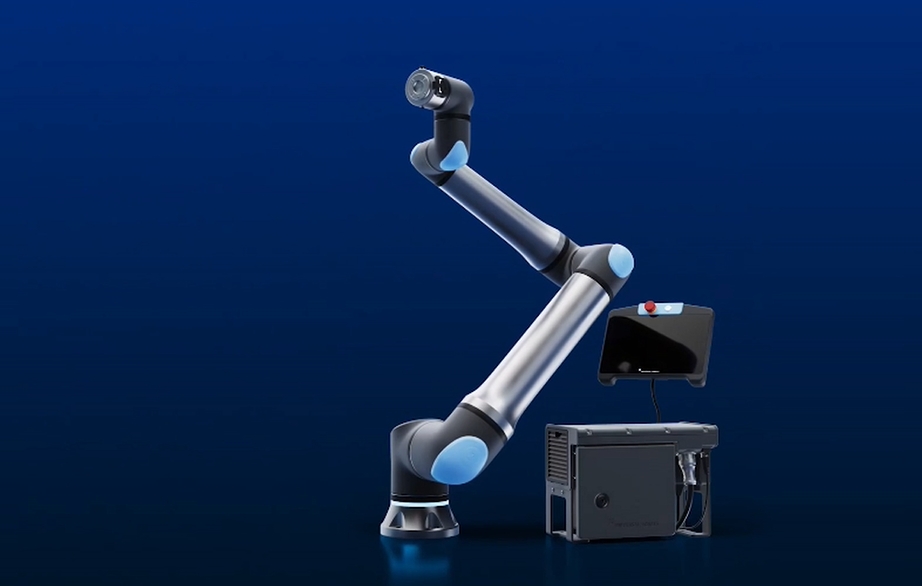
The Gen7 platform comprises four major hardware modules and a brand-new software system: the g-Series robot arm, CB7-Core controller, TP7-Core teach pendant, and SP7 smart operation panel, powered by the PolyScope-X robot operating system. It also maintains backward compatibility, allowing legacy e-Series arms to upgrade to the CB7-Core controller, thereby protecting existing investments in Universal Robots production lines.
In-Depth Hardware Analysis: From Controller to AI-Ready Tool Flange
1. CB7-Core Controller: Upgraded Computing Power and Integration
The controller serves as the brain of the entire platform. Compared to the previous generation, the unit volume has been reduced by 30%, while overall computing performance has increased by 40%.
In addition to the standard standalone control cabinet version, an embedded version has been introduced. This allows for direct installation inside the customer’s automation electrical cabinets—an ideal solution for compact machine-tending applications and small workstations.
Network capabilities are a key focus of this upgrade: it offers native support for multiple independent industrial networks, enabling simultaneous connections to MES, PLC, and vision inference units without the need for additional network switches. For Physical AI scenarios, the RTDE (Real-Time Data Exchange) bandwidth has been significantly enhanced; joint, torque, and position data can be output to AI inference engines with ultra-low latency, while motion commands from external AI algorithms can be received and executed.
Advantage: Reduces latency caused by intermediate gateways when deploying AI-based vision picking or flexible assembly workstations in factories. > Limitation: The boost in computing power remains focused on industrial motion control; the controller lacks a built-in, dedicated AI acceleration NPU, and large-model inference still requires an external edge computing unit. It is important to clarify this distinction: while it is an “AI-Ready” platform, this does not mean the robot unit itself possesses native computing power for large models.
2. Three New g-Series Collaborative Robot Arms
The three new models—UR10g-1750, UR17g-1300, and UR18g-950—cover three distinct product categories: long-reach/light-payload, medium-reach/heavy-payload, and short-reach/high-payload. They are suitable for mainstream applications such as palletizing, machine tending, precision assembly, and grinding.
Key Hardware Innovation: The AI-Ready Tool Flange (Wrist Output Interface)
On previous collaborative robot models, the power and data interface bandwidth at the end-effector was limited. Mounting a 3D camera on the wrist often required a thick external cable to move repeatedly along with the wrist; cable wear was a frequent point of failure in the field.
The Gen7 wrist flange integrates 1Gbps high-speed Ethernet, high-power supply, and safety signal links directly. Wrist-mounted 3D depth cameras, miniature laser sensors, and force sensors draw power and communicate directly through the flange, eliminating the need for long, trailing high-speed data cables and significantly reducing cable fatigue caused by bending during wrist movement.
Additionally, the entire series features built-in high-precision joint torque sensing and native support for impedance-based compliant control. If AI vision detects misalignment in part placement, the robot arm can utilize force sensing to perform compliant insertion—a capability of immense value for unstructured feeding and assembly scenarios.
3. TP7-Core Teach Pendant & SP7 Wrist-Mounted Smart Panel
The TP7-Core teach pendant is approximately 20% lighter than the previous generation, features an upgraded Full HD display, and adds virtual joystick controls. These improvements make programming and waypoint teaching more intuitive, facilitating the work of field engineers during workstation commissioning. The SP7 smart panel is mounted directly near the robot arm’s wrist, allowing operators to perform point teaching and start/stop operations right at the end-effector without walking back and forth to the control cabinet; this significantly boosts debugging efficiency for workstations frequently fine-tuning AI-based vision picking programs.
Software Ecosystem: PolyScope‑X Bridges Robotics and AI
The PolyScope‑X operating system serves as the software foundation for the Gen7 platform.
The upgraded URCap‑X SDK offers native support for ROS2 communication, enabling seamless integration between third-party machine vision SDKs or edge-based physical AI algorithms and the robot’s motion control layer.
This eliminates the need for system integrators to develop complex intermediary communication programs and shortens development cycles for solutions such as random bin picking (based on industrial large models) and adaptive grinding following workpiece inspection.
However, an objective view reveals that the platform itself does not provide native vision recognition or large-model inference capabilities; AI functions are still delivered by third-party ecosystem partners. UR focuses on providing the hardware foundation and standardized communication interfaces—pursuing an open ecosystem strategy rather than developing proprietary vertical AI applications.
Hands-on Perspective: Analysis of Strengths and Current Limitations
✅ Key Strengths
- Revolutionary end-flange upgrade addresses real-world pain points: High-speed data and power delivery at the wrist simplify the deployment of wrist-mounted vision systems at the hardware level; this is a pragmatic hardware enhancement for physical AI, not merely conceptual marketing.
- Controller miniaturization + backward compatibility with existing equipment: Legacy e-Series arms can be directly upgraded to the CB7‑Core controller, allowing existing automated production lines to integrate AI upgrades incrementally without a complete overhaul, thereby lowering the cost of trial and error in factory digitalization.
- Built-in high-precision torque sensing and an impedance control foundation: These create a perception closed-loop with AI vision, lowering the barrier to implementing random feeding and flexible assembly applications.
- Open software ecosystem with deep ROS2 integration: This facilitates secondary development for research institutions and automation integrators, fostering collaboration between universities and enterprises on physical AI robotics projects. ### ⚠️ Current Shortcomings and Limitations
- No built-in AI acceleration chip in the controller: All deep learning and large-model inference tasks still require an external edge industrial PC; on-device AI computing power is not provided by the unit itself.
- No native low-code AI programming suite: Deploying AI-based picking still requires integrators to develop vision solutions; “out-of-the-box” AI workstation solutions for SMEs still rely on the UR+ ecosystem partners.
- Ecosystem still maturing: As the new g-Series robotic arms have just been released, a complete ecosystem of third-party end-effectors and wrist-mounted 3D cameras will take about six months to fully develop.
Industry Positioning and Market Outlook
Amid the hype surrounding humanoid robots, UR Gen7 offers an alternative path in the industrial automation sector: instead of chasing the humanoid form factor, it upgrades the cobot hardware foundation to pave the way for the industrial implementation of Physical AI.
Past failures in industrial AI projects were not solely due to inadequate algorithms; often, the issues stemmed from shortcomings in robot hardware—such as data interfaces, latency, cabling, and on-site stability. The Gen7 platform specifically targets this infrastructure layer.
Its target customers are clearly defined: factories in automotive parts, 3C electronics, and precision machining that have already begun piloting AI-vision-enabled flexible production lines, as well as universities and robotics laboratories seeking a research platform for Physical AI.
In the short term, the three new g-Series arms will focus on machine tending, flexible assembly, and the random palletizing of small parts. In the medium to long term, as the UR+ ecosystem fills the gaps regarding wrist-mounted vision tools, applications such as random bin picking and AI-adaptive grinding workstations will see increased adoption.
Conclusion
UR Gen7 is not merely an “intelligent robot terminal” equipped with large AI models; rather, it is a cobot hardware infrastructure designed for the era of Physical AI.
Its innovation lies not in flashy, “show-off” intelligent features, but in systematically addressing the shortcomings that hinder cobots from integrating with AI perception—specifically regarding controller computing power, wrist flange hardware interfaces, and the software communication ecosystem. For the industrial robotics sector as a whole, Gen7 represents the strategy adopted by traditional manufacturers to address the AI wave: prioritizing the strengthening of the hardware foundation and leveraging an open ecosystem to integrate AI algorithms, thereby helping factories successfully deploy “physical AI”—originally confined to the laboratory—directly onto the production floor.