
The queue outside the service-robot zone at the 140th Canton Fair, which wraps up today in Guangzhou, has become one of the show’s defining images — organisers report more than 25,000 visitors a day through the hall. The company drawing the deepest crowds is AgiBot (Zhiyuan Robotics), China’s shipment-volume leader in humanoids, showing its Interstellar-edition A2 alongside a growing family of wheeled and quadruped siblings. Having spent time at the booth, the story is more interesting than the crowds suggest.
The Numbers Behind the Hype
According to Omdia, global humanoid shipments reached roughly 13,300 units in 2025, nearly six times the prior year — and the top six vendors were all Chinese. AgiBot led at over 5,100 units, ahead of Unitree’s 4,200 and UBTech’s 1,000, while Figure, Agility and Tesla each shipped in the hundreds. That scale matters more than any single demo: it means real production lines, real field-failure data, and a cost curve Western rivals cannot yet match.
Three Chinese vendors accounted for roughly 78% of global humanoid shipments in 2025, a concentration that has strategic implications beyond manufacturing. Learning curves in robotics are driven by deployment hours, and deployment hours correlate with units in the field. The company that ships the most robots also collects the most data about how robots fail.
The Interstellar Edition, Up Close
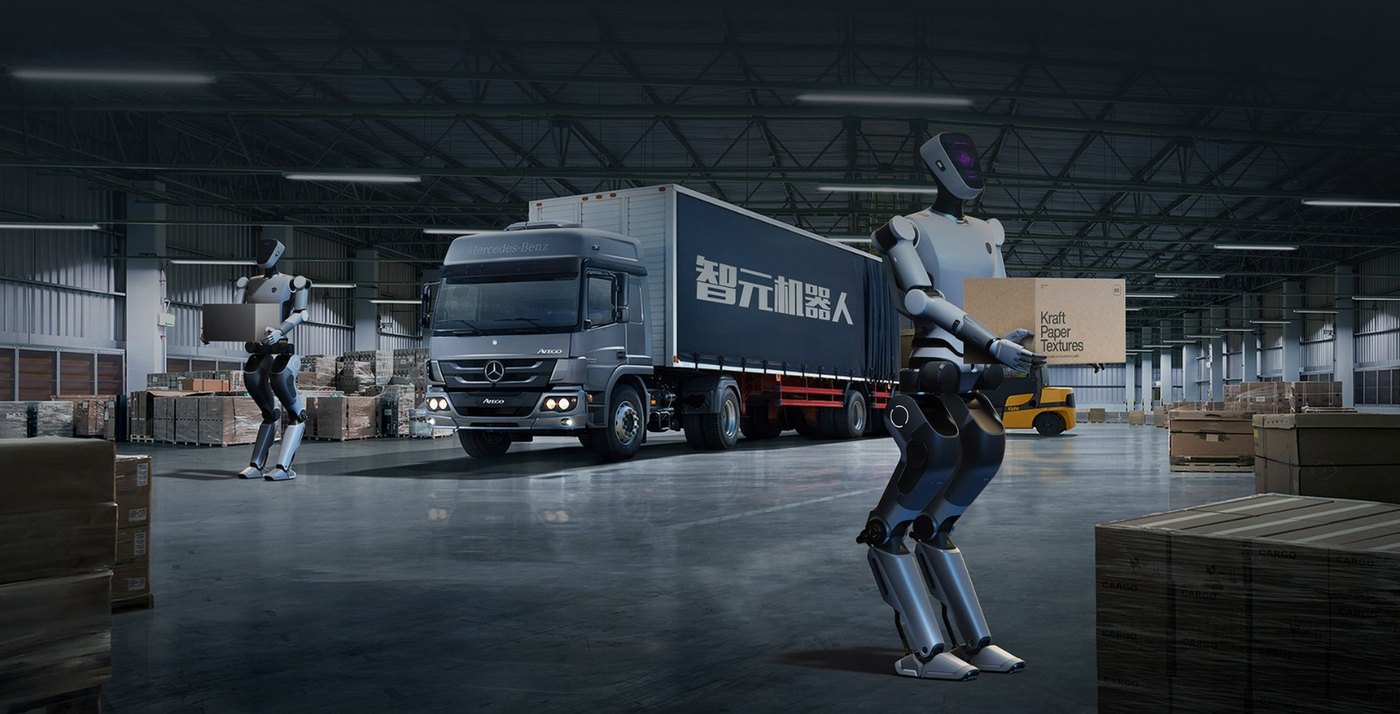
The Canton Fair unit wears a distinctive silver-and-white shell with an illuminated chest module, but the substance is in the motions. The A2 on display performed continuous box transfer between a conveyor and a pallet station, self-correcting grip failures without operator input — the kind of unglamorous, high-cadence task that actually determines whether humanoids earn their footprint. Walk cycles remain conservatively slow in demo mode, a deliberate choice to avoid the fall risks that have embarrassed competitors at past shows.
The A2 is a full-size bipedal humanoid with dexterous multi-finger hands, a vision-language-action model stack that accepts natural-language task instructions, and a battery pack sized for multi-hour shifts. AgiBot’s “Genie” embodied-AI stack is the software story: instead of hand-coding every grasp, operators describe a task and the model generates the motion plan, with human demonstration data fine-tuning it for the specific line.
Beyond the Humanoid: A Family Strategy
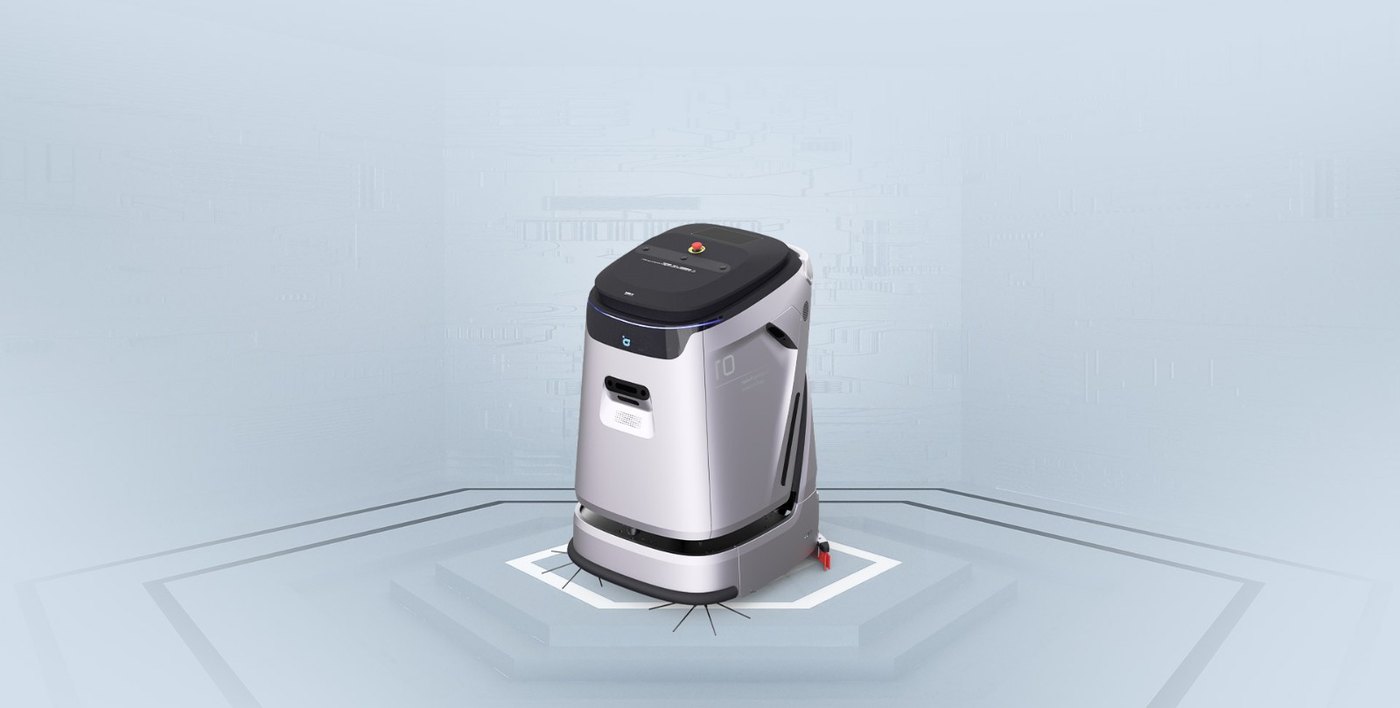
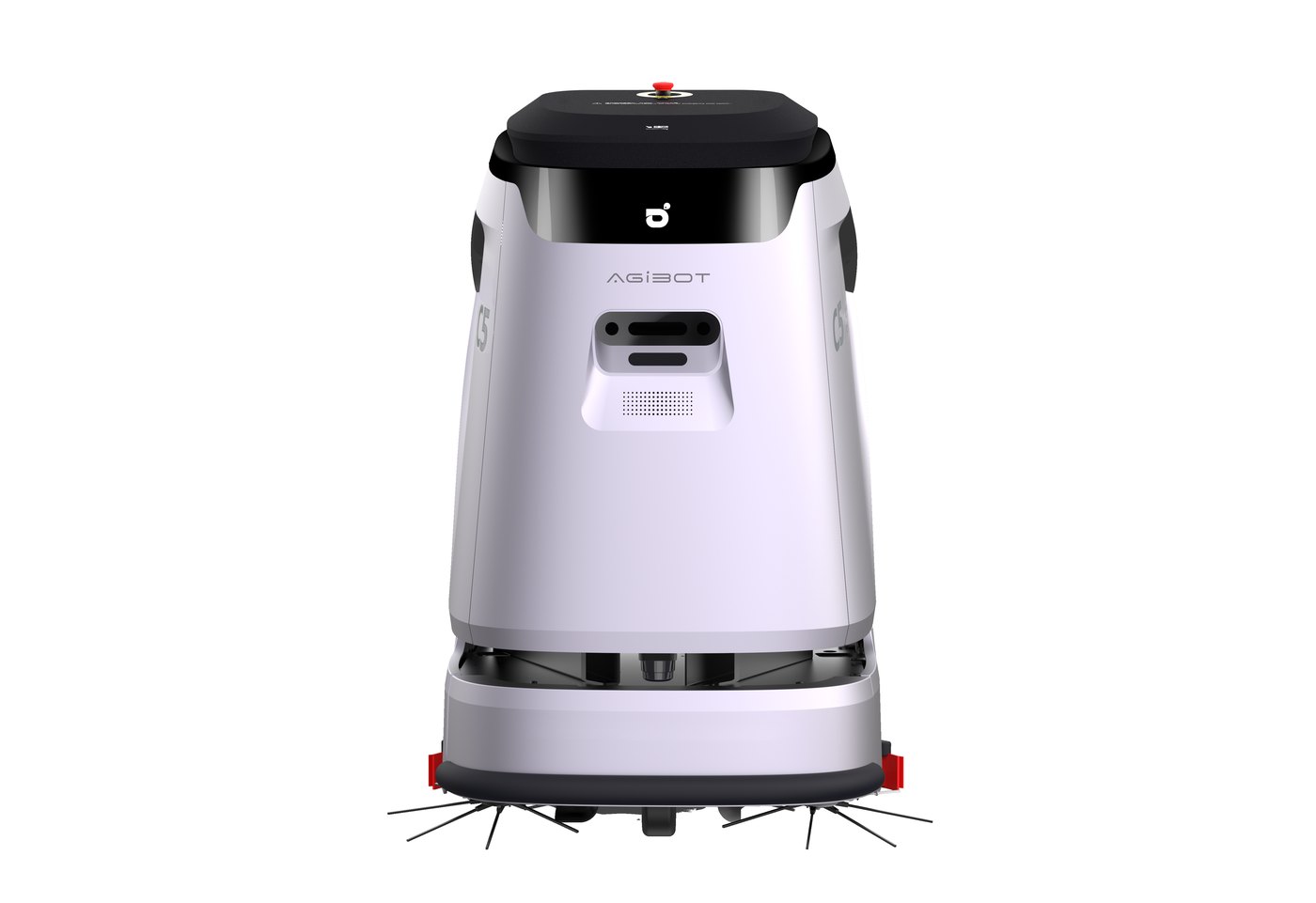
AgiBot’s booth makes the company’s real bet legible. The humanoid is the flagship, but the shipped volume comes from form factors that solve today’s problems. A wheeled cleaning robot for commercial interiors, a quadruped with wheel-feet for inspection patrol, and a low-profile delivery platform all share the same autonomy stack. This portfolio approach — one brain, many bodies — mirrors what worked for industrial automation incumbents and hedges the demand uncertainty around bipedal machines specifically.
The logic is commercially sound. A hospital that will not yet buy a bipedal humanoid will buy a cleaning robot that navigates corridors, and that purchase funds the company’s next generation of humanoid development. It also produces data: the same perception models trained on corridor navigation improve the humanoid’s ability to move through cluttered spaces.
The Uncomfortable Questions
Two caveats temper the showcase. First, “shipped” is not “productive.” Industry reporting suggests a meaningful share of early humanoid orders go to showrooms, tech parks and brand experiences rather than production work, and churn on those orders is nontrivial. UBTech’s well-documented experience — an order book of 13,000 units against a realistic 2026 delivery of 1,500 to 2,000 — is the cautionary tale every buyer at the fair had heard.
Second, pricing remains unpublished for most export configurations, and the gap between demo performance and contracted service-level agreements is where humanoid deals go to die. Buyers at the fair were notably focused on service contracts, spare-parts guarantees and remote diagnostics — questions the marketing materials don’t answer. The difference between a robot that works for an hour on a stage and one that works for eight hours on a line is mostly maintenance engineering, and none of the booths were eager to discuss mean time between failures.
What to Watch
Three indicators will determine whether AgiBot’s lead is durable. First, whether the 2026 delivery figures include a higher proportion of production-floor deployments rather than showroom installations. Second, whether the company publishes uptime and intervention-rate data per customer site — the metrics that industrial buyers actually use to justify capital allocation. Third, whether the Genie model stack becomes a developer platform, which would let integrators build vertical applications the way they did on top of industrial robot operating systems a decade ago.
The geopolitical dimension is also unavoidable. With US restrictions on Chinese robotics components tightening, AgiBot’s export strategy in Europe and Southeast Asia will be shaped as much by trade policy as by product quality. The Canton Fair crowds were international, and so were the questions about compliance.
Verdict
Rating: 4/5 (hardware), 3/5 (commercial clarity) — AgiBot’s Canton Fair presence confirms that Chinese embodied AI has moved from viral videos to volume manufacturing faster than anyone in the West. The A2 is genuinely capable hardware backed by an ecosystem strategy that hedging-averse buyers will appreciate, and the portfolio approach is a more credible business model than the pure-humanoid pitches common at the show.
What remains unproven is the economics at customer sites. Watch the 2026 delivery numbers, not the demo reels — and read the SLA, not the brochure.
What a Buying Committee Actually Asks
Walk any humanoid booth at a trade fair and you will hear the same five questions from serious buyers, in roughly the same order. What is the payload, and what is the repeatability of the arm? What is the mean time between failures, and who replaces a joint? How is the robot trained on my process, and how long does that take? What does the service contract cost per year? And what happens when it meets a person in a corridor at speed?
The booths that answer those questions well tend to be the ones with real deployments, and AgiBot’s answers are more complete than most. Payload and repeatability figures exist for the A2, though they vary by end-effector configuration. The Genie stack’s task-training method is demonstrable: a human operator demonstrates the motion, the model generalises, and the site can retrain after a line change without calling in the vendor. That last point matters more than any specification, because a robot that requires a service engineer every time a process changes has an ongoing cost that destroys the business case.
Service and safety are where the answers get vaguer across the whole industry. Mean time between failures is published by almost nobody, and the honest vendors will tell you privately that joint wear in continuous operation is still the dominant failure mode. On safety, a full-size bipedal humanoid operating near people in a shared space is a genuinely hard regulatory problem, and no vendor at the fair had a certification story that would satisfy a European insurer.
The Software Is the Moat
Hardware differentiation in humanoids is converging fast: actuator quality, structural design and battery architecture are all improving in parallel across dozens of vendors. What differentiates the survivors will be software — specifically the ability to take a natural-language instruction and turn it into a reliable motion plan on a specific line, with a specific gripper, handling specific objects.
This is the hardest problem in embodied AI and it is where scale becomes decisive. Every deployed unit produces data about what went right and, more valuably, about the thousand ways a grasp can fail. A vendor with five thousand units in the field accumulates failure data at a rate a vendor with two hundred cannot match, and failure data is what trains the recovery behaviour that makes a robot feel reliable to the humans working beside it.
AgiBot’s portfolio strategy feeds this loop. A cleaning robot moving through a hospital corridor generates navigation data that transfers to the humanoid’s locomotion stack. A quadruped inspecting an industrial site generates perception data for obstacle avoidance. Same brain, many bodies, one accumulating dataset. It is a genuinely clever way to bootstrap a data advantage without needing to win the humanoid market first.
The Economics of a Humanoid Line
The arithmetic that decides whether a humanoid gets bought looks roughly like this. A warehouse or factory job that pays a worker fifty thousand dollars a year all-in, across two shifts, represents about a hundred thousand dollars of annual labour cost. A robot that costs forty thousand dollars, works two eight-hour shifts with battery swaps, needs one technician per ten units and a five-thousand-dollar annual service contract, pays back in under a year — if it works ninety-five percent of the time. At eighty percent uptime, the payback stretches past the warranty, and the deal dies.
That sensitivity to uptime is why the duty-cycle engineering story matters more than the demo story. It is also why the industry’s habit of publishing unit shipment figures while staying quiet on utilisation is unhelpful to buyers. Shipped is not deployed, deployed is not productive, and productive is not profitable. Buyers doing due diligence should ask for the third number and be suspicious of vendors who only have the first.
China’s Manufacturing Advantage Is Real but Narrowing
The concentration of humanoid shipments among Chinese vendors — roughly three quarters of global volume — reflects three advantages: a mature supply chain for actuators and harmonic drives, aggressive cost engineering, and a domestic market with thousands of factories willing to pilot new automation. None of those advantages is permanent. Actuator costs are falling globally, Western vendors are building contract manufacturing relationships in Asia, and the pilot-happy customer base is being replicated in Southeast Asia and Eastern Europe.
What is harder to replicate is the accumulated operational knowledge: what breaks, how often, and what to do about it. That knowledge is the real export, and it is why the moat for companies like AgiBot depends less on the next model of robot than on the number of hours their existing fleet has worked.
What Buyers Should Insist On
Three contractual demands separate a serious deployment from a demo. First, uptime guarantees with financial penalties, not targets. Second, a defined spare-parts programme with local stock, because a robot waiting three weeks for a joint from Shenzhen is a robot that has stopped earning. Third, a training clause: the vendor trains the customer’s staff to retrain the robot, so that a line change does not trigger a service call and an invoice.
Vendors who refuse all three are selling a showroom product. Vendors who accept them — and only a handful currently will — are selling a tool. That distinction, not the number of joints or the elegance of the walk cycle, is what will decide which humanoid companies exist in five years.
The View From the Floor
The Canton Fair crowds tell a story about attention, not about procurement. The buyers taking photographs are largely not the people who sign contracts; the people who sign contracts are in smaller rooms asking about service intervals. But attention has a second-order effect that is easy to dismiss and shouldn’t be: it convinces factory managers that robots are normal, and normalisation is the precondition for adoption. Every visitor who watched the A2 move boxes and stopped flinching is one fewer obstacle when the procurement proposal reaches the floor supervisor.
That is the real significance of a show like this. The hardware on display will be obsolete in three years. The change in what the audience considers plausible will persist, and AgiBot — with the largest fleet and the loudest booth — is the company most likely to benefit from it.
A Day in the Life of a Deployment
Abstract arguments about humanoid economics become concrete when you follow a single unit through a shift. The robot arrives at the dock, swaps to a fresh pack, and walks to its station. For the first hour it moves totes from a conveyor to a pallet, a task it repeats several hundred times. In that hour the interesting events are the exception cases: a tote that arrives at an angle, a corner that catches the gripper, a pallet stacked one centimetre too high. A robot that recovers from those without human help looks unremarkable in a video and is enormously valuable in a warehouse.
By mid-shift the exception rate climbs, because the environment degrades — labels peel, debris accumulates, colleagues leave things in aisles. This is where field experience tells, and where a model trained on thousands of real failure cases behaves differently from one trained on scripted demonstrations. Recovery behaviour is the least visible and most valuable asset any humanoid company owns.
The shift ends with a swap, not a charge, and this is where the design decision pays off. A shift that ends with a nine-minute pack exchange is a shift that ended on time. A shift that ends with a two-hour charge is a shift with a gap nobody planned for, and gaps are what operations managers notice when they decide whether to expand a pilot.
What a Booth Cannot Show You
A trade fair shows capability; it cannot show reliability. The demonstrations are choreographed, the floor is flat and clean, the lighting is even, and the crowds are kept at a distance. Every one of those conditions is different in a real facility, and the gap between demonstration performance and production performance is where humanoid programmes get cancelled.
Buyers should therefore treat a booth visit as the beginning of diligence rather than the end of it. The useful questions are about the least glamorous parts of the system: how the robot is transported between sites, how software updates are validated, how a technician diagnoses a joint that is beginning to fail, what the spare-parts lead time is for the three most frequently replaced components. Vendors who can answer those have shipped hardware. Vendors who cannot have shipped renderings.
Who Should Actually Buy One
Three buyer profiles make sense today. Large manufacturers with repetitive machine-tending tasks inside otherwise automated lines, where the humanoid fills a gap that would otherwise need a person and where the facility already has engineering staff. Logistics operators running night shifts where labour is hardest to recruit and supervision is thinnest. And research institutions with a genuine research programme — not just an ambition to be seen with a robot — that can exploit access to the software stack.
The profile that does not make sense is the company buying one unit to demonstrate innovation to a board. A single humanoid with no integration, no trained staff and no service contract is an expensive photograph. Almost all of the failed pilots in this category share that shape.
The Takeaway
What the Canton Fair showed is that the hardware problem is substantially solved at the demonstration level and is being solved at the production level. Every serious vendor on that floor could show a humanoid doing useful work. What separated them was everything behind the demonstration: data, service, uptime, contracts and the willingness to talk about failure modes.
AgiBot’s advantage is that it has the largest fleet and therefore the largest body of evidence. Its risk is that shipment volume in a market where many units go to showrooms does not translate into operational knowledge. The next two years of disclosed delivery data will resolve which of those is true, and buyers should watch the delivery mix rather than the delivery count.
Talking to the Robot: What Instruction Means
Every humanoid demonstration now includes the same beat: a person speaks a sentence, the robot pauses, then performs the task. What the audience does not see is how much of that sentence the robot actually understood. “Pick up the box and put it on the pallet” can be executed by recognising three objects and two motions. “Get the parcel from the bottom of the stack without tipping the one above it” requires reasoning about physics, geometry and intent.
Vision-language-action models have made the first kind of instruction routine and the second kind unreliable. That gap is the frontier of embodied AI, and it is where the practical value of a system like Genie lies: the difference between a robot that can be re-tasked by anyone and a robot that must be reprogrammed by an engineer.
For buyers, the relevant question is not how impressive the instruction-following looks but how the system behaves when it fails. Does it stop and ask? Does it retry with a different grasp? Does it report a diagnostic the floor staff can act on? Failure handling is the feature that determines whether a robot is trusted by the people working beside it, and it is invisible in a showroom.
The Supply Chain Behind the Booth
China’s humanoid lead is frequently described as an engineering achievement. It is equally a supply chain achievement. Harmonic drives, frameless torque motors, planetary reducers and force sensors are all manufactured at scale within a few hundred kilometres of Shenzhen and Shanghai, and the resulting cost curve is what allows a Chinese vendor to quote a price that Western competitors cannot match without losing money.
That supply chain is also a dependency. Export controls on precision components, changes in tariff treatment and tightening rules on dual-use technology all affect the ability of Chinese humanoid makers to sell into Western markets. Buyers in Europe and North America should therefore assess vendors not only on capability but on their compliance posture and their exposure to policy changes that could strand a deployment.
What an Honest Roadmap Looks Like
The humanoid industry has a forecasting problem: almost every public timeline has slipped, and the slippage is predictable because it always comes from the same place. Demonstrations are easy, integration is slow, and service networks take years to build. A vendor that says 2026 for a pilot and 2027 for scale is describing a plausible sequence. A vendor that says 2026 for scale is describing a press release.
Judged against that standard, AgiBot’s claims are relatively disciplined: shipment leadership supported by third-party counts, a portfolio that generates revenue while the humanoid market matures, and a software stack positioned as a platform rather than a mirage. The company has not published uptime data, which is the most important missing number, and that is the question buyers should press hardest on.