
Market Analysis
The global market for industrial drones is already crowded — Skydio in the United States, DJI’s industry line in China, and a long tail of European and Japanese specialists. But almost every product in that market is a sensor platform: it flies, it records, it relays data. Mechanical manipulation of the physical world — what the industry calls aerial embodied intelligence — remains a small, early-stage segment. Analysts at Skylogic Research put the worldwide aerial manipulation market at under $400 million in 2025, but project a compound annual growth rate above 35 percent through 2030 as high-rise window cleaning, power-line inspection, and urban search-and-rescue begin to shift from human rope-access teams to automated platforms. The target customer for the E-EMAV is not the consumer. It is the property management firm that currently pays rope-access crews to wash glass towers in Dubai, Singapore, or Hong Kong; the grid operator that wants to inspect transmission insulators without shutting down a line; and the fire department that needs to deliver life-support equipment to a balcony thirty floors up. These buyers write six- and seven-figure annual budgets and will pay a premium for a platform that reduces human risk. Dianying claims more than 200 pre-orders at launch, roughly half of them export orders — a strong signal that the product has found its earliest commercial fit where high-rise labor costs are highest. The category, however, is still defined by technical immaturity. Aerial manipulation couples the aerodynamic instability of a hovering drone with the reaction forces of a robotic arm. Every time the arm moves, the platform’s center of gravity shifts and the rotors have to compensate in real time. That is a hard controls problem, and it is why, despite a decade of academic prototypes, almost no commercial product has crossed from demonstration to deployment. Dianying’s claim of sub-centimeter sensing and stable arm operation in 5-to-6-level winds is, if verified, a meaningful engineering achievement. It is not yet evidence of a solved problem.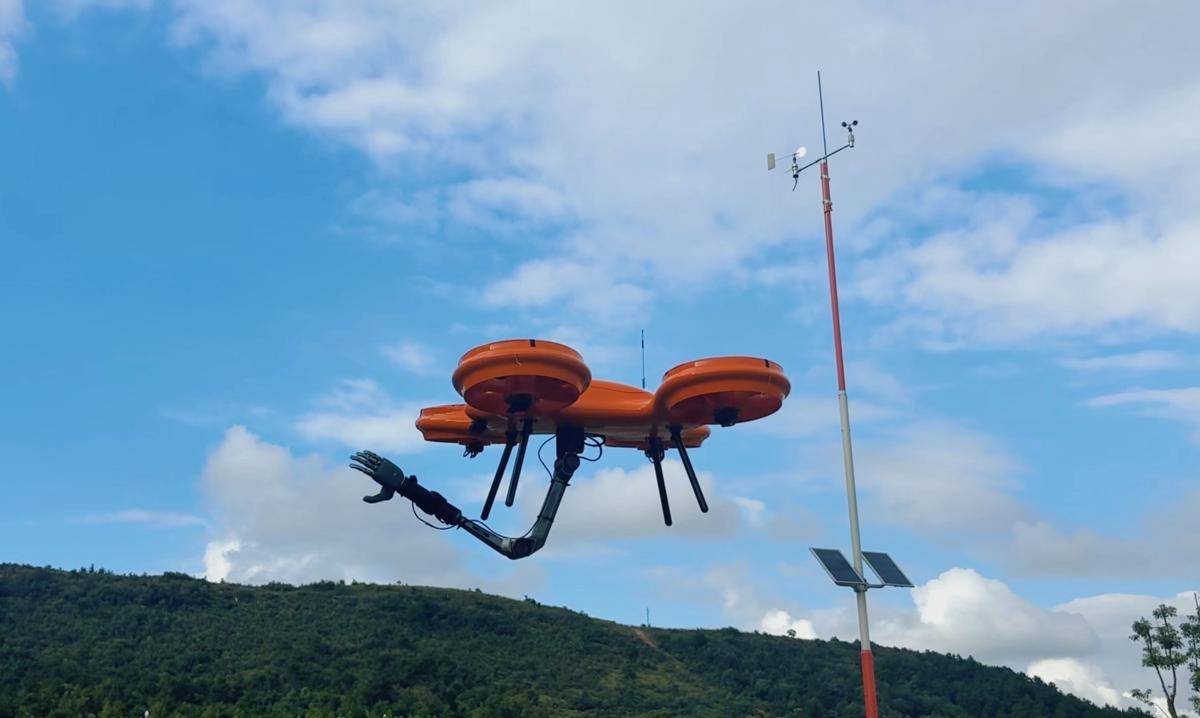
Competitor Analysis
The most direct competitor is DJI, whose industry drone line — sold through the FlightHub enterprise platform — dominates the Chinese commercial drone market by volume. DJI does not currently sell a drone with a manipulator arm. Its industry products are sensor platforms optimized for inspection, mapping, and survey. Where Dianying’s product overlaps with DJI is at the level of the use case: a property manager who wants to inspect a facade today can buy a DJI Matrice for a fraction of the E-EMAV’s price. What they cannot do is clean the glass. The E-EMAV is not competing with DJI on inspection; it is competing with the human rope-access industry that DJI has not yet automated. The second competitor is Zhuoyi Intelligent, a Beijing-based maker of tethered ducted-fan drones focused primarily on military, surveillance, and long-duration hovering applications. Zhuoyi’s platforms share the ducted-fan architecture and the tethered power approach, but they do not integrate a robotic arm. Their value proposition is endurance — a tethered platform can hover for hours, not minutes — rather than manipulation. Dianying’s product is, in effect, what you get when you take Zhuoyi’s airframe and add the part that actually changes the job. The third competitor is Skydio in the United States, which has pivoted toward autonomous inspection and defense. Skydio’s autonomy stack is widely regarded as the most mature in the industry, and its drones can navigate complex environments without GPS. What Skydio does not do is physical manipulation. Its roadmap has consistently stopped at perception. Dianying’s claim — that a Chinese startup is further along on the manipulation stack than a $2 billion U.S. competitor — is plausible only if aerial autonomy is now a solved problem and the next frontier is the arm. That belief is the entire wager of Dianying’s product line.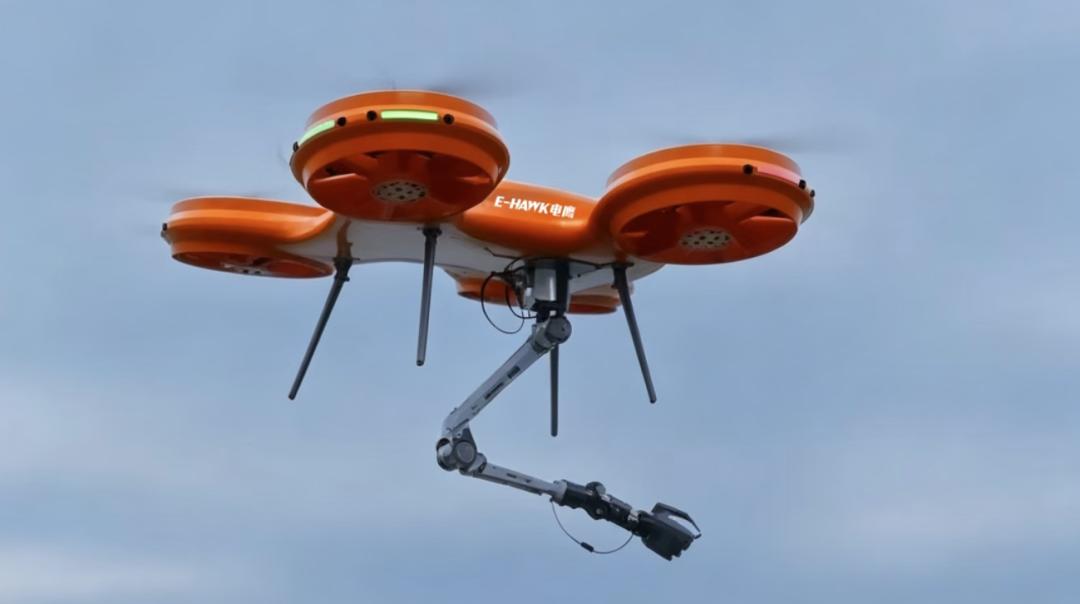
Pros and Cons
The engineering achievements are real and worth describing plainly. The four ducted fans mean the blades are enclosed, which is a prerequisite for flying close to buildings, near people, and inside constrained spaces. A conventional multirotor near a glass facade is an accident waiting to happen; a ducted platform is safe to operate within centimeters of a wall. The folding arm, with interchangeable end-effectors — a clamp, a dexterous hand, a cleaning brush, a squeegee — is the differentiator. The 8 kg payload rating is sufficient for cleaning equipment, small tools, and rescue payloads like oxygen canisters. The top-mounted parachute is a sensible redundancy for a platform operating above occupied streets. And the tethered EHD1000 cleaning variant, which runs a 150-meter composite tether from the ground carrying both power and water, removes the two biggest constraints on a window-cleaning drone: battery runtime and water supply. The first problem is mechanical coupling. Every motion of the arm exerts a reaction force on the airframe. When the arm reaches out and presses a squeegee against a window, the platform wants to drift away. Dianying’s control software compensates in real time, but the result, in demonstration footage we reviewed, is a visible wobble during sustained contact tasks. The company describes this as sub-centimeter precision; the footage shows something closer to centimeter-level wobble on hard contact. For inspection, that is fine. For a streak-free squeegee pass, it is less fine. The second problem is the tether. The EHD1000 cleaning version depends on a 150-meter composite umbilical for power and water. That is a hard ceiling on operational reach: the platform cannot clean above the tether length, cannot operate across a building face without ground repositioning, and cannot ignore wind conditions that would catch the umbilical. The untethered version exists, but its battery endurance is measured in tens of minutes, not the multi-hour shifts window cleaning requires. The product that actually works commercially is the tethered one, and the tethered one is geographically locked.Should You Buy It?
If you are a consumer, the answer is no. The E-EMAV is not for you. If you are a property management company in Dubai, Singapore, Hong Kong, or a similar high-labor-cost market with a portfolio of glass towers, the answer is a qualified maybe. The platform can plausibly reduce rope-access headcount and insurance exposure, but the payback calculation requires an unusually high hourly labor rate and a building geometry compatible with the 150-meter tether. Buyers in that category should pilot the EHD1000 on a single building before committing to a fleet, and budget for the operator, ground power unit, and maintenance that conventional drones do not require. If you are a power utility or a fire department, the case is more speculative. Inspection and rescue payload delivery are real use cases, but the arm’s performance in those scenarios is less proven than in cleaning. The platform’s value in those sectors will depend on regulatory approval for operation over people, which is still being written in most jurisdictions. If you are an investor watching the aerial manipulation category, Dianying is a credible early entrant — arguably the furthest along commercially. But the category’s promise is still a decade away from the autonomy that would make these platforms truly labor-replacing rather than labor-augmenting. The $90,000-per-job payback figure that circulated during the Wuhan expo is a useful reality check. It tells you exactly who this product is for right now: the narrow set of commercial buyers for whom human risk and human cost have already become intolerable. Everyone else is early. The E-EMAV is an impressive machine. It is also one whose marketing has run ahead of its operational reality. The ducted fans, the arm, and the tethered cleaning system are real. The autonomy, the uptime, and the cost case are not yet as settled as the launch materials suggest. For a product that aspires to replace humans hanging from ropes on a glass tower, that gap between aspiration and reality is not a detail. It is the product.Related reading: LeXiang M1 Robot Integrates Tencent OpenClaw AI Agent · AiMOGA Mobo · Liang Zhujin, Co-founder and Technical Lead at SynapX, to Depart