
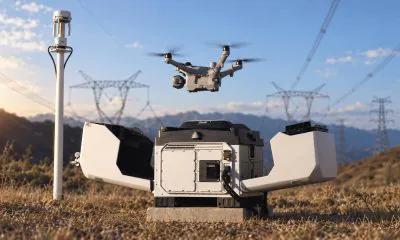
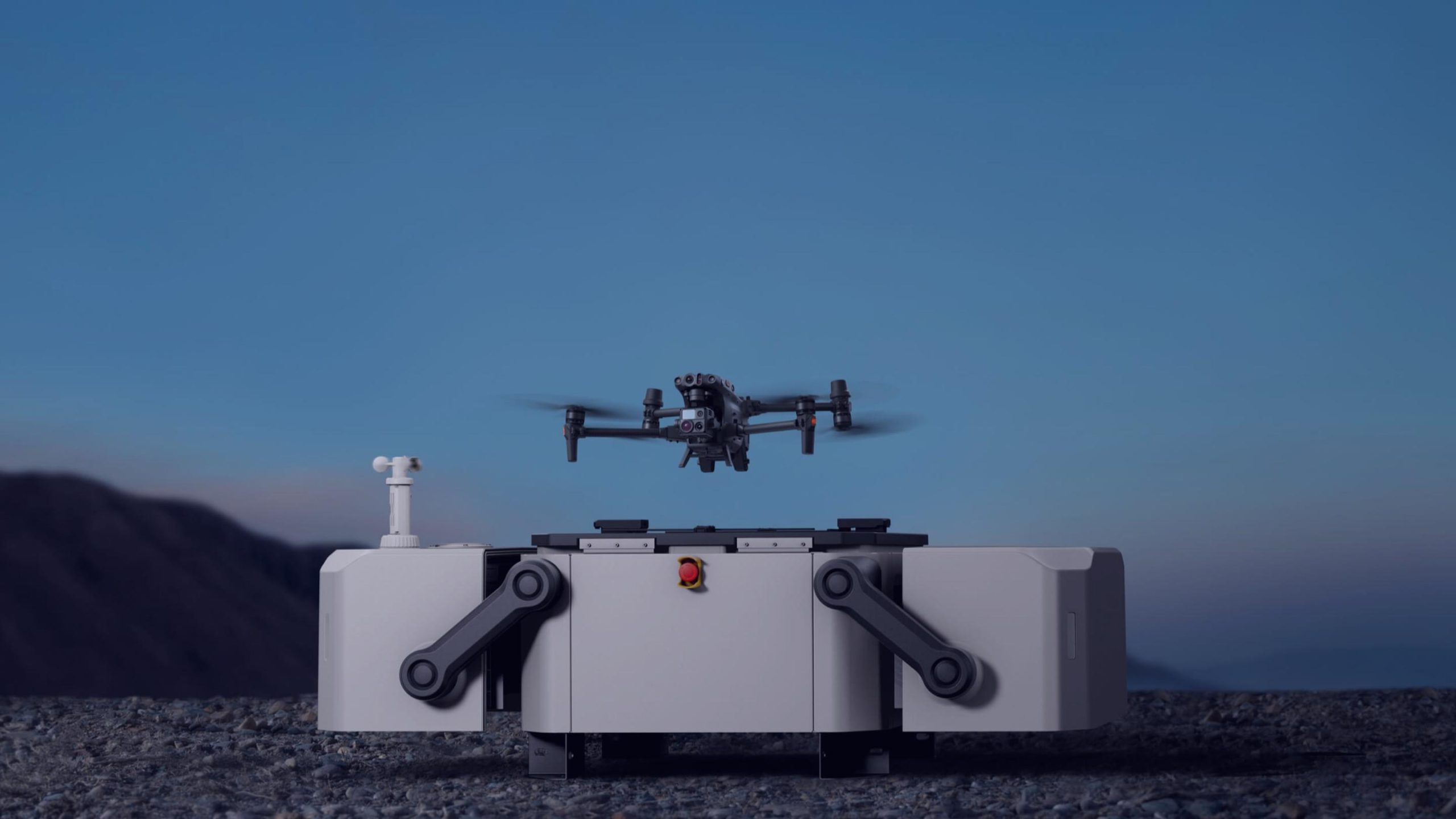
On October 14, 2026, DJI officially launched the DJI Dock 4, its first unattended drone platform built around automatic battery swapping rather than slow on-dock charging. The headline number is seductive: a battery change in roughly 25 seconds, with the aircraft reportedly back in the air within about 45 seconds, versus the ~30-minute charging cycle of its dock predecessors. The launch bundle — Dock 4, a Matrice 5TD drone, an O4 ground station and four batteries — is priced at ¥167,999 (about US$23,600) in China. It is aimed squarely at power-line inspection, emergency response, security patrols and event monitoring.
Market Analysis
The Dock 4 lands in the fast-growing “drone-in-a-box” (DIAB) market, where a self-contained hangar launches, lands, services and remotely operates an aircraft without a pilot on site. DJI’s own framing is telling: it now positions the dock not as a gadget but as low-altitude infrastructure, claiming the Dock family has been deployed in 80+ countries, flown 8 million+ sorties and logged 2 million+ unattended flight hours. That installed base is the real moat.
The positioning is deliberately industrial, not consumer. The Matrice 5TD pairs a telephoto camera, thermal imaging, laser ranging and full-color night vision into one airframe, which DJI says lifts return-on-investment by roughly 50% versus single-purpose aircraft. The 25-second swap is the strategic bet: it converts drones from “one-off dispatch” tools into continuously-on-duty assets for 7×24 operations. That matters for utilities and public safety, where coverage gaps between charges are the main operational headache.
Competitor Analysis
The DIAB space is crowded and maturing, and Dock 4 is not entering an empty room. Airobotics and other automated boxed-station vendors have long offered self-contained hangars, while Skydio exited the early autonomy hype to refocus on defense, and Wingtra/Quantum-Systems push fixed-wing endurance for long linear inspections. European and Chinese rivals — including XAG, Autel Robotics, and a wave of Chinese DIAB startups — increasingly match DJI’s pricing and sensor specs.
Where Dock 4 genuinely differs is speed and ecosystem. Most competitors still rely on wired charging or slower swap mechanisms; 25 seconds is best-in-class on paper. But the flip side is the ecosystem lock-in DJI is famous for. The Dock 4 is tightly coupled to DJI’s FlightHub 2 cloud, its O4 ground station, and its own airframe. Buyers who hoped to slot in a third-party drone or a rival management console will be disappointed — you are buying into DJI’s stack, not an open platform. That is convenient for standardization but painful if you ever want to exit.
Pros and Cons
The genuine pros are easy to list. The 25-second battery swap is a real operational breakthrough and collapses the “coverage blackout” between missions. The temperature range of -40°C to 50°C is industry-leading for unattended hardware. The Matrice 5TD’s claimed 59-minute flight, 11× telephoto that can read license plates at ~400 m and small bolts at ~100 m, and a 1280×1024 thermal camera are serious. Onboard AI detecting 17 target categories, plus two docks alternating for continuous coverage, rounds out a compelling spec sheet.
But the weaknesses deserve the spotlight, because the launch narrative buries them. First, ¥167,999 is hardware-only. DJI explicitly states software subscriptions, deployment outside the standard scope, and service plans all cost extra. The real total cost of ownership over a five-year horizon is materially higher than the sticker price, and prospective buyers who budget against ¥167,999 will be surprised.
Second, the autonomous-safety claims need heavy caveats. DJI says the drone can identify license plates at 400 m and micro-defects at 100 m “under ideal conditions” — but explicitly notes real recognition depends on lighting, angle, atmosphere and the target itself. Thermal “faults” still require human confirmation. This is a powerful inspection aid, not an autonomous fault-diagnosis system, despite the AI marketing.
Third, the swap mechanism is a new, unproven single point of failure. Automated battery swapping is mechanically complex; DJI has shipped docks since 2022, but this specific swapper is brand-new. If the actuator jams, a contact fails, or a swappable battery wears unevenly, “24/7 unattended” becomes a service call in the field. Battery lifecycle under rapid-swap cycling is also unproven, and batteries are consumables you will keep buying.
Fourth, regulatory and physical limits quietly cap the “anywhere, anytime” dream. Wind limits, ADS-B/RID airspace constraints, and the requirement for authorized deployment mean most buyers still need a trained ops team behind the console. This is not set-it-and-forget-it.
Buyer’s Guide / Things to Watch Before You Buy
Before committing, price out the full recurring cost, not the ¥167,999 headline: FlightHub 2 cloud subscription tiers, out-of-scope deployment labor, DJI Care Enterprise coverage, and a multi-year battery replacement budget. Ask DJI for a documented mean-time-between-failure rate on the swap mechanism and a warranty that covers the actuator, since that is the brand-new mechanical heart of the product.
Validate the AI detection claims on your actual target site — not in DJI’s demo footage. Run a pilot project in your real lighting, weather and clutter before fleet expansion. Confirm airspace authorization for your specific sites, and ask whether your existing software can integrate via DJI’s cloud API, or whether you are locking yourself into FlightHub. Finally, watch the resale and exit story: because the Dock 4 only runs Matrice 5TD, a future DJI airframe change could strand your hangars. For well-resourced utilities and public-safety teams this is a strong, forward-looking tool — for anyone expecting cheap, autonomous, no-monthly-bills automation, it is anything but.
Related reading: Xiaomi CyberOne Gen 2 Review · UBTECH U1 Humanoid Robot Review · Unitree Technology IPO