
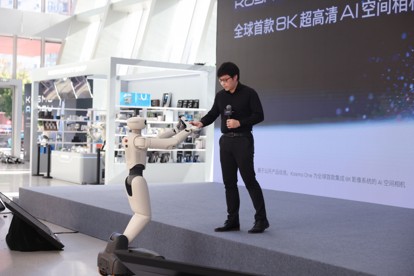
On October 14, Hesai Technology (NASDAQ: HSAI; HKEX: 2525) officially launched Kosmo, a 3D world data engine. Alongside it, the company introduced Kosmo One—the world’s first 8K ultra-high-definition AI spatial camera—and Kosmo World, an AI-driven cloud platform. This marks a significant step in Hesai’s evolution from a LiDAR provider to a core infrastructure player in the realm of Physical AI. At the launch event, Hesai signed strategic partnerships with Galaxy General Robotics and Yuanli Lingji, and showcased major industry use cases developed in collaboration with partners such as Pixar Animation Studios (a Disney company) and Amap (Gaode).
Digitizing the Real World: The Official Launch of Kosmo
The Kosmo One AI spatial camera effortlessly digitizes the real world, while the Kosmo World cloud platform transforms this input into high-quality 3D spatial data. This process not only supplies the “fuel”—real-world data, a scarce resource in the industry—needed for embodied AI and world models, but also enables anyone to authentically capture the 3D world and easily create immersive experiences.
“What Physical AI lacks today is not data in general, but real-world data; this has become the biggest bottleneck for industry development,” said Shaoqing Xiang, Co-founder and CTO of Hesai Technology. “2D images and videos lack depth, pose information, and authentic spatial relationships; purely synthetic data struggles to fully replicate complex physical phenomena like material properties, friction, and deformation; while teleoperation data from actual robots is authentic, it is costly, inefficient, and difficult to scale. High quality, large scale, and low cost have long formed the ‘impossible triangle’ of embodied AI data. Kosmo aims to make high-quality, scalable, real-world 3D data the foundational infrastructure for both Physical AI and content creation.”
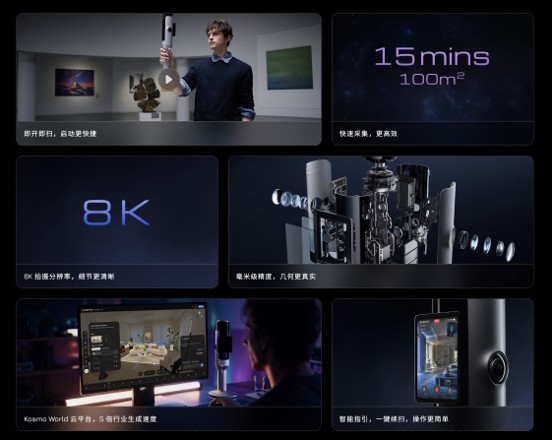
A single Kosmo One unit integrates ultra-high spatial resolution LiDAR, an 8K ultra-high-definition imaging system, a large 1-inch CMOS sensor, and a high-precision IMU. It captures spatial geometry, color, texture, and device pose with microsecond-level synchronization. By combining 3D Gaussian Splatting (3DGS) reconstruction technology with a specialized ISP tuning system, Kosmo One achieves millimeter-level geometric precision and image quality up to 8K (2), faithfully reproducing materials, textures, colors, and lighting.
Regarding ease of use, Kosmo One significantly lowers the professional barrier to entry for spatial data acquisition through industry-first features such as “scan-on-start,” intelligent guidance, and one-touch scan resumption; a 100-square-meter indoor space can be scanned in approximately 15 minutes (3). When processed via the Kosmo World cloud platform, model generation speed is five times faster than the industry average (4).
Embodied AI: Transforming the Real World into Data Understandable by AI
Kosmo World, an all-in-one 3D content creation and management platform, transforms captured data into intelligent spaces that AI can understand, interact with, and train upon. It is powered by Kosmo Spatial Core (KSC), Hesai’s AI-native 3D spatial reconstruction and understanding system. A single KSC reconstruction simultaneously generates 3D data in three formats: 3DGS, mesh, and depth. Native AIGC capabilities ensure spatial completeness—automatically filling in unscanned areas, intelligently reconstructing materials and textures, and seamlessly fusing multi-view information to produce a complete, coherent 3D scene suitable for free-roaming navigation. Leveraging AI-driven 3D semantic segmentation, every object in the scene is independently identified and defined, transforming static 3D models into spatial objects—complete with semantic information and operational attributes—that physical AI can comprehend. Thus, the real world is converted into “sim-ready” data for embodied AI training.
In the realm of embodied AI, these three data formats address three major pain points in robot training: 3DGS provides detailed visual fidelity, solving the issue of “unrealistic visuals”; mesh data accelerates the segmentation and modeling of interactive objects, solving the issue of “unrealistic interactions”; and depth data provides accurate spatial distance information, solving the issue of “spatial inaccuracy.” The three types of data originate from the same scene and are spatially aligned—meaning the world the robot sees, grasps, and measures is one and the same.
Moreover, the data generated by Kosmo can be visually adapted to the specific camera characteristics of the target robot. This allows the robot to train within a world as perceived through its own “eyes,” further narrowing the gap between simulation and reality. This capability set covers the entire workflow of embodied AI training—from pre-training and post-training to evaluation and deployment.
This pathway has already been validated through real-world deployment. Take the application of Sharpa robots at DQ (Dairy Queen) stores, for example: previously, manually modeling a single store required a professional team to invest approximately 300 hours. With Kosmo, scanning and generating a highly faithful 3D training environment takes only about 15 minutes. Consequently, the failure rate for Sharpa robots dropped to one-tenth of its previous level, the task success rate rose to 99%, and the robots were successfully deployed for active duty in real stores.
World Models: Every Act of Imagination Begins with Reality
In the realm of world models, real-world data is an indispensable prerequisite. Whether generating 3D scenes from images or creating video content, the more realistic the generated world, the greater the need for the actual world as a reference. Kosmo provides geometrically precise, 1:1 reconstructions of the real world in 3D. Coupled with accurate camera poses, depth information, and multi-view correspondences, this data serves as the “ground truth coordinates” that enable world models to comprehend physical laws. Furthermore, based on this shared 3D space, tens of thousands of training trajectories can be automatically generated, boosting the acquisition efficiency of high-quality real-world data by more than 100-fold. As companies developing world models race to achieve “more realistic imagination,” real-world data has become the industry’s scarcest infrastructure. Kosmo is poised to serve as the data foundation for these companies, ensuring that every act of imagination is grounded in reality.
Beyond embodied AI and world models, Kosmo’s value is extending into additional sectors, including film and media, cultural tourism and heritage, and commercial spatial applications.
Film and Media: A Revolution in Efficiency and Unlocked Creativity
In the film and media sector, Kosmo is driving an efficiency revolution while simultaneously unlocking unprecedented creative possibilities. Traditional film and television production captures only a fixed perspective; once filming is complete, changing angles or scenes necessitates reshoots. Location scouting often involves dozens of people over several weeks, while set construction takes months. Kosmo is streamlining this cumbersome process: during pre-production, a single person can complete digital scene capture in just one day, potentially reducing scouting costs from approximately 30% of the pre-production budget to 5%, while enabling rapid integration into mainstream production pipelines like Unreal Engine. During filming, the data directly supports LED virtual production and green-screen workflows—creating a 10,000-square-meter European streetscape takes two months to build physically but only one week to scan, reconstruct, and edit, yielding cost savings of up to 80%. In post-production, every element within the scene—down to the last blade of grass—becomes an interactive, editable, production-ready 3D asset; day can turn to night, lighting can be reconfigured, and reshoots can utilize existing assets. Real-world spaces are no longer “one-off” filming content but permanent, reusable 3D digital assets.
Kosmo has been adopted by world-leading film and television companies, including Pixar’s industry-standard renderer, RenderMan—the tool behind the visuals of global blockbusters like Toy Story, The Mandalorian, and Jurassic Park, and a contributor to multiple Academy Awards for Best Visual Effects. By integrating high-quality 3D Gaussian Splatting (3DGS) data generated by Kosmo into the RenderMan pipeline, top artists can, for the first time, apply cinematic-grade stylistic control to real-world data within professional rendering software and freely extract virtually any element from real spaces for use as creative material. Recently, Pixar released an official tutorial making this workflow open to creators worldwide; RenderMan will bring Kosmo-reconstructed real-world environments into top-tier productions, positioning Kosmo as the standard-setter for cinematic-grade 3DGS. AI-Driven Film & TV Industrialization: Partnering for Enhanced Visuals
In the realm of AI-driven film and TV production, Kosmo has partnered with Yuemo Studio—a team recognized by major platforms like Tencent. By utilizing real-world spaces instead of purely AI-generated virtual environments, the collaboration significantly reduces token consumption while enhancing camera movement and visual expressiveness. The creative team extracts authentic, verifiable 3D assets from the real world as the foundation for key shots, then integrates AI for character insertion and rendering. This approach ensures stories retain a sense of authentic texture and human warmth while benefiting from the high efficiency of next-generation production techniques.
Culture, Tourism, and Heritage: Reimagining Millennia-Old Legacies
In the sectors of culture, tourism, and heritage, Kosmo enables the permanent digital preservation of historical and cultural assets. It transforms artifacts and spaces from static archives into digital assets that are remotely accessible, immersive, and open to creative reinterpretation. Kosmo has partnered with TRIC (a UN partner) to create an immersive digital art piece based on Chengdu’s Du Fu Thatched Cottage, allowing the former residence of the legendary “Sage of Poetry”—whose legacy spans a millennium—to be viewed, explored, and reimagined in an entirely new way.
[TRIC-no-logo.mp4]
Spatial Commercialization: From Navigating to a Store to Navigating to a Product
In the field of spatial commercialization, Hesai has entered a strategic partnership with Amap (Gaode). The first batch of 3D-reconstructed venues—including the Chong Art Museum and P-Space Gallery—has launched on Amap’s “Aerial Street View” feature. This marks a shift in location services from 2D maps to 3D spaces, evolving the concept of “navigating to a store” toward “navigating to a specific product.” For merchants, physical store spaces become continuously updatable digital assets, providing data-driven insights for decisions on shelf layouts and product placement for the first time. For consumers, it offers the ability to immerse themselves in a store virtually and decide if it is worth a visit before leaving home. In the future, Kosmo will bring more real-world scenes into Amap—a ubiquitous app with nearly one billion monthly active users—ensuring that 3D spatial data informs every travel and purchasing decision. Hesai’s Physical AI Blueprint
Over the past decade, Hesai has built comprehensive, full-stack capabilities—spanning integrated opto-mechatronic hardware and software design, in-house chip development, and ultra-scale precision manufacturing—centered around LiDAR technology. It has grown into a vital infrastructure provider for the global automotive and robotics industries. Hesai has achieved exponential growth in LiDAR shipments for nine consecutive years and holds the top global market share by a wide margin in both the ADAS passenger vehicle and Robotaxi sectors. As digital AI increasingly extends into the physical realm, Hesai is expanding its capabilities into the broader physical AI market—evolving from a leading global LiDAR company into a premier global provider of physical AI infrastructure.
For physical AI to achieve true large-scale deployment, two critical challenges must be addressed: how machines interact with the real world, and how AI acquires sufficient, high-quality real-world data. To tackle these issues, Hesai is developing two core engines for physical AI: a robotics motion engine and a 3D world data engine. Kosmo represents the first systematic product implementation of this 3D world data engine.
Hesai Co-founder and CEO David Li stated: “While digital AI has already taken off, the infrastructure for physical AI remains to be built—creating new industrial opportunities. For AI to transition from the digital realm to the real world, two types of infrastructure are essential: the ability to perceive the real world through 3D data, and the motion capabilities to drive robotic action. The 3D world data engine and the robotics motion engine represent the most significant opportunities in the industry today; they align perfectly with Hesai’s core capabilities and extensive product development expertise, and will serve as our second engine for growth. Over the past decade, Hesai’s mission was to enable machines to see the world; in the coming decade, our goal is to enable robots to understand and transform it.”
Related reading: Sharpa Fully Autonomous Robot · Xiaomi CyberOne Gen 2 Review · UBTECH U1 Humanoid Robot Review