
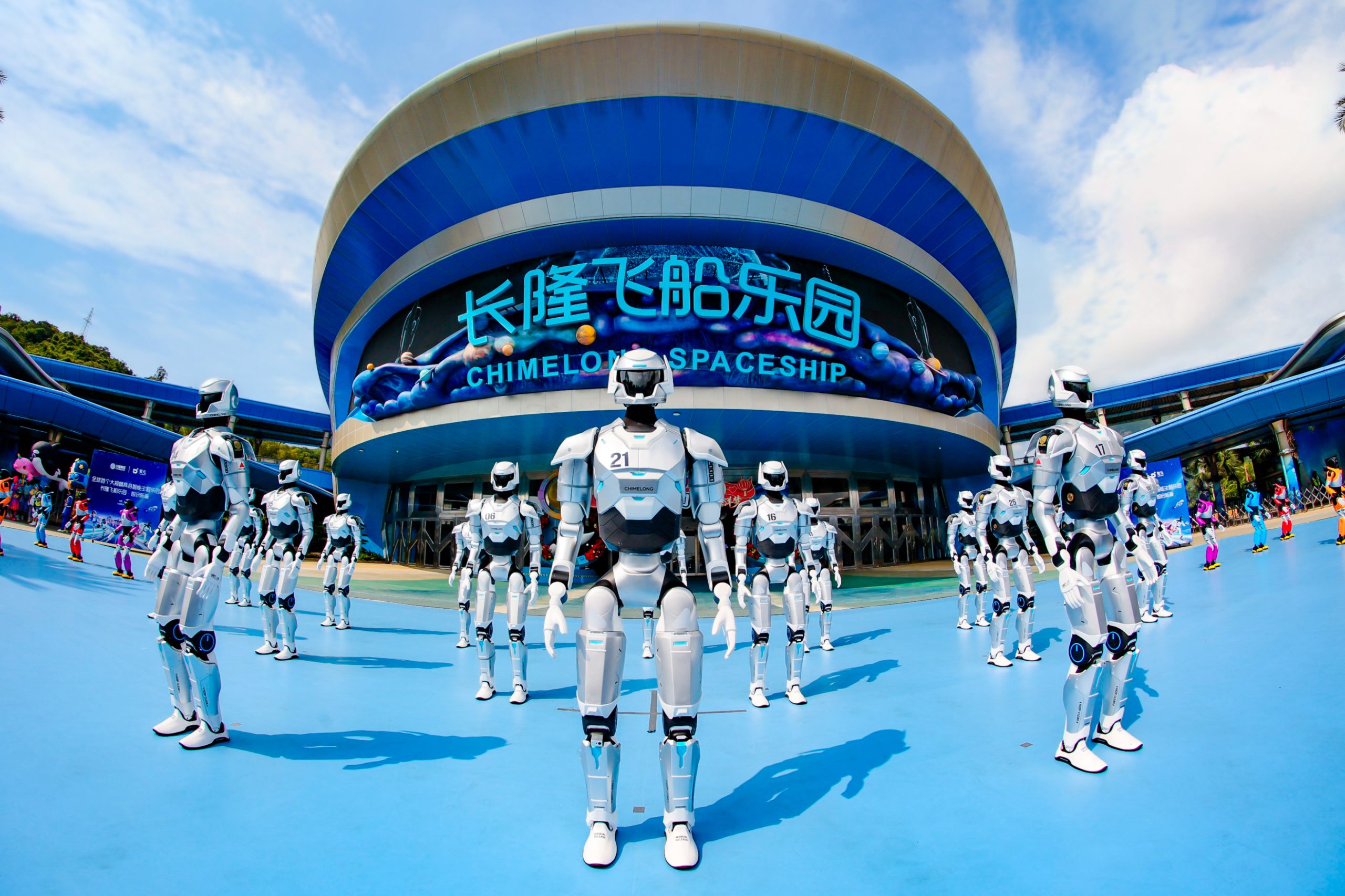
September 24, 2026 — Hengqin, China: The world’s first large-scale embodied AI theme park has celebrated its grand opening. A joint venture between AGIBOT, a leading international embodied AI technology company, and Chimelong Group, a global leader in the cultural tourism industry, the park launched with a spectacular opening performance featuring the world’s largest regular “human-robot collaborative show” and a pioneering aerial acrobatics performance by robots.
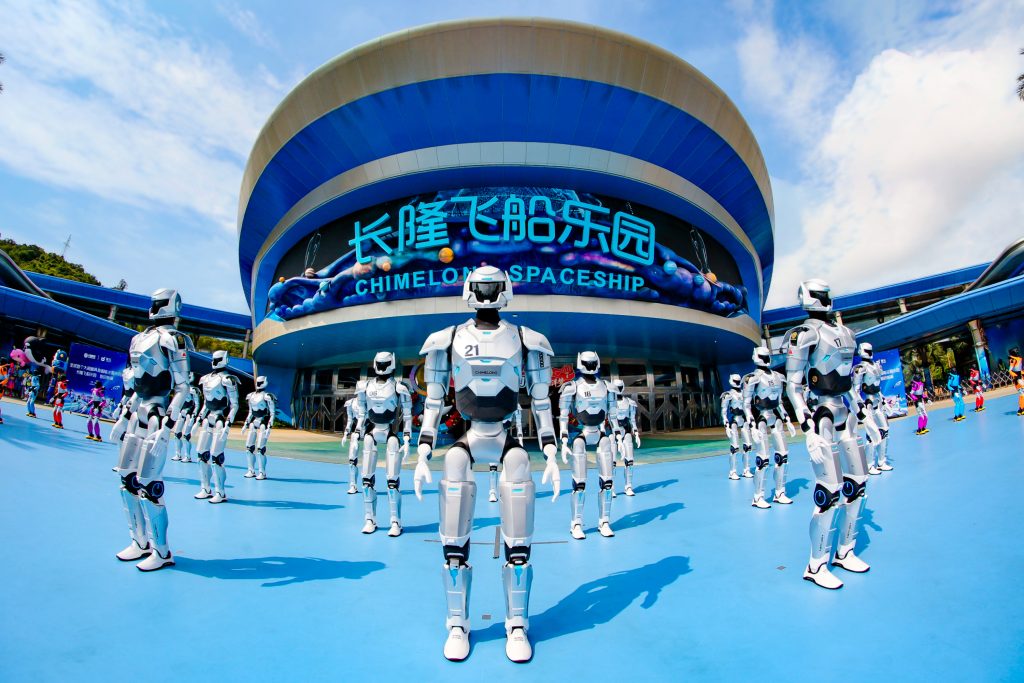
As the world’s first, largest, most technologically advanced, and scenario-diverse embodied AI theme park, it features over 300 robots from AGIBOT’s full product lineup deployed for regular operations at Chimelong Spaceship Park. These robots operate across seven core scenarios—including entertainment performances, educational tours, guidance and shopping assistance, retail service stations, intelligent companionship, hotel services, and sports competitions—thereby transforming embodied AI from a technical capability into scalable service productivity.
2026 marks the inaugural year for the large-scale deployment of embodied AI. At the opening ceremony, AGIBOT officially delivered its 20,000th embodied AI robot, the A3 Ultra, to Chimelong Group, and the “Chimelong × AGIBOT Joint Research Institute for Embodied AI in Cultural Tourism” was formally inaugurated. Additionally, the “World’s First Large-Scale 5G-A Embodied AI Innovation Application in Cultural Tourism”—co-developed by AGIBOT, Chimelong Group, and China Mobile—was officially released, leveraging network infrastructure to empower the large-scale implementation of embodied AI. Deng Taihua, Founder, Chairman of the Board, and CEO of Agibot, stated: “Today marks the historic opening of the world’s first large-scale theme park dedicated to embodied AI—a perfect synergy between embodied AI technology and premier cultural tourism. Last month, Agibot and Chimelong launched a strategic partnership; the intensive one-month delivery process fully demonstrated ‘Chimelong Efficiency’ and ‘Agibot Speed,’ as well as the teams’ shared spirit of excellence and pragmatic dedication, together establishing an industry milestone for innovation in tech-integrated tourism. The opening is merely the starting point for innovation; we will continue our joint efforts, deepen our decade-long strategic partnership, and constantly set new industry records. Through deployments across more scenarios and the creation of richer content, we aim to continually elevate the visitor experience and pioneer the exploration of a future world defined by human-machine symbiosis.”
Dong Guixin, Senior Vice President and Chief Scientist of Chimelong Group, noted that Agibot’s 20,000th general-purpose embodied robot has officially arrived at Chimelong as a special “new employee” of the resort. This achievement reflects Agibot’s world-leading technological prowess and serves as a significant milestone in the integration of Chinese technology and cultural tourism. “Moving forward, leveraging the jointly established ‘Chimelong × Agibot Joint Research Institute for Embodied AI in Cultural Tourism,’ we will explore a new paradigm for the integrated development of technology and tourism. We aim to set a benchmark for the large-scale commercial application of embodied AI in China and offer a ‘Chinese solution’ for global innovation in the cultural tourism sector.”
Comprehensive Deployment Across Seven Core Cultural Tourism Scenarios
Chimelong Spaceship, the world’s largest indoor theme park, centers on immersive space exploration and marine ecological education, having welcomed over ten million visitors since its opening. Its diverse range of settings and massive visitor traffic make it an ideal environment for robots to enter the real world and achieve large-scale application.
In the newly revitalized Spaceship park, robots are now ubiquitous, serving as new companions that interact with, accompany, and assist visitors. More than 300 robots engage deeply with guests on a regular basis at over 100 interactive points, covering seven core cultural tourism scenarios. Guided tour robots leverage scene mapping and natural language understanding to provide visitors with services such as destination inquiries, route planning, autonomous escorting, and roving commentary. Science education robots utilize visual perception, speech understanding, and multimodal interaction capabilities to facilitate Q&A sessions, game challenges, and engaging presentations centered on marine knowledge. In retail and hospitality settings, robots proactively sense visitor needs, offering services like welcoming, product consultation, interactive entertainment, and information inquiries. With multilingual and dialect capabilities, these robots adapt to diverse communication needs, enabling interactive services to transcend linguistic and geographical boundaries.
Robots from Agibot—specifically the “Champion Edition” models that recently topped both the gold medal and total medal counts at the 2nd World Humanoid Robot Games—have gathered at the park to showcase their “gold-winning” capabilities on a regular basis. Visitors can interact with the robots up close, experiencing firsthand the myriad possibilities of humanoid robots entering daily life as a productive service force.
How do human-robot interactions within the park achieve such fluidity and naturalness? Powered by Agibot’s proprietary “WITA” large model (Silicon-Optic Dynamic Language Model), the robots integrate the model’s comprehension and generative capabilities with visual perception, voice interaction, and motion execution. This allows them to sense the environment, understand visitor intent, and carry out interactions and services. Moving beyond simple “listen-and-respond” loops, WITA enables robots to comprehend the people and events within real-world scenarios, resulting in smoother interactions and more natural service delivery.
Building on this foundation and leveraging the AIMA full-stack embodied AI ecosystem, Agibot’s unique “LinkSoul” platform allows for the customization of robots across five dimensions: voice, facial expressions, persona, movements, and attire. This gives each robot a unique voice, vivid expressions, and a distinct personality. Combined with WITA’s interactive capabilities, the robots can weave Chimelong’s IP characteristics into greetings, educational commentary, and interactive responses. By aligning character personas with both appearance and behavior, they deliver distinct and natural character expressions across various settings.
When technology truly acquires a personality, the robot ceases to be merely a service executor; it becomes a park companion with whom visitors are eager to engage and interact. 20,000th Embodied Robot Delivered to Chimelong
Mass production capability is a cornerstone for embodied AI to transition from the laboratory to industrial application.
Agibot has previously delivered its 15,000th robot to Longcheer’s production line, serving industrial manufacturing environments and providing labor productivity. In contrast, the delivery of the 20,000th unit—the Expedition A3 Ultra—to the Chimelong Group marks its entry into the cultural tourism and commercial sector, focusing on delivering service productivity.
The leap from 15,000 to 20,000 units in mass production signifies the simultaneous validation of Agibot’s capabilities in both labor and service productivity. It further confirms the versatility and replicability of its industrial roadmap: “mass production at the scale of tens of thousands of units combined with routine deployment.”
In just over three years since its inception, Agibot has grown into the world’s leading embodied AI enterprise in terms of shipment volume, revenue scale, and growth rate. Driven by industry-leading R&D investment, the company has continuously solidified its technological edge, laying a robust foundation for large-scale deployments across diverse scenarios. Leveraging its “Three-Intelligences-in-One” full-stack architecture, Agibot’s products combine a stable, reliable hardware body with three core forms of intelligence: motion, interaction, and task execution.
“Motion intelligence” serves as the foundational capability, acting as the driver for the embodied AI’s physical platform. The other two advanced forms—”interaction intelligence” and “task intelligence”—correspond to distinct types of productivity: interaction intelligence acts as a gateway for emotional engagement, enabling robots to deliver service productivity across various interactive settings within the theme park; task intelligence serves as the engine for labor value, allowing robots to perform productive work across multiple operational scenarios in the park. The “One” refers to the hardware body—stable, reliable, cost-effective, and offering high performance potential—which serves as the physical carrier for the embodied AI. The “Three Intelligences” are deeply coupled with the hardware body and evolve in synergy.
The combination of proprietary full-stack technology and a meticulous mass-production quality control system has endowed Agibot with core capabilities: large-scale mass production, highly consistent delivery, and stable, long-term deployment. It is precisely this robust capability that ensures the robots can operate continuously, reliably, and routinely amidst massive visitor traffic (numbering in the hundreds of thousands). Furthermore, it provides the solid technical and quality assurance needed for large-scale deployment across diverse scenarios and the efficient operation of the data flywheel. On a global scale, many theme parks feature only sporadic robot displays—mostly limited to short-term shows or pilot trials—falling short of achieving full-scale, continuous, day-to-day operations. The Chimelong Spaceship park in Hengqin has shattered these industry limitations by pioneering three global firsts:
Given the park’s complex architecture, diverse ecosystems, and massive daily visitor volume, the world’s first large-scale 5G-A embodied AI application in a cultural tourism setting establishes the network infrastructure necessary for the routine operation of a vast robot fleet. The solution employs an architecture combining “5G network slicing,” “local edge device deployment,” and “security isolation.” It creates two distinct logical networks—a dedicated 5G LAN for robots and a controlled 5G internet connection—physically separating visitor traffic from robot operations. This setup ensures ultra-low end-to-end latency, enabling “instantaneous response” for multimodal interactions and “massive synchronization” for swarm control.
Furthermore, the park has launched the world’s first one-stop management platform for the operation and maintenance of embodied AI in a cultural tourism attraction, transitioning robot services from mere “deployment” to “sustainable long-term operation.” Additionally, a comprehensive safety solution—the first of its kind for routine embodied AI deployment in this sector—covers six critical dimensions: spatial safety, personal safety, charging and fire safety, AI integrity, data security, and operational safety. This framework ensures a secure environment for the frequent, close-range human-robot interactions taking place within the park.
These three technical solutions work in tandem to propel large-scale robot deployment beyond the initial “implementation” phase toward “stable, continuous operation.” Their replicability offers invaluable experience and technical insights for the broader journey of embodied AI deployment.