
Industry context
Few demographic forces will shape the next decade of hardware as decisively as population aging, and Japan is where that future arrives first. With a rapidly shrinking working-age population and a large, active elderly cohort, the country has become a test bed for machines that help people walk farther and hold on to independence longer. Medical exoskeletons—once confined to rehabilitation clinics—are migrating toward lighter, consumer-priced devices aimed at “active aging”: not the infirm, but people who simply want fewer rest stops on the stairs.
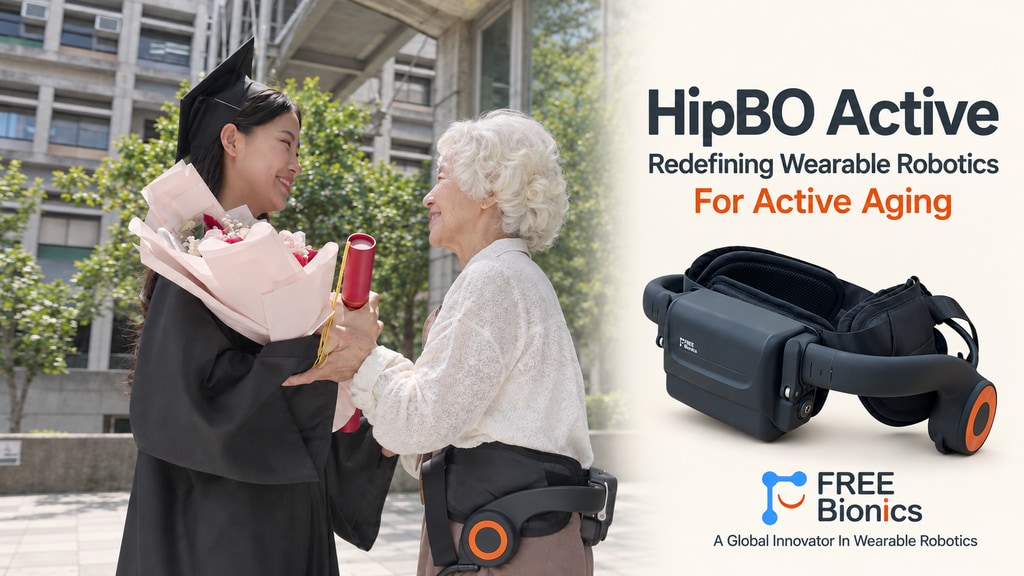
HipBO Active is the latest attempt at that migration. It comes from FREE Bionics Japan Inc, a Tokyo-based company that, since 2016, has built medical exoskeletons used in hospitals and rehabilitation centers across more than twenty-five countries. HipBO is its consumer-facing wager: a light wearable for the hips that gives a gentle lift with every step, priced to reach ordinary older adults rather than clinics.
Competitive landscape
The wearable-exoskeleton field splits between clinical and consumer products. On the clinical side, Cyberdyne’s HAL and Panasonic’s rebornyg-style systems dominate hospital rehab, carrying medical-grade pricing and heft. On the consumer side, SuitX and a handful of startups offer lighter hip and back supports, but most are either simple passive braces or motorized devices that still feel like rehabilitation equipment.
HipBO’s differentiator is its medical pedigree applied to a consumer form factor. Unlike the therapy devices, it needs no app, no phone pairing, and no clinician setup—you put it on, press start, and walk. That positions it between a passive brace and a full rehab exoskeleton, competing on ease of use and the credibility of a team whose machines already sit in hospitals. The ISO 13485 quality certification the company cites is a signal that it is thinking about regulatory seriousness, not just crowdfunding sizzle.
Design and hardware specs
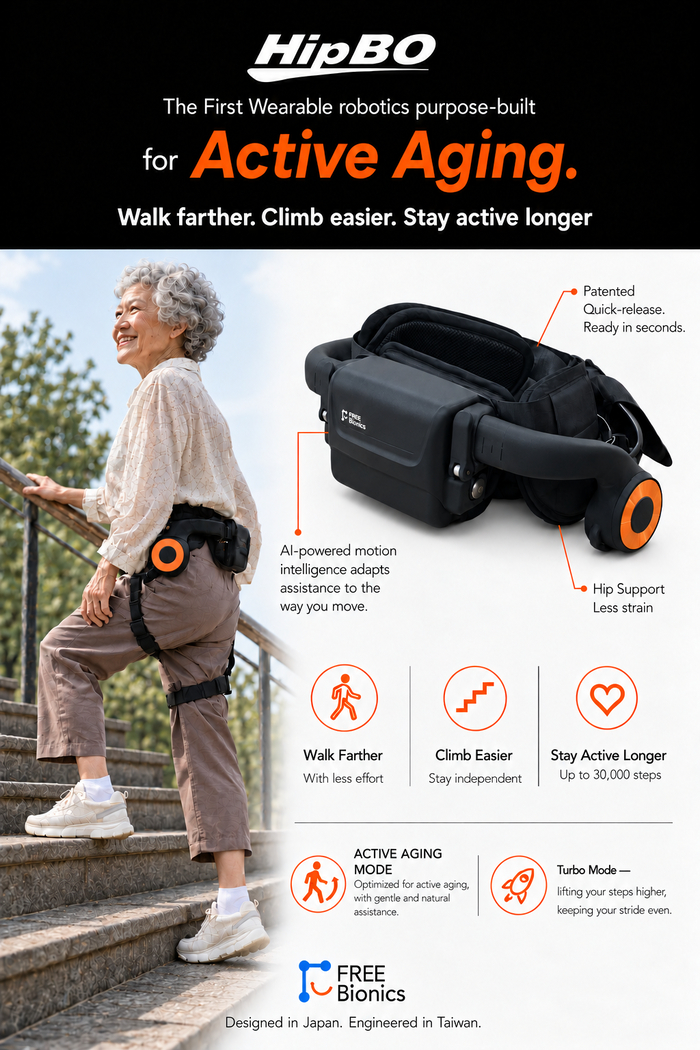
HipBO Active is a waist-worn unit that supports the hips and thighs during walking and stair climbing. The company’s headline internal-testing claims are striking: up to 45% more walking distance and two fewer rest stops on stairs. Crucially, it is designed to be donned independently, with no smartphone or companion app required—an explicit choice to avoid the complexity that frustrates older users.
The hardware is the product of a medical exoskeleton team, and the company emphasizes that its quality system is ISO 13485 certified. The device is pitched as “designed for everyone, optimized for active aging,” with a dedicated Active Aging mode tuned to older adults’ everyday walking rhythm. Shipments are promised in early 2027. The exact weight, battery life, peak assist torque, and waterproofing are not detailed on the teaser page—gaps that matter for a wearable medical-adjacent product.
Core AI features
AI is a core, not cosmetic, part of HipBO’s movement support. Rather than delivering a fixed assist pattern, the system analyzes movement data in real time, reads changes in the user’s walking rhythm, and adjusts the assistance accordingly. The pitch is adaptive control: the device responds to each step rather than running a pre-set program, which should make the support feel natural rather than mechanical.
This on-board adaptation is what separates HipBO from a passive brace. By continuously interpreting gait, the exoskeleton aims to deliver timely support that works with the wearer’s momentum—more help on an incline or a stair, less on flat ground. The company also cites real-world trials across Japan, Singapore, and Taiwan, where more than eighty people tried the device at a single event and over a quarter ordered on the spot, suggesting the experience resonates beyond the lab.
Pros and cons
The case for HipBO is stronger than for a typical crowdfunding gadget. The team brings a decade of medical-exoskeleton experience and a deployment footprint in hospitals across twenty-five-plus countries—an unusual credential for a Kickstarter hardware launch. The decision to skip the phone and app entirely is the right product call for an older audience, and independent donning lowers the barrier to daily use. The real-time, AI-driven adaptive gait control is a credible technical approach, and the ISO 13485 certification signals manufacturing seriousness. The early-bird price, at a quoted US$1,290 for the first forty-eight hours, undercuts clinical exoskeletons by a wide margin.
The caveats are nonetheless substantial. The headline performance claims—45% more distance, two fewer stair stops—come from the company’s own internal testing, not an independent clinical trial, and individual results will vary widely. The price, even at the early-bird discount, is a four-figure impulse purchase for a device whose real-world benefits are not yet independently verified. Although the campaign is marketed around this launch window, the page states a go-live of October 28, meaning backers are committing before any independent review. Key wearable specs—weight, battery life, torque, durability—are undisclosed, and shipping is not promised until early 2027. Buyers should also weigh whether the “active aging” pitch applies to them, or whether they need a clinically indicated device instead.
Target users
HipBO is aimed at active older adults who want to walk farther, climb stairs with fewer rests, and preserve the independence of running everyday errands. It may also appeal to adult children buying a meaningful mobility gift for a parent, and to users in walkable cities who want a little assistance without entering the rehab-medicine system.
Who should buy
Consider it if you are an active older adult—or are buying for one—who wants genuine walking assistance at a consumer price and is comfortable with the campaign timeline. The medical team behind it makes this a more credible bet than most crowdfunded hardware. But wait for the early-bird window, look for independent reviews after units ship in 2027, and do not substitute it for a medically prescribed device if you have a diagnosed condition.
Pricing and availability
HipBO Active launches on Kickstarter on October 28 at 3:00 PM Japan time. The Super Early Bird price is US$1,290 for the first forty-eight hours, limited to a set number of units, with up to 44% off standard pricing. Backers who click “notify me on launch” are emailed when the campaign goes live. Shipping is scheduled for early 2027. All performance figures are from the company’s internal testing and should be treated as preliminary until independently validated.