
In the current era of rapid AI hardware innovation, AI earbuds have become the latest battleground for fierce competition. Plaud—a dark horse in the AI recording sector that rose to fame with the Plaud Note recording card and Plaud NotePin clip-on recorder—has recently launched its first pair of AI earbuds: the Plaud One. Priced at $249.99 (approximately 1,800 RMB), is this “AI earbud” merely a gimmick or a genuine productivity powerhouse? After putting the Plaud One through its paces, this review reveals the reality behind the device.
I. Design and Hardware: Semi-In-Ear Fit and an “Independent Brain” Charging Case
The Plaud One features an AirPods-style semi-in-ear design. Weighing just 4.5 grams per earbud, they offer a lightweight fit that minimizes pressure during extended use, making them ideal for commuting and daily office work. The earbuds are equipped with 12mm dynamic drivers, support the LDAC codec, and offer up to 40dB of adaptive active noise cancellation (ANC); the audio quality is solid and reliable, easily meeting the needs for daily music listening and calls.
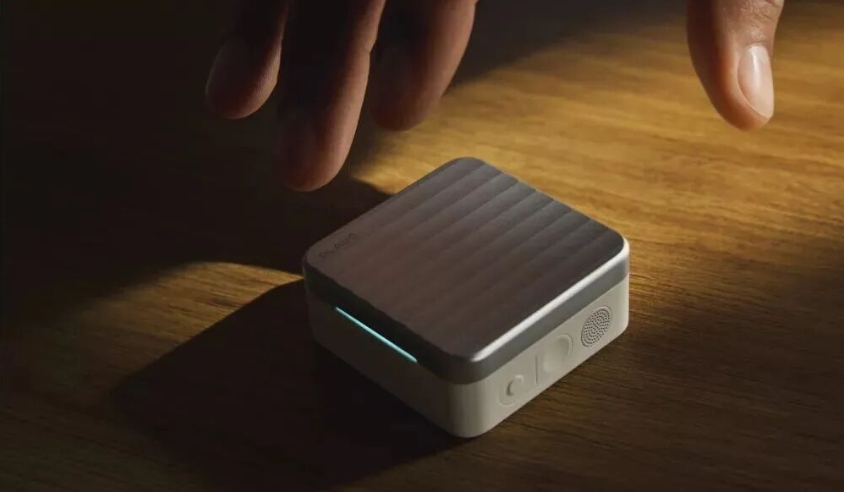
However, the true “soul” of the Plaud One lies in its charging case. The case features a compact, square design and houses four MEMS microphones (supporting 5-meter far-field pickup), a built-in speaker, 512MB of local storage, and a 4G LTE eSIM module. This means the case is not merely a charger but an independent “recording hub” and “AI interaction terminal” capable of functioning without a smartphone—a feature that sets it apart from similar AI earbuds.
II. Core Experience: From “Recording” to “AI Execution”
The core value of the Plaud One lies in its capabilities as an “AI assistant,” rather than simply serving as headphones for listening to music.
- All-Scenario Recording and Independent Audio Capture
The earbuds themselves support recording for phone calls, online meetings, and face-to-face conversations (2-meter pickup range), while the charging case supports desktop far-field recording (5-meter pickup range). Without needing a smartphone or an internet connection, the charging case can record audio independently and cache it locally for later upload. This perfectly addresses pain points like a dead phone battery or the inconvenience of taking out one’s phone, making it ideal for scenarios such as in-person meetings and café interviews. - AI Transcription and Long-Term Memory
Once recording ends, the audio syncs to the Plaud Intelligence platform, supporting real-time transcription in 112 languages, speaker diarization, and intelligent summarization. A standout feature is its “long-term memory” capability, which links context across meetings and enables precise cross-temporal retrieval—overcoming the limitation of traditional voice recorders that treat each meeting as an isolated event. - AI Agent and Workflow Integration (Key Highlight)
This is where Plaud One truly distinguishes itself from traditional voice recorders. By using the “Agent button” on the charging case or a voice wake-up command, the AI can leverage conversation context to directly interact with third-party tools like Gmail, Google Calendar, Notion, and Slack. This enables automated actions such as drafting follow-up emails, generating meeting minutes, and scheduling calendar events. It moves beyond simple “recording + transcription” to “recording + understanding + execution,” effectively integrating AI capabilities into actual workflows.
III. Software and Ecosystem: Companion App and Subscription Model
Plaud One comes with the Plaud App, offering intuitive recording management, transcription viewing, and AI task configuration. The device includes a monthly allowance of 300 minutes of free transcription; usage beyond this requires a subscription costing $8.33 per month (billed annually). Additionally, early buyers receive $200 worth of Plaud credits to redeem for AI tasks, helping to offset initial usage costs.
IV. Battery Life and Connectivity: The Trade-off of Standalone Connectivity
Plaud One’s battery performance varies significantly based on usage scenarios: the device itself offers about 6 hours of continuous recording, while the charging case provides approximately 25 hours of standalone recording. The total combined battery life is around 36 hours, and it supports fast charging (a 10-minute charge provides 2 hours of use). The charging case’s 4G eSIM capability enables standalone connectivity; however, the 4G module consumes significant power during continuous audio uploading or AI task execution. Consequently, battery life is reduced under heavy usage (simultaneous recording and AI interaction), so users should plan their usage scenarios accordingly.
V. Conclusion: Who is it for? Is it worth buying?
The Plaud One is not a perfect “all-rounder”; while its sound quality and noise cancellation place it in the top tier of TWS earbuds, they do not quite reach the absolute pinnacle. Its core value lies in the integration of hardware and software—combining AI, recording, and standalone connectivity—making it ideal for professionals with meeting-heavy schedules (such as salespeople, consultants, journalists, and designers) and users who rely heavily on AI-driven workflows.
If you need an AI assistant that can take notes, draft emails, and generate summaries for you—and if you frequently encounter recording scenarios where you are away from your phone—the Plaud One offers a significant boost in efficiency. However, if your priority is simply ultimate sound quality or noise cancellation, or if you have little need for standalone connectivity and on-device AI execution, a standard pair of TWS earbuds paired with a recording app might offer better value for money.
The Plaud One represents a successful attempt to evolve AI hardware toward greater autonomy and task execution capabilities. Through incremental hardware innovation, it redefines the boundaries of what “earbuds” can be, opening up imaginative new possibilities for AI application.