
As Embodied AI transitions from the laboratory to the mainstream, high hardware costs often deter many enthusiasts. However, the Microduck bipedal robot—which has recently gone viral in the open-source community—has successfully broken this barrier with its accessible $399 price tag and compact 25cm frame. Is this mechanical duck—capable of walking, kicking a ball, and standing up on its own—merely a gimmick, or is it a genuine “AI toy”? This article presents an in-depth review of the Microduck.
I. Design and Hardware: Small but Fully Featured
Jointly developed by Hugging Face and the French robotics company Pollen Robotics, the Microduck stands just 25cm tall and weighs 800g. Comparable in size to a standard thermos, it fits comfortably in the palm of your hand.
In terms of hardware, the Microduck employs a minimalist yet practical design. It is powered by a Rockchip RK3566 main processor (featuring 0.8 TOPS of NPU computing power) and equipped with 1GB of RAM and 32GB of storage, ensuring smooth on-device AI inference. The robot features 15 servo motors distributed across its legs, neck, and head; its beak serves as an independent gripper actuator capable of grasping lightweight objects. For perception, it is equipped with a wide-angle camera, an 8×8 ToF depth sensor, dual IMUs (located in the body and head), and a microphone/speaker setup, enabling comprehensive environmental awareness and precise balance control.
II. Movement Performance: Agility Powered by Reinforcement Learning
The Microduck does not execute movements via traditional “hard-coding.” Instead, it relies entirely on neural network policies trained through reinforcement learning (RL), achieving a seamless “Sim2Real” (simulation-to-reality) transfer. 1. Basic Movements: Fluid and Natural
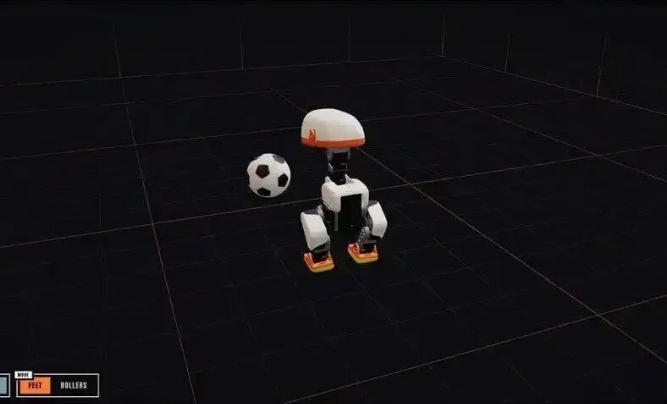
The robot comes pre-installed with seven trained motion strategies, including walking (featuring a signature swaying gait), sitting and standing, kicking, bending down to pick up objects, self-righting after a fall, and roller-skating (when equipped with roller-skate accessories). The transitions between movements are seamless; the self-righting capability, in particular, demonstrates excellent dynamic balance—allowing the robot to quickly “flip” back up even after being pushed over, achieving a high level of execution precision.
- Motion Switching: Seamless Transitions
Thanks to a shared 61-dimensional observation space, Microduck’s various motion strategies support “hot-switching.” For instance, if the robot detects a fall while walking, it can instantly switch to the self-righting strategy and then revert to walking once recovered—all without needing a system restart, ensuring a smooth user experience.
III. Software and Ecosystem: A “Full-Stack” Experience for Geeks
Microduck’s appeal lies not only in its hardware but also in its fully open-source “full-stack” software ecosystem, offering immense versatility for developers and enthusiasts.
- Minimalist Runtime Architecture
The robot’s underlying system is written in Rust and utilizes a seven-daemon architecture, communicating via Unix Sockets. At its core, therobotdprocess runs the control loop at 50Hz, handling motor driving and strategy inference. It also incorporates a rigorous safety layer to prevent invalid commands from damaging the hardware, ensuring safe debugging. - Comprehensive RL Training Pipeline
The project provides a complete Microduck-RL training environment (based on the MuJoCo physics engine) that supports large-scale parallel training in simulation; trained ONNX models can be deployed to the physical robot with a single click. This “simulation-to-reality” closed-loop workflow enables developers to easily fine-tune strategies and iterate on algorithms, truly bringing AI from the screen into the real world. - Active Community and Open-Source Spirit
The project is released under the Apache-2.0 license, with all code, pre-trained models, and simulation environments made open-source. An active community provides developers with abundant resources for learning and project replication. IV. Experience and Summary: An “AI Experimental Platform” with Exceptional Value
Microduck is not an “all-rounder” robot in the traditional sense; it cannot replace industrial robots for complex labor, nor can it be compared to professional-grade robots costing tens of thousands of dollars. Its core value lies in its exceptional cost-performance ratio and immense playability.
For the average enthusiast, Microduck is a desktop “AI pet” with significant emotional appeal; its $399 entry price makes it an excellent gateway to experiencing embodied AI. For developers, university students, and AI researchers, Microduck serves as an outstanding “AI experimental platform”; its complete Sim2Real pipeline and open-source code significantly lower the barriers to learning and R&D in the field of embodied AI.
Conclusion:
With its “little duck” design, Microduck demonstrates that embodied AI does not necessarily entail exorbitant costs or massive physical dimensions. Through the seamless integration of hardware and software, it perfectly fuses the AI ”brain” with a physical “body,” allowing everyone to experience the “liveliness” of AI right on their desktop. If you are looking for an AI robot that offers both hands-on fun and educational value—one that is entertaining to watch yet capable of serious experimentation—Microduck is definitely worth acquiring.