
Faraday Future — the EV maker that has spent a decade perfecting the art of the dramatic pivot — announced this week that its robotics arm, FF EAI, has launched a humanoid robot line headlined by the FF Nova at under $2,500, with an education-focused Nova Mini at $299. The company will formally present both at its Nasdaq listing ceremony and first Investor Day on October 26 at the Nasdaq Tower in New York. After the announcement, the question is not whether the price is remarkable — it is — but whether anyone should believe it.
The Price Is the Product
To be blunt about context: Unitree sells capable humanoids from around $16,000; Chinese full-size industrial units run into six figures; Boston Dynamics doesn’t publish prices because the answer would end the conversation. At under $2,500, FF Nova is not competing on capability. It is competing on the hypothesis that an enormous population of students, researchers, hobbyists and small businesses has been waiting for a humanoid at hobby-servo prices.
The historical analogy is instructive. 3D printers were lab equipment until a generation of cheap kits made experimentation affordable, and the entire additive-manufacturing industry grew out of that price collapse. Drone platforms followed the same curve. Bipedal humanoids have never had that moment. If FF Nova is real at this price, it is the industry’s RepRap moment — the point at which the number of people who can experiment with embodied AI grows by two or three orders of magnitude.
What the Hardware Looks Like
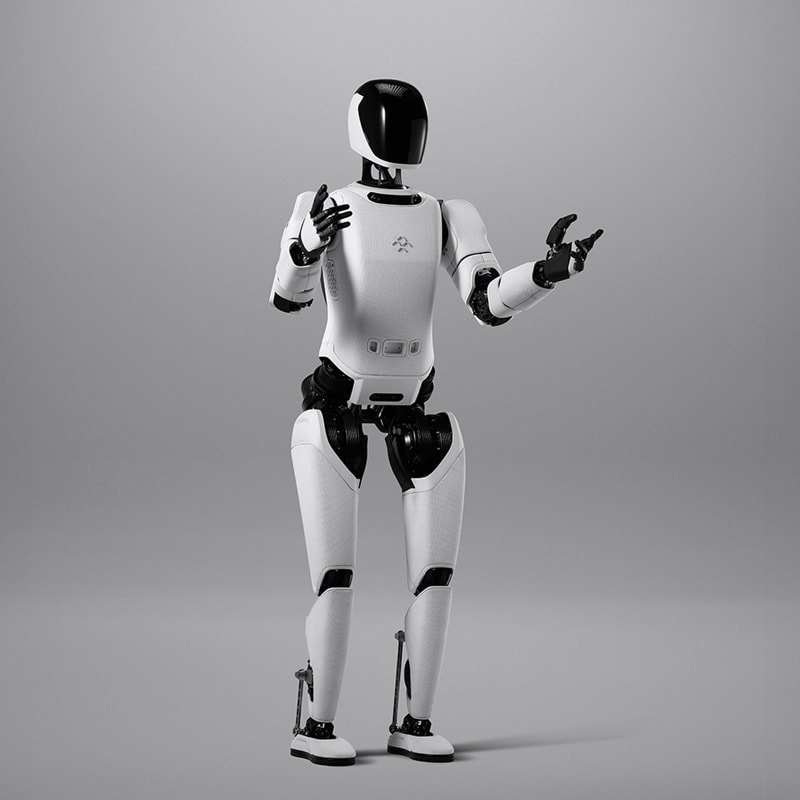
Published materials show a compact full-body humanoid with a dark visor head, five-finger hands and articulated legs — clearly aimed at human-interaction and education demonstrations rather than heavy payload work. The design language is clean and industrial, closer to a consumer product than a research platform, which aligns with the price positioning. Faraday Future has not yet published full actuator specifications, payload capacity, degrees of freedom, battery life or runtime, which is exactly the kind of omission that matters when the price is the entire pitch.
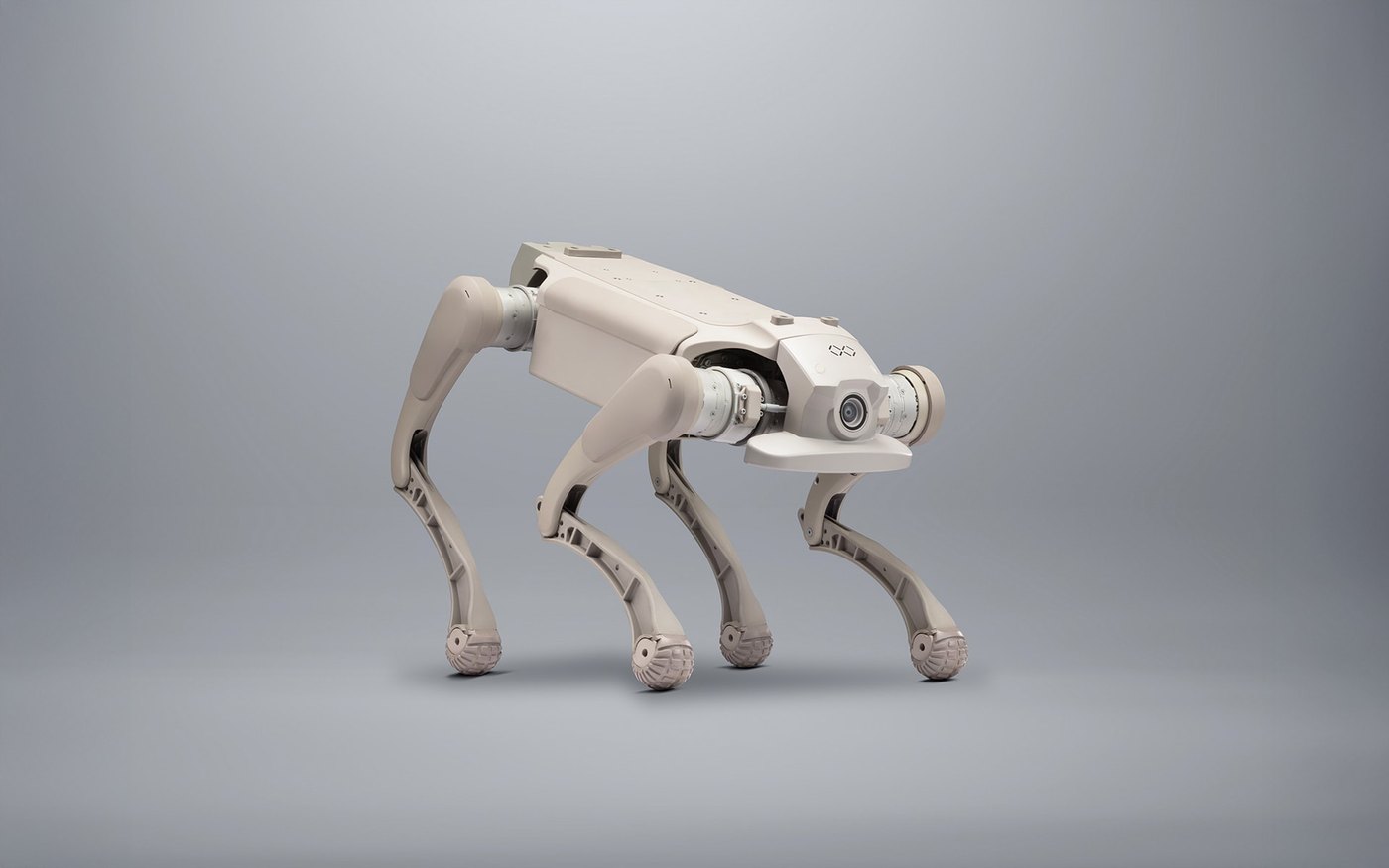
The companion quadruped shown at the same event shares the AI stack, and Faraday Future is framing the pair as an “AI ecosystem” — the same pitch Xiaomi, AgiBot and Unitree have each attempted, where a common software layer spans multiple robot bodies. That is a sensible architecture if you have the software to back it, and a marketing slide if you don’t.
The Skeptic’s Ledger
Fair questions abound, and they are not unfair to ask. Faraday Future’s automotive record includes missed deadlines, capital shortfalls and a very long road from concept to delivery — the FF 91 has sold in tiny volumes despite years of promotion. The Nova’s under-$2,500 price is “starting at,” and robotics has a rich history of entry prices that correspond to configurations no customer actually receives. The Nasdaq listing on October 26 is itself a capital event, and product announcements timed to listings deserve proportionally more scrutiny.
None of this proves the Nova won’t ship. It does mean the burden of proof sits with the company. The October 26 event will be the first test of whether specifications and delivery dates survive daylight, and the second test will be whether independent units reach reviewers — not company videographers — within a stated window.
There is also a technical question worth flagging. A humanoid at under $2,500 implies aggressive choices somewhere: fewer degrees of freedom, cheaper actuators with shorter service life, a plastic rather than metal frame, or a dependency on cloud inference rather than on-board compute. Any of those is an acceptable trade for an education product and an unacceptable one for a workplace robot. Buyers need to know which trade was made, and the specification sheet so far does not say.
Why It Still Matters
Even with those caveats, the Nova’s pricing target moves the goalposts for the category. If a functional, developer-friendly humanoid can genuinely ship at $2,499, the addressable market changes from robotics labs to STEM classrooms, and the competitive response from Unitree, Deer Express and Chinese value leaders becomes an immediate question. Hardware at this price also changes who gets to experiment with embodied AI — historically the strongest predictor of where the next breakthrough comes from.
There is a secondary effect that matters for the whole sector: when a US company announces a sub-$2,500 humanoid, it creates pressure on Chinese vendors’ export pricing, and on Western rivals’ justification for six-figure platforms. Even a partially delivered FF Nova would change the negotiation dynamics of every humanoid procurement currently underway.
The Education Angle
The $299 Nova Mini is, if anything, the more strategically interesting product. A humanoid-shaped robot at a toy price point targets exactly the audience that produced a generation of programmers: children who learn by breaking things. If Faraday Future ships the Mini in volume to schools, the long-term payoff — a cohort of students who think in terms of embodied AI rather than chatbots — is larger than anything the full-size Nova can achieve in industrial deployments.
Whether schools will buy from a company with Faraday Future’s delivery record is another question. Procurement officers are conservative, and warranties matter more than vision statements.
Verdict
Rating: 3/5 (provisional) — The FF Nova is either the price-collapse moment the hobbyist robotics community has awaited for a decade, or another Faraday Future promise engineered for a listing event. The under-$2,500 ambition and $299 Nova Mini are genuinely significant if real, and the ecosystem framing is architecturally sensible.
We will withhold a final score until independent units ship and the full specification sheet is published, including actuator quality, runtime, payload and the cloud-versus-on-device compute split. Watch October 26 — but read the investor deck’s risk factors before the press release.
What $2,499 Buys in 2026
To understand why the FF Nova’s price is remarkable, it helps to know what the money buys elsewhere. A capable student robot arm with five degrees of freedom and an open controller costs around three thousand dollars. A research-grade quadruped starts near fifteen hundred for the hobbyist tier and climbs past ten thousand for anything with useful payload and runtime. A bipedal humanoid that can walk, balance and manipulate at all has historically started around sixteen thousand and rarely stopped below six figures.
Against that backdrop, a full-body humanoid with a head, articulated arms and five-finger hands at under $2,500 is not an incremental price cut — it is an assertion that the entire cost stack has changed. That assertion is either true, in which case the market re-rates immediately, or it is a marketing number attached to a product that does not yet exist in shippable form. There is no middle case, and that is why the October 26 event matters.
The components that determine whether the price is achievable are well understood: actuators are the dominant cost, with a humanoid needing somewhere between twenty and forty of them; the compute module adds several hundred dollars; the frame and hands add hundreds more; batteries, sensors and assembly account for the rest. To hit $2,499, a manufacturer has to be paying under a few hundred dollars per actuator at volume, which is below anything Western supply chains currently deliver and plausible only through Chinese component sourcing at scale.
The Demand Question Nobody Asks
Announcements in this category tend to assume demand that has not been demonstrated. The realistic near-term buyers for a sub-$2,500 humanoid are not factories — they will not accept a machine with unstated payload and no service network. They are universities, vocational schools, robotics labs, science centres and a long tail of enthusiasts and small integrators who want a platform to build on.
That is a real market, and it is larger than most people assume: thousands of institutions worldwide, each buying one or two units, with budget cycles that favour anything under a five-thousand-dollar approval threshold. The number is meaningful. It is also not the industrial market that the valuation of humanoid companies currently implies, and buyers should be clear about which one they are participating in.
The education angle is therefore the more interesting bet. Nova Mini at $299 targets classrooms where a humanoid-shaped robot is a teaching aid rather than a research instrument. Schools buy in lots of ten or thirty, they value durability and repairability over capability, and they keep equipment for a decade. A company that gets into that channel has a durable business, and a company that merely announces it does not.
The Delivery Record Is the Discount Rate
Any assessment of Faraday Future has to price in the company’s history. The FF 91 programme took years longer than promised, cost far more than forecast, and delivered in volumes that never approached the original plan. That record does not prove the robotics programme will fail, but it does mean that every future commitment should be discounted, and that a product announced alongside a Nasdaq listing event deserves particular scrutiny about which audience the announcement is for.
There is a fair counterargument: the robotics team is separate, the price point is achievable with Chinese components, and the company’s pivot reflects a genuine strategic judgement that consumer robotics is a better business than boutique EVs. That argument would be more persuasive if the specification sheet were complete, and it is not. Actuator type, degrees of freedom, payload, runtime, compute architecture and service model are all absent.
What to Check Before Ordering
Three things, all of which a serious buyer should demand in writing. First, the full bill of materials with degrees of freedom per limb and the actuator technology — harmonic drive versus planetary versus belt, because it determines both precision and service life. Second, whether inference runs on-board or in the cloud, because a cloud-dependent humanoid is a subscription product and stops working when the network does. Third, the delivery date with a refund clause, because a deposit on a promise is a different financial instrument from a purchase order on a product.
None of those demands are unusual in industrial procurement and all of them are unusual in consumer robotics, because the category has been trained by crowdfunding to accept renders in place of specifications. A company asking buyers to move first should expect to answer more questions, not fewer.
Why Believers Should Still Be Interested
Despite everything, there is a scenario worth taking seriously. A sub-$2,500 humanoid that is merely adequate — slower than a Unitree, less capable than a research platform, with a plastic frame and modest payload — would still be the cheapest way for a thousand labs and ten thousand hobbyists to start working with embodied AI. That population is where the next generation of robotics engineers and startups comes from, and the historical evidence from 3D printing, drones and single-board computers is that cheap access is the strongest predictor of an ecosystem forming.
If the Nova ships, even partially, it will have done more for that ecosystem than a decade of six-figure demos. If it does not, the announcement will have cost the category some credibility, which is the more likely outcome and the one buyers should price in.
The Road to a $2,499 Humanoid
It is worth calculating backwards from the price to see what the product must be. At $2,499 retail, a manufacturer needs a bill of materials well under two thousand dollars to leave room for assembly, distribution, warranty and margin. Actuators dominate that bill, and a humanoid with twenty-eight degrees of freedom at even sixty dollars per joint consumes nearly seventeen hundred dollars before structure, compute, batteries and sensors are counted.
That arithmetic does not make the price impossible; it constrains the design. Fewer degrees of freedom, simpler actuator topologies, a plastic-and-aluminium frame, a smaller compute module, and volume sourcing from Chinese component makers all get the total down. What emerges is a robot that is genuinely useful for education, demonstration and research, and genuinely unsuitable for industrial payload work. That is a legitimate product — it is simply not the product that the price tag will lead many buyers to imagine.
It also explains why the specification sheet is the critical document. If the published degrees of freedom, payload and runtime match a hobby-class machine, the price makes complete sense and the product is honest. If they claim industrial specifications at this price, something is unstated and buyers should assume the unstated thing is a compromise they will discover in month two.
What Education Buyers Actually Need
Schools, universities and vocational programmes evaluating a humanoid have requirements that differ sharply from industrial buyers. They need repairability above almost everything else, because student robots get dropped. They need an open software interface so that a graduate student can run experiments rather than admire a black box. They need documentation good enough that a lab technician can service the machine without a vendor visit. And they need a warranty that survives the fact that students will exceed every stated limit.
None of those are glamorous features, and none of them appear in marketing materials. A company entering this market with consumer-electronics instincts — sealed units, cloud dependency, service by replacement — will fail in education even if the hardware is excellent. The channel rewards openness and durability, and it punishes everything else.
The $299 Nova Mini is the more interesting education product for exactly this reason. At a price where a school can buy a dozen, the economics of repair versus replace invert, and durability becomes less critical. A classroom set of small humanoids at toy prices is a genuinely plausible way to put embodied AI into curricula, and it is the sort of thing that compounds over a decade.
The Capital Markets Context
Announcing hardware at a listing ceremony is a well-established pattern and it should be read as such. A listing event is designed to attract capital, and a product announcement is one of the most efficient ways to generate attention during a listing window. None of that makes the product fake, and all of it means the announcement’s timing should be discounted when assessing its reliability.
Investors should also weigh what a robotics pivot means for a company with an automotive history. Robotics requires different supply chains, different talent and different customers, and the capital required to build a service network is substantial. A pivot can be a genuine strategy or a story told to a market that has stopped believing the previous story, and the distinguishing evidence is delivered units rather than announced prices.
How to Evaluate the October 26 Event
Three things to look for. A complete specification sheet, published at the event rather than promised afterwards. A named delivery window with a deposit mechanism that includes refund terms. And independent hands-on access — journalists and researchers touching the robot rather than watching a video of it. If all three appear, the Nova is a serious product and the industry should take the price seriously. If the event is a stage, a render and a price, then the announcement was for the listing and not for the customer.
That test is fair, it is simple, and it is the same test that has separated credible robotics companies from promotional ones for a decade. The category does not need another promise; it needs the first genuinely affordable humanoid that a school can order, receive and repair. If Faraday Future delivers that, the price will have earned its place in the story.