
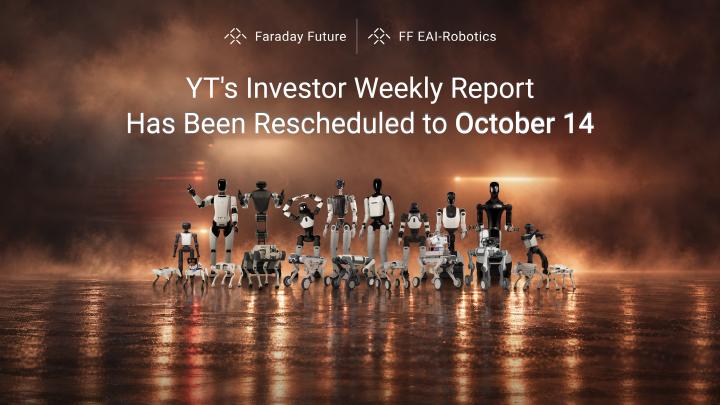
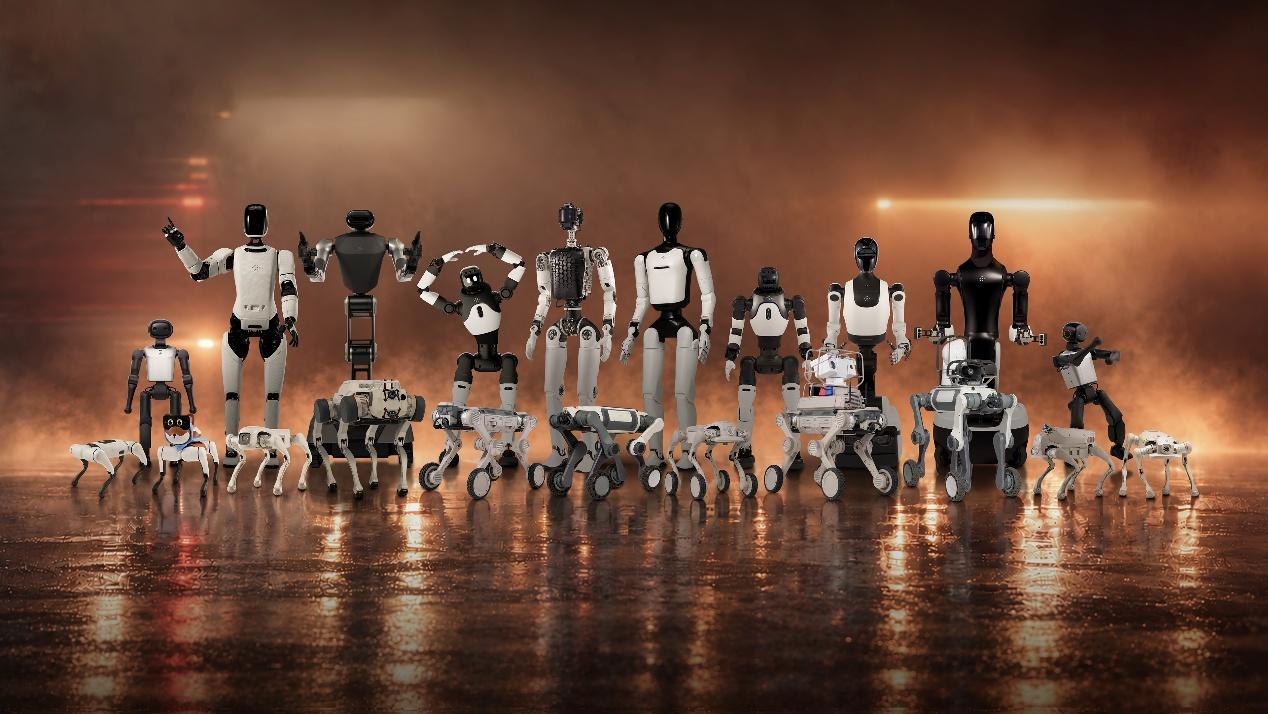
El Segundo, Calif. — Two nights before an invitation-only product event that the company has spent four months teasing, the showroom floor at Faraday Future’s headquarters smells faintly of hot soldering iron and ambition. Rows of humanoid and bionic robots stand on a glossy black floor that reflects the overhead orange lights like oil on a parking lot. There is a full-size humanoid, nearly five and a half feet tall, with a narrow visor for a face; a squat wheeled manipulator with a reaching arm; a pair of robot dogs; and, at the front of the line, almost comically small, a pair of miniature humanoids barely taller than a loaf of bread.
That smallest pair is the point of the evening. On October 14, 2026, Faraday Future — the company built by founder and global chief executive YT Jia, the Chinese entrepreneur once synonymous with the failed electric-vehicle startup LeEco — will formally unveil FF Nova, described by the company as its first embodied-AI humanoid robot designed for developers and educational institutions. A companion model, FF Nova Mini, aimed at foundational physical-AI education for younger children, is expected alongside it, together with an “EAI Education Ecosystem Brain and Curriculum Skills 2.0” software stack and an early-access “Nova Developer Reinforcement Learning Platform.” The full event video is scheduled to be posted the following afternoon, October 15 at 5:00 p.m. Pacific.
Everything about the timing is deliberate. Two days before the cameras arrive, the detailed specifications, degrees of freedom, battery life, and price of Nova are still officially unannounced. What exists on the record is a trail of press releases, SEC filings, and one defiant pitch: that a U.S. company best known for a stalled luxury electric sedan and a long, painful history of convertible-debt financing can become, in the words of one Los Angeles magazine profile, “the Apple of Embodied AI.”
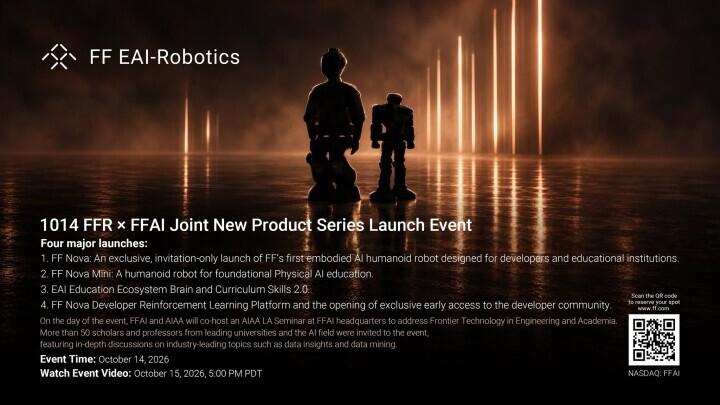
Nova, as Faraday Future describes it in its June preview materials, is about 50 centimeters — roughly twenty inches — tall. The company calls it the first entry-level miniature embodied-AI humanoid in the United States, engineered for both education and companionship, “an EAI learning companion that can grow alongside children.” On its consumer-facing website, the model is listed as “FX Nova,” marked simply “Coming Soon.” The bet is narrow but shrewd: rather than wade into the brutal, capital-hungry race to sell full-size humanoids to factories, Faraday Future is starting at the bottom of the pyramid — classrooms, hobbyist workbenches, and university labs — where the robots are cheap, the stakes are low, and a generation of future robotics engineers can be raised on your operating system.
Whether that gambit works depends on three things the market does not yet know. The first is whether Nova is genuinely capable enough to be a development platform rather than an expensive toy. The second is whether Faraday Future, a company with a documented reliance on a single Chinese original-equipment manufacturer for its entire robotics line and a balance sheet scarred by years of restructuring, can actually ship at the volumes its investor presentations promise. The third is whether, in a humanoid market that by late 2026 is visibly separating into factories and homes, a miniature education robot has a real commercial destination — or is simply a charming way to seed a software ecosystem.
The Company Behind the Robot
To understand Nova, it helps to understand what Faraday Future has become, which is almost nothing like the company that dazzled auto shows in 2016. Founded in 2014, the firm spent a decade trying, and largely failing, to mass-produce the FF 91 electric crossover. Along the way it went public via a SPAC, was delisted and relisted, raised money through repeated convertible notes, and watched its stock become a favorite of day traders. By the time the company pivoted toward robotics, the car business was, for all commercial purposes, a sideshow.
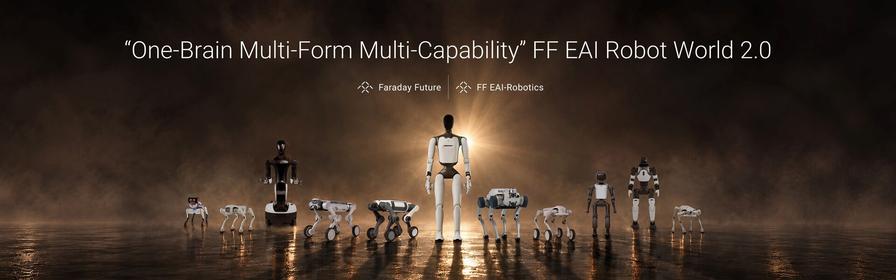
The robotics strategy began in earnest in early 2026. At the NADA dealers convention and then at a cascade of launch events through June and September, Faraday Future rolled out what it calls a “Six-Series Full-Form EAI Robot World,” built around a single mantra: “One Brain, Multiple Forms, Multiple Capabilities.” The idea is that one shared embodied-AI software core — the “EAI Brain” — can drive robots of radically different shapes. There are the humanoid lines: Futurist, a full-size professional machine that starts at $89,900, weighs about 54 kilograms, and is the first full-size humanoid in the U.S. to natively support NVIDIA’s SONIC full-body motion-control stack, running on an NVIDIA Jetson Thor compute module with up to 51 degrees of freedom, a peak knee-joint torque of 320 newton-meters, and an 1,152-watt-hour dual-battery system rated for roughly six hours of runtime. There is Master, a sport-oriented humanoid built for athletic competition and even, the company claims, kicking a real ball. And then there is Nova, the miniature.
The non-humanoid siblings matter to the story. FX Navi is a foundational education quadruped priced at $1,990, notable as the only quadruped in the U.S. under two thousand dollars that supports secondary development, using a customer’s own iOS or Android phone as its main compute brain. FX Aegis is a professional security and companion quadruped. Faber is a family of wheeled mobile manipulators, one variant of which the company says is already deployed at scale for power-inspection and data-center tasks such as closing electrical switches — a dull, dangerous, industrial job that humans would rather not do.
The corporate structure around all of this is itself a study in restructured capitalism. The robotics business sits inside Faraday Future Intelligent Electric Inc. (ticker FFAI), but a separate entity, FF EAI Robotics Ecosystem Inc. (NASDAQ: FFR), is in the process of acquiring that robotics business. The two entities now stage joint launch events — including the October 14 Nova event — and issue combined investor updates. Jia’s weekly investor letters, once a cult object among retail shareholders, have been rescheduled around the robotics calendar. The company reported that its robot sales reached 265 units in September 2026, a record, bringing cumulative 2026 shipments to roughly 817 units, and it has raised its full-year shipment target.
Those numbers are tiny by industrial standards, and they come with a long list of risk factors the company itself discloses: its dependence on convertible-debt investors to keep funding operations; its reliance on a single Chinese OEM for essentially all of its robots; the need for those robots to comply with U.S. safety and import rules; and the volatility of its own share price. It also promotes a “Built in USA” acceleration plan, shown off at the IROS 2026 robotics conference, that would eventually move more assembly onto American soil. A miniature classroom robot, in this light, is not just a product. It is the cheapest, fastest, most politically legible way to start selling something, anywhere.
The personal narrative attached to this pivot is hard to overstate. Jia Yueting, known in the West as YT Jia, built a sprawling Chinese consumer-electronics and media empire at LeEco, promised an electric car to rival Tesla, and then watched the empire collapse under a mountain of debt, leaving him in the United States and on the wrong side of multiple creditor actions. For years, Faraday Future was treated as a cautionary tale — a company that could unveil a dazzling prototype but never quite deliver it. The robotics pivot is, in this sense, framed internally as redemption: a second act in which the same founder who once promised a car to change the industry now promises a fleet of robots to seed an era. Investors, particularly the retail holders who have followed Jia’s weekly letters for years, are buying as much that narrative as the hardware. That cuts both ways. It gives the company a loyal, forgiving base that will show up to a launch event. It also means that every promise is heard against a long record of promises deferred, which is why the market will judge Nova by shipping dates and invoice numbers rather than by keynote rhetoric.
Product Market Analysis
The embodied-AI and humanoid market that Nova is stepping into in late 2026 is simultaneously enormous and unproven. Investors have poured billions into the category on a simple thesis: that artificial intelligence, which for a decade has lived on screens, is about to acquire a body and begin doing physical work. The long-run forecasts routinely invoke trillion-dollar addressable markets and millions of deployed units. The short-run reality, as even the most enthusiastic players concede, is messier.
The first and most obvious market is industrial. Factories, warehouses, and logistics centers want robots that can unload boxes, tend machines, and walk between workstations without rebuilding an entire facility around a fixed arm. This is the market Tesla, Figure, and Boston Dynamics are chasing, and it is where the dollars are largest — but it is also where the bar is highest. A factory robot must work eight-hour shifts, recover from a dropped object without human help, and manipulate unstructured clutter reliably. As Tesla’s own ramp has demonstrated in 2026, even a company with world-class manufacturing DNA is struggling to get there: Optimus production climbed to several hundred units a week at Fremont by the autumn, still well short of the company’s internal target of more than a thousand per week by year’s end, and analysts report that dexterous hands and forearms still require painstaking manual assembly. Generalization — the robot learning a new task from a few demonstrations rather than being hand-programmed — remains the central unsolved problem.
The second market is research and education. This is smaller in revenue per unit but far more forgiving, and it is the one Nova aims at. Universities, high-school robotics clubs, and indie developers buy humanoids not to replace workers but to train the next generation of models, to publish papers, and to prototype behaviors. The requirements are different: the robot must be affordable, open enough to hack on, and reliable enough that a weekend experiment does not end in a broken joint. Buyers in this market tolerate imperfection because they are paying for a platform, not an appliance.
The third market is consumer companionship and the home. This is the most hyped and least mature. A 50-centimeter robot in a child’s bedroom sits at the boundary of education and companionship, and it is no accident that Faraday Future frames Nova this way. The home is where margins and brand loyalty could eventually live, but it is also where safety expectations, parental trust, and durability demands are most unforgiving.
The commercialization bottleneck across all three markets is familiar by now. Hardware costs are still high relative to value delivered. Batteries and actuators are expensive. Software generalization lags far behind the dazzling one-minute demo videos that dominate social media. And the gap between a rehearsed onstage routine and an unsupervised eight-hour shift is, in practice, enormous. Buyers have learned to discount the sizzle. Several high-profile humanoid launches in 2025 and early 2026 promised industrial deployment and delivered limited pilots; the market has, slowly, begun to distinguish companies that can build a demo from those that can build a product.
Into this gap steps the “robot as platform” model, which is where Nova’s education angle becomes commercially interesting. Faraday Future’s explicit ambition is to build a data and developer flywheel, “replicating Tesla’s success in EVs, data, and FSD” — except, instead of collecting driving data from cars, it would collect motion and interaction data from a fleet of small robots in classrooms and homes. Every time a child programs Nova to wave, or a student trains it to pick up a cup, the company’s “EAI Data Factory” theoretically gains another real-world demonstration. If enough robots are deployed, the data improves the models, which improves the robots, which sells more robots. It is the same network-effect logic that made smartphone platforms valuable, applied to the physical world.
The risk in that thesis is equally obvious. Education robots must actually be bought by cash-strapped school districts and parents, not just admired by engineers. And the data flywheel only spins if the hardware is cheap and reliable enough to reach the tens of thousands of units required to make the data meaningful — a threshold Faraday Future’s current shipment volumes are nowhere near.
Beneath the commercial questions sits a technology shift that is reshaping what every one of these robots is actually doing. For most of the last decade, a robot’s “intelligence” was largely hand-authored: engineers programmed a walk gait, mapped a warehouse, and scripted each grasp. The new wave is different. So-called vision-language-action models — the same family of technology behind conversational AI — are being fused with “world models” that let a robot predict the consequences of its motion before it commits, and with reinforcement-learning pipelines that train behaviors in simulation and then transfer them to the physical machine. Faraday Future’s Futurist is explicitly marketed around a vision-language-action brain fused with world-model capabilities, and the Nova Developer Reinforcement Learning Platform it is launching alongside Nova is, in essence, a tool that lets students and researchers train exactly this kind of policy. That choice matters commercially: it means Nova is aimed at the fastest-moving technical frontier rather than the mature, scripted robotics of the past. It also means Nova inherits the field’s central limitation — these models are still data-hungry, still brittle outside their training distribution, and still far from the general-purpose reasoning the launch videos imply.
The geography of this market is as important as its technology. The affordable-hardware layer — the actuators, the small bipedal frames, the open SDKs — is increasingly defined by Chinese companies, which have driven the price of a capable research humanoid down from the hundreds of thousands to the low tens of thousands of dollars in the space of a few years. American and European buyers, mindful of supply-chain dependence and geopolitical friction, are actively looking for non-Chinese alternatives. That is precisely the opening Faraday Future is exploiting with its “Built in USA” messaging, even though its own robots are, by its own SEC disclosure, currently manufactured by Chinese OEMs. The education market, in other words, is where the commercial and the political collide: it is the first place a U.S.-branded entrant can plausibly win not on pure cost, but on trust, curriculum, and the reassurance of a familiar flag on the box.
Competitor Product Analysis
Nova does not compete head-on with the full-size humanoids the public associates with the category. But it competes for the same research budgets, the same developer mindshare, and the same long-term ecosystem loyalty — and against a field that has already defined the expectations it must meet.
Tesla’s Optimus is the gravitational center of the category, whether or not that is healthy. By the autumn of 2026, the third-generation, production-intent Optimus had begun to ramp at Tesla’s Fremont factory, with additional production space under construction in Texas. The robots are deployed almost entirely inside Tesla’s own plants, doing supervised learning and light tasks, and Tesla has not disclosed external customers or unit sales to the public. Management targets a consumer price in the low tens of thousands of dollars once production is mature, even though the current manufacturing cost is estimated far higher. Optimus matters less for what it sells today than for what it signals: that the world’s most valuable manufacturing company is willing to absorb enormous losses to learn how to build a humanoid at car-industry scale. Nova’s developers will compare every Nova capability against the videos of Optimus, and Faraday Future cannot win that comparison on raw hardware. It can only win by being cheaper, more open, and aimed at a classroom Tesla will never serve.
Figure AI, the California startup founded by Brett Adcock, has spent the last few years refining its electric humanoid through the Figure 02 and then its next-generation Figure 03 platform, which it has piloted in manufacturing and warehouse settings including BMW facilities. Figure’s pitch is tightly industrial: a sleek, battery-electric humanoid with a focus on bimanual manipulation and on AI that can reason about factory tasks. Backed by major venture capital and aligned with the broader Hyundai–Boston Dynamics manufacturing orbit, Figure represents the well-funded, venture-first path to the industrial humanoid. For Nova, Figure is both a credibility reference and a warning: the standard for dexterous, mobile manipulation has been set high, and a miniature educational robot will be judged against the same bar even if its price point is a fraction.
Unitree Robotics, the Chinese company, is the competitor that actually shares Nova’s price and customer. Unitree’s G1 humanoid starts at roughly $13,500 and offers 23 to 43 joint motors, force-controlled dexterous hands, and an open SDK aimed squarely at researchers, while its lower-cost R1 biped, priced in the low thousands, has become a default platform for university labs and open-source reinforcement-learning work. Unitree H1 and the company’s quadruped line have already made it the volume leader in affordable, hackable locomotion. This is the most dangerous comparison for Nova: if Nova’s education robot is not meaningfully cheaper, better documented, or more integrated with a coherent curriculum than a Unitree, the research market will simply keep buying Unitree. Faraday Future’s counter is that it offers not just hardware but an education ecosystem — curriculum, a skills marketplace, teacher training, and a “Three-in-One EAI Education” stack — that Unitree’s open-platform model does not.
Zhiyuan Robotics, known commercially as Agibot, is the Shanghai-based humanoid maker whose A-series machines — including the Agibot A2, a roughly 40-degree-of-freedom biped pitched for warehouse handling and exhibition reception — have become common sights at Chinese factories and trade shows. Agibot represents the aggressive, Chinese-ecosystem approach: low costs, rapid iteration, heavy emphasis on “world model” and vision-language-action models, and deep ties to domestic supply chains. Notably, Faraday Future itself depends on that same Chinese OEM supply base that has made companies like Agibot and Unitree possible, which means Nova is, in a very real sense, competing with the very ecosystem that manufactures it.
Boston Dynamics, now part of the Hyundai Motor Group, looms over the category as the technical gold standard. Its electric Atlas humanoid, the successor to the retired hydraulic original, is being put to work on Hyundai’s manufacturing floors, and the company’s decades of locomotion expertise set the reference for how a humanoid should walk, balance, and recover from a stumble. Boston Dynamics is not trying to sell a $2,000 classroom robot, and it never will. But its existence means that “our robot can walk” is no longer a differentiator at all; the bar is now smooth, autonomous, unscripted motion that survives contact with messy real world.
There is also a quieter competitive set that Nova will actually meet on the shelf: the established education-robotics brands. Chinese and European STEM-education companies have spent years selling programmable humanoid and bipedal kits to schools, and consumer electronics firms offer drone-based and block-based robotics platforms that already occupy the classroom budget. These products win on proven curriculum support, teacher training, and durability, and they have already absorbed the skepticism of administrators who have seen fads come and go. Nova’s education ecosystem — its bundled curriculum, its skills marketplace, its visual programming tools — is a direct answer to that entrenched competition, not to Tesla. The most dangerous rival to Nova may not be a humanoid at all, but a well-entrenched STEM curriculum that a district has already standardized on.
Set against this field, Nova’s positioning is clear and, on paper, sensible. It is not trying to out-Optimus Optimus, out-figure Figure, or out-Unitree Unitree on price alone. It is trying to occupy the one niche none of them owns particularly well: a purpose-built, U.S.-branded, curriculum-bundled miniature humanoid for American education and developers, low enough in cost to be an impulse institutional purchase and open enough to seed a future software ecosystem. The strategy is coherent. Whether the product is good enough to justify it is exactly what October 14 is meant to answer.
Pros and Cons
The case for Nova begins with the niche it has chosen. A 50-centimeter humanoid is, by definition, safer and cheaper than a full-size one. There are no 320-newton-meter knee torques to worry about in a classroom; a child cannot be crushed by a twenty-inch robot, and the bill of materials is dominated by small, commodity actuators rather than the expensive, high-torque joints that make industrial humanoids so costly. That makes Nova the rare embodied-AI product that could plausibly be sold to schools and families rather than only to venture-backed pilots.
The second strength is the ecosystem wrapped around it. Faraday Future is not just shipping a robot body. On October 14 it is pairing Nova with a reinforcement-learning developer platform, early access to a developer community, and an upgraded curriculum and “EAI Brain” software layer. Combined with the existing Navi quadruped, the open “Brain Blocks” visual-programming tools, and the skills marketplace, the company is offering a coherent path from a seven-year-old dragging blocks on a screen to a graduate student training a policy on a humanoid. That funnel — classrooms today, developers tomorrow, data the day after — is the most thoughtful part of the strategy, and it is genuinely differentiated from the bare-hardware approach of competitors.
The third strength is the U.S. brand and timing. At a moment when Western buyers are increasingly cautious about relying on Chinese robotics supply, an El Segundo-headquartered company promoting a “Built in USA” plan and selling into American education has a marketing advantage that Unitree and Agibot, for all their price appeal, cannot easily replicate. Nova is, in part, a response to a political and sourcing environment rather than purely a technical one.
The weaknesses are the mirror image of those strengths, and they are serious. First, Faraday Future has not, as of this writing, published Nova’s real specifications. Until October 14 delivers degrees of freedom, compute, sensing, battery life, and a price, Nova is a promise — and Faraday Future’s corporate history is littered with promises that slipped. A developer community is only as credible as the company’s ability to fund itself long enough to support it, and the disclosed reliance on convertible debt and a single Chinese OEM is a standing risk that any institutional buyer should weigh.
Second, a miniature humanoid’s technical ceiling is low by design. At twenty inches tall, Nova cannot manipulate heavy objects, walk across rough terrain with any agility, or demonstrate the kind of whole-body dexterity that defines the state of the art. Its motion will be compared, fairly or not, to the fluid strides of Atlas and the piloting of Optimus, and it will come up short. It may be an excellent education platform and a weak “robot” in the cinematic sense. Buyers must decide which one they are paying for.
Third, the gap between a polished launch demo and a reliable classroom companion is a chasm the entire industry has yet to cross. The robot that waves for the cameras on October 14 is almost certainly rehearsed. The robot that must recognize a child’s voice, avoid falling off a desk, and update safely over the air a year from now is a much harder product. Companionship is an emotional claim, and emotional products demand durability, software support, and customer trust — the exact things a financially fragile robotics startup is least equipped to guarantee.
Finally, the education market itself is a slow, procurement-heavy business. Selling to school districts means navigating budget cycles, adoption committees, and cautious administrators, not a viral product launch. The “learning companion that grows with your child” framing, meanwhile, targets a consumer market that has previously rejected most companion robots as novelty items that lose their appeal within weeks. The cons, in short, are not fatal to the concept, but they are exactly the cons that have sunk prior generation robots that looked, on launch day, every bit as promising.
There is also a subtlety in the product lineup itself that buyers should weigh. Faraday Future is launching not one miniature humanoid but two: Nova, aimed at developers and educational institutions, and Nova Mini, aimed at foundational physical-AI education for younger children. That segmentation is sensible — a university lab and a first-grader need very different machines — but it also splits the early ecosystem. A developer platform is only valuable if a large community converges on a single software standard; launching two related but distinct robots at once can dilute the very network effect the company is trying to build. The price gap between the two, and the degree to which they share a common SDK and curriculum, will determine whether Nova becomes a platform or just another SKU. On that question, too, the company has so far been silent, deferring the answer to the October 14 event.
Consumer and Buyer Considerations
For the actual buyer considering Nova — a university robotics lab, a high-school program, a corporate research team, or an early-adopting family — the practical questions begin well before the price is announced.
The first question is timing. Nova is being launched as an invitation-only event on October 14, with a public video the next day, but the company has a history of previewing products months before they are available to buy. A buyer should treat any commitment ahead of confirmed pricing and shipping dates as a pre-order into an unproven supply chain. The company’s disclosed dependence on a single Chinese OEM, and its ambition to eventually shift assembly to the U.S., means that early units may face longer lead times, supply hiccups, or import-compliance uncertainty.
The second question is what, concretely, the robot can do on arrival. The demonstration videos will show the robot at its best: walking, waving, perhaps manipulating a simple object. But a buyer should ask for the boring specifications that determine real usefulness. How many degrees of freedom, and how many are in the hands? What compute module drives it — does it use a phone like Navi, a dedicated edge module, or both? What sensors does it carry — cameras, depth, LiDAR? How long does the battery last in continuous use, and how easy is it to swap or charge? What is the supported operating temperature and ambient environment? And, most importantly for a development platform, what does the software stack actually expose: a Python SDK? A simulation environment? Pretrained reinforcement-learning policies a student can fine-tune? The value of Nova to a researcher is almost entirely in the software access, not the plastic shell.
The third question is maintenance and total cost of ownership. A classroom robot will be dropped, bumped, and poked. Buyers should ask about replacement parts availability, the cost and lead time of a broken actuator, and whether the company offers any service or warranty program. Given Faraday Future’s financing history, a longer-term worry is whether the company will still exist to release firmware updates and honor that warranty two or three years from now — a genuine consideration, not a scare tactic, for any purchase from a company with a volatile share price and convertible-debt funding.
The fourth question is whether Nova actually fits the intended use case. A university lab that needs an open platform to publish locomotion research may still find Unitree’s G1 or R1 a more proven, better-documented, and cheaper bet. A corporate buyer wanting a robot for a real industrial task is looking at the wrong product entirely — Nova is not a worker. But a school district or an after-school program that wants a safe, U.S.-branded, curriculum-bundled humanoid to teach embodied-AI concepts, or a developer eager to get early access to a reinforcement-learning platform with a built-in community, may find Nova’s combination compelling precisely because none of the competitors is packaging it that way.
The fifth and most honest consideration is the gap between the marketing narrative and the current state of the art. Embodied AI is real and progressing fast, but a miniature 20-inch robot in late 2026 is not going to have a general-purpose brain that understands arbitrary commands. It will do what it was programmed and trained to do, reliably within a narrow envelope and unreliably outside it. The most satisfied early buyers will be the ones who buy Nova as a teaching and prototyping tool with clearly bounded expectations, not as a step toward a household robot that can do anything.
A sixth, increasingly decisive consideration for education and companion robots is privacy and data governance. A miniature humanoid placed in a classroom or a child’s bedroom will, by necessity, carry cameras and microphones and will be programmed to send interaction data back to the company’s “data factory.” That is the entire mechanism of Faraday Future’s flywheel, and it is also exactly what makes parents and school-district lawyers nervous. Any institutional buyer should ask before committing: what sensor data does Nova capture, where is it stored, who owns it, whether children’s voices and faces are used to train commercial models, and whether the platform complies with the student-privacy rules that govern schools. A company that can answer those questions credibly, and offer local-only or opt-in data modes, will have a durable advantage over competitors who treat classroom data as a free asset. Faraday Future has not yet published that policy for Nova — which, given the launch is still two days away, is expected, but which buyers should insist on seeing before purchase.
Market Summary and Product Summary
It is tempting to dismiss Nova the way the commenters on Faraday Future’s own press-release pages dismiss it — as another logo, another keynote, another act of reinvention from a founder whose career has been defined by leaps of faith that have sometimes landed, and often not. That would be a mistake. Underneath the corporate theater, the product strategy embedded in Nova is one of the most coherent in the category.
The humanoid market in late 2026 is converging on a rough hierarchy of credibility. At the top sit the factories, where Tesla and Figure and Boston Dynamics are burning capital to solve the hardest problem in robotics: general-purpose manipulation in unstructured spaces. That market will be large, but it will be slow, and it will reward companies that can manufacture at industrial scale. Below that sits the research and education market, where Unitree has already built a profitable business on cheap, open hardware. And at the bottom, waiting to be claimed, is the branded, curriculum-bundled, education-first miniature humanoid — the Raspberry Pi, or the Arduino, of embodied AI. Nova is Faraday Future’s bid to own that rung.
The commercial logic is sound. Start cheap and small, in a market where imperfection is tolerated and volume is achievable; bundle hardware with curriculum and a developer platform to lock in a generation of users; collect interaction data from the installed base to improve the models; and only then, once the ecosystem matures, work upward toward the larger and more lucrative humanoid markets the company already advertises in the form of Futurist and Faber. It is the classic land-and-expand playbook, and it is far more likely to generate real shipments than trying to out-engineer Tesla on day one.
The product summary, though, must be written in pencil, not ink. As of October 12, 2026, Faraday Future has told us what Nova is for — education, companionship, and developer enablement — and roughly how big it is, about twenty inches tall. It has not yet told us what it costs, how it performs, what it runs on, or when it will actually ship. The October 14 event will answer some of those questions; the months after will answer the others. What can be said today is that Nova is a real, officially teased product from a real, publicly traded U.S. robotics company, not a rumor or a concept render — but it is a product whose specifications, price, and real-world capability remain, by the company’s own choice, unannounced.
The larger question Faraday Future is posing with Nova is not really about a single robot. It is about whether an education-first, ecosystem-building strategy can carry a financially fragile company through the brutal early years of the embodied-AI boom, long enough to reach the day when its miniature classroom robots have grown up into industrial machines. For the industry, the launch is a useful signal: that even the most capital-rich humanoid programs have not cracked general-purpose deployment, the smartest newcomers are choosing to start where the costs are lowest and the customers are most forgiving. For Faraday Future, Nova is a last, best chance to do what the EV era never allowed — to ship something, sell it, learn from it, and build a flywheel.
Two days before the cameras arrive, the robots stand lined up on their reflective floor, small and large, waiting. Whether Nova becomes the opening move of an American embodied-AI education empire, or another beautifully launched product that the market eventually files alongside the FF 91, depends on what Faraday Future can do in the days after October 14 — the quiet, unglamorous work of shipping, supporting, and improving a robot that no keynote can substitute for.
For investors and industry watchers, there are three concrete signals to track in the weeks after the launch. The first is the price. If Nova arrives at a price point that makes it a realistic classroom purchase — plausibly in the low thousands of dollars, competitive with the likes of Navi and Unitree’s entry biped rather than the $89,900 Futurist — the education strategy becomes credible; if it arrives at a price suited only to well-funded labs, it collapses back into being a niche research device. The second signal is shipping. The company’s September record of 265 units and year-to-date total near 817 are real but small numbers; the question is whether Nova converts that early industrial trickle into a durable consumer and education volume. The third signal is the developer platform’s adoption — whether the reinforcement-learning tools attract a community that builds third-party skills, or whether the skills marketplace remains curated entirely in-house.
Nova, in the end, is a bet on humility. At a moment when the loudest voices in humanoid robotics promise million-robot factories and a $20,000 home android, Faraday Future is offering a twenty-inch robot for classrooms, wrapped in a curriculum and a developer’s toolkit. It is a smaller, more patient, and more honest version of the embodied-AI dream. Whether patience is a luxury a debt-laden company can afford is the question that October 14 begins, but does not finish, answering.