
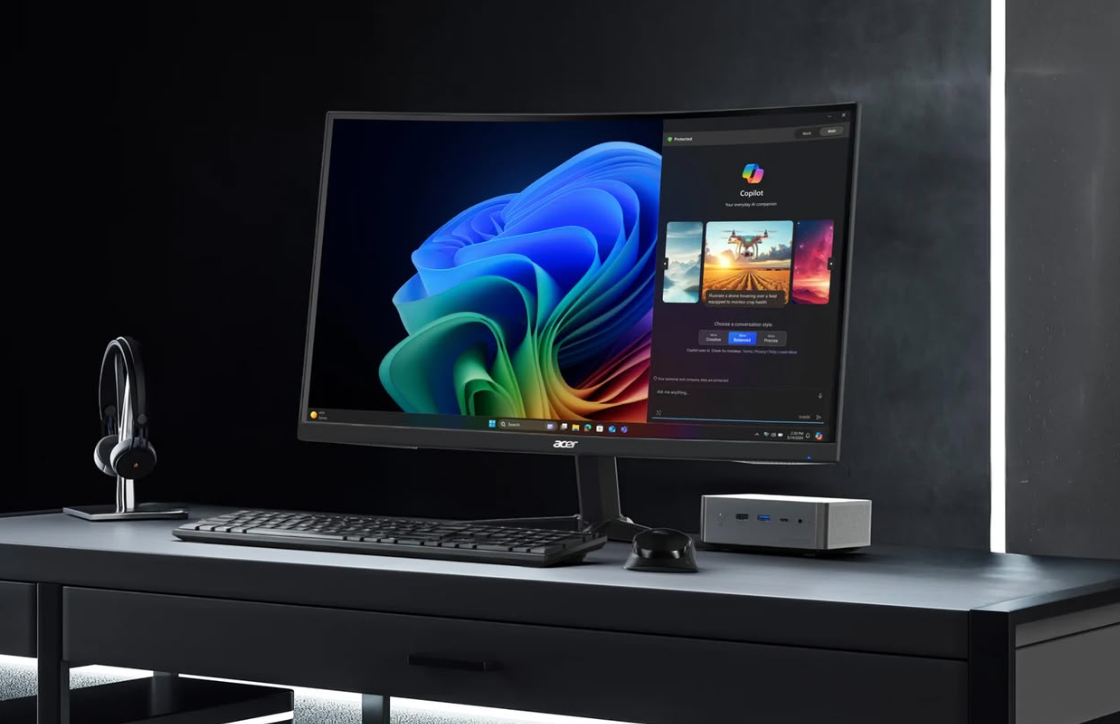
Unveiled at IFA 2026 in Berlin, the Acer Veriton RI110 is a compact AI workstation designed for professional developers, creatives, and small-to-medium-sized enterprises (SMEs). Unlike consumer-grade mini-PCs that focus primarily on multimedia and entertainment, the RI110 is positioned as a terminal for local agentic AI workflows. Despite its compact 0.63kg form factor, it supports local inference for large models with up to 120 billion parameters, making it suitable for tasks ranging from engineering development and AI-generated imagery to private data processing. For enterprises concerned about data leakage risks associated with cloud-based AI, this compact unit offers a lightweight solution for offline AI computing.
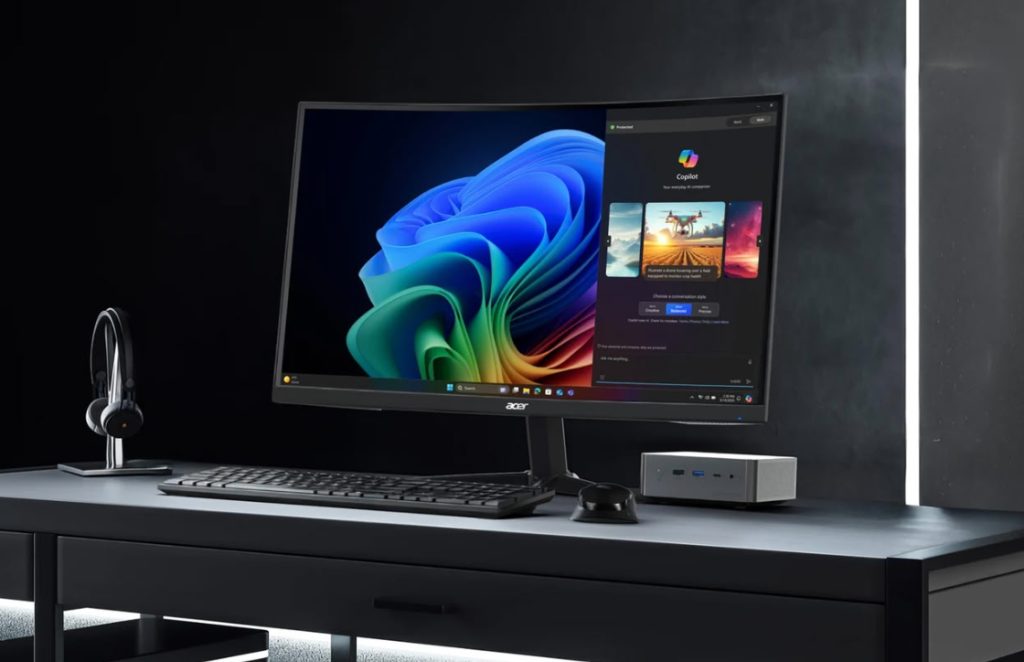
Design and Hardware Structure: A Mini Workstation Mountable Behind the Monitor
Measuring just 138.5 × 131.3 × 52.1mm and weighing 0.63kg, the unit features a professional-grade metal chassis with a fine-grid surface pattern that balances thermal efficiency with a premium aesthetic. It supports VESA mounting, allowing it to be attached directly to the back of a monitor and occupy virtually no desk space. ### Core Hardware Specifications
- Processor: Intel Core Ultra X7 358H
- Graphics: Intel Arc B390 discrete GPU (handles AI inference acceleration and graphics rendering)
- Memory: Up to 96GB LPDDR5X dual-channel
- Storage: Up to 4TB M.2 2280 PCIe Gen4 SSD
- Expansion Highlight: OCuLink interface (64Gbps high bandwidth); supports external GPU/storage expansion, allowing for future computing power upgrades without replacing the entire unit
- Wireless: Wi-Fi 7 + BT5.4
- OS: Windows 11 Pro (native Copilot+ PC)
- Software Suite: Acer Qubi Claw local AI agent; runs workflows in a sandbox environment, ensuring data never leaves the local device
The port layout is designed for commercial use cases: featuring multiple USB-A, USB-C, HDMI, and Ethernet ports. It supports simultaneous connections to multiple monitors, peripherals, and capture devices, making it ideal for developer workstations and edge AI deployment scenarios.
Real-World Performance: A Compact Box Running Large Models with Tens of Billions of Parameters
The Veriton RI110’s standout feature is its ability to run large models with up to 120 billion parameters locally and offline—a fundamental distinction from standard Copilot PCs. While typical AI PCs are generally limited to running smaller models (7B or 13B parameters), this X7 358H + Arc B390 combination leverages high-capacity memory and discrete GPU acceleration to smoothly handle inference tasks for 120B parameter models, eliminating the need to upload sensitive business data to the cloud.
Real-World Use Cases
- AI Agent Development and Local Inference
Paired with Acer Qubi Claw, the system enables the creation of isolated sandboxes for deploying custom AI agents that automate document parsing, information retrieval, and multi-step task orchestration. Processing for internal corporate documents, customer data, and R&D information takes place entirely on the local machine, ensuring privacy compliance; this makes it ideal for government agencies, enterprises, and R&D studios to prototype private AI applications. - AI Creative Content Generation
AI image generation, video frame generation, and 3D modeling assistance. The Arc B390 graphics card handles both graphics rendering and AI acceleration, delivering local image generation speeds in Stable Diffusion and ComfyUI that far surpass standard mini-PCs. Designers can generate assets in batches offline, keeping sensitive design files off third-party platforms. - Engineering, Simulation, and Multitasking Productivity
The advantage of 96GB of high-capacity memory shines in multitasking scenarios: users can run large model inference while simultaneously handling large CAD projects, multiple documents, and virtual machines without lag or stuttering. Ideal for algorithm engineers, product developers, and data analysts. - Edge AI Deployment
Compact and wall-mountable, it serves as an edge node to locally process data from IoT devices and perform real-time AI recognition. Only refined results are uploaded to the server, reducing cloud bandwidth load.
Summary of Advantages
- High Ceiling for Local Large Models: Supports local inference for models with up to 120 billion parameters, meeting enterprise needs for private AI and agent development while ensuring data privacy and security through local processing.
- Ultra-Compact Design: Weighs just 0.63kg and supports VESA wall mounting; it takes up zero desk space, serving as a replacement for bulky traditional tower workstations.
- Scalable Computing Architecture: Features a high-speed OCuLink interface, allowing for future expansion with an external discrete GPU to extend the system’s lifecycle.
- Comprehensive Commercial Security: Comes with Windows 11 Pro and TPM 2.0 support, offering enterprise-grade security suitable for corporate procurement.
- End-to-End AI Acceleration: Utilizes hybrid AI computing power (CPU + NPU + Arc discrete GPU) to collaboratively accelerate tasks like image generation and model inference.
Objective Limitations
- Professional Positioning, Higher Price Point: Targeted at enterprises and professional users rather than general home media consumers; the entry-level configuration costs significantly more than standard mini-PCs.
- Thermal Constraints: Due to the compact chassis, fan noise increases noticeably during prolonged, full-load operation (such as running large models), making it less suitable for ultra-quiet studio environments.
- Non-Upgradable Onboard LPDDR5X Memory: Memory is soldered to the board and cannot be replaced by the user; the memory specification must be selected at the time of purchase, as manual upgrades are not possible later. 4. Not Designed for Model Training: It excels at inference, agent workflows, and content generation; it is unsuitable for large-scale model pre-training but ideal for fine-tuning and inference tasks.
Target Audience & Buying Advice
✅ Recommended for: AI algorithm engineers, independent creative studios, and SMEs requiring private local LLMs and agent prototype development; users needing desktop-based edge AI nodes who prioritize data privacy; and those with limited desk space who still require workstation-grade AI computing power.
❌ Not Recommended for: General home entertainment or hardcore AAA gaming; users with limited budgets who only need the device for office work and web browsing; or scenarios involving large-scale model training.
Conclusion
The Acer Veriton RI110 redefines the mini-workstation; it is not merely an ordinary commercial mini-PC, but a lightweight local AI computing node. Amid the rapid growth in demand for AI agents and private LLMs, many teams desire AI capabilities but are wary of cloud-based data leaks—a pain point this device addresses perfectly.
It eschews the bulky tower form factor in favor of a compact, wall-mountable design, bringing the local inference capabilities of 120B-parameter models right to your desktop. If you require offline AI inference, local agent development, or AI-assisted creation using sensitive materials, the Veriton RI110 stands out as a highly competitive compact AI workstation among products launched at IFA 2026. However, if your needs are limited to daily office tasks, streaming, and gaming, its professional positioning and cost may represent overkill.