Note: No qualifying Korean consumer AI hardware launches in the Oct 10–17, 2026 window. Samsung’s Android XR glasses are confirmed for November; Galaxy Buds On retail in Korea on Oct 27; LG humanoid robots wait until Q1 2027. The closest Korean product is the Samsung Galaxy SmartTag 3, which launched in Korea on Oct 7 (three days before this window). It is reviewed here as the closest qualifying Korean hardware.
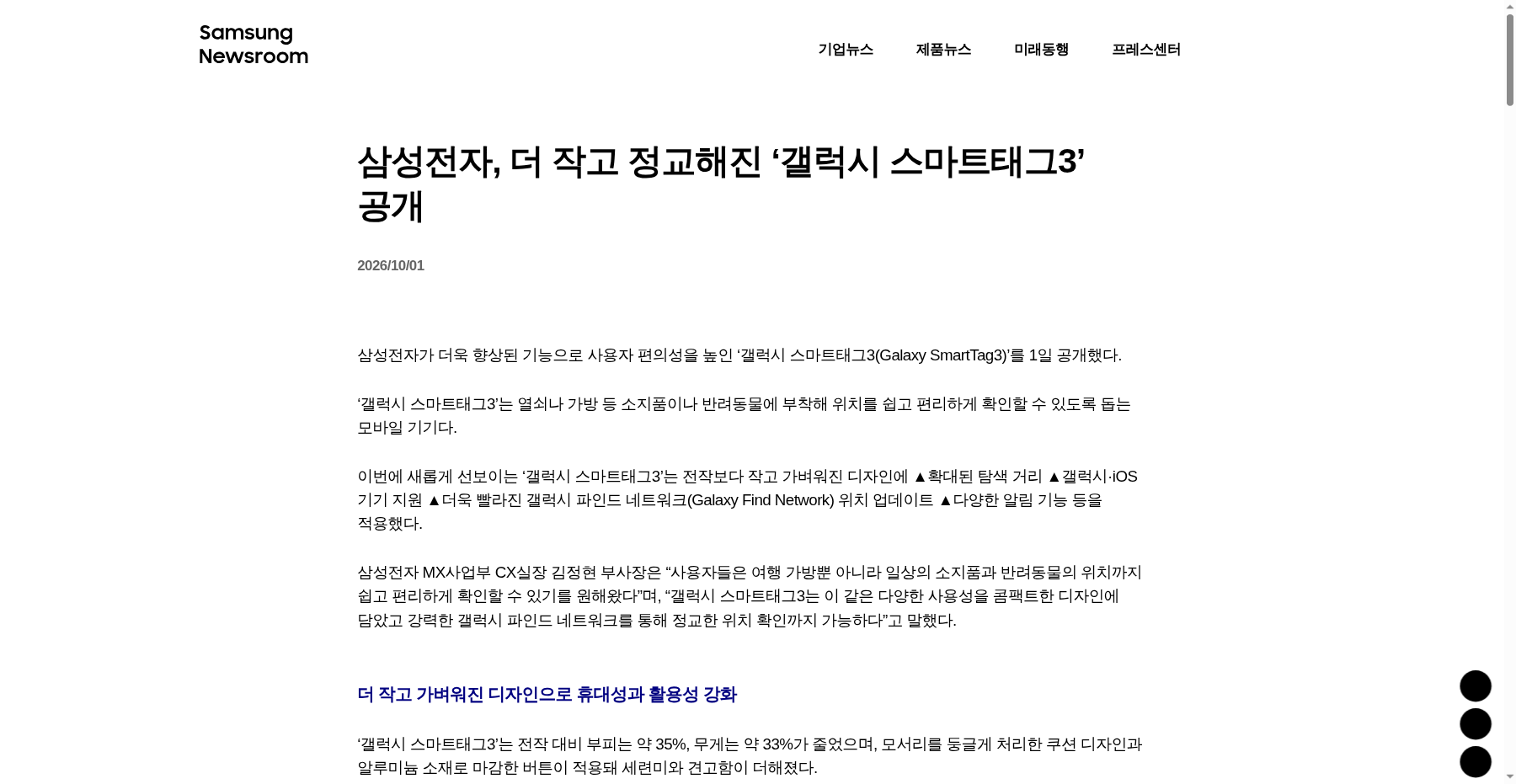
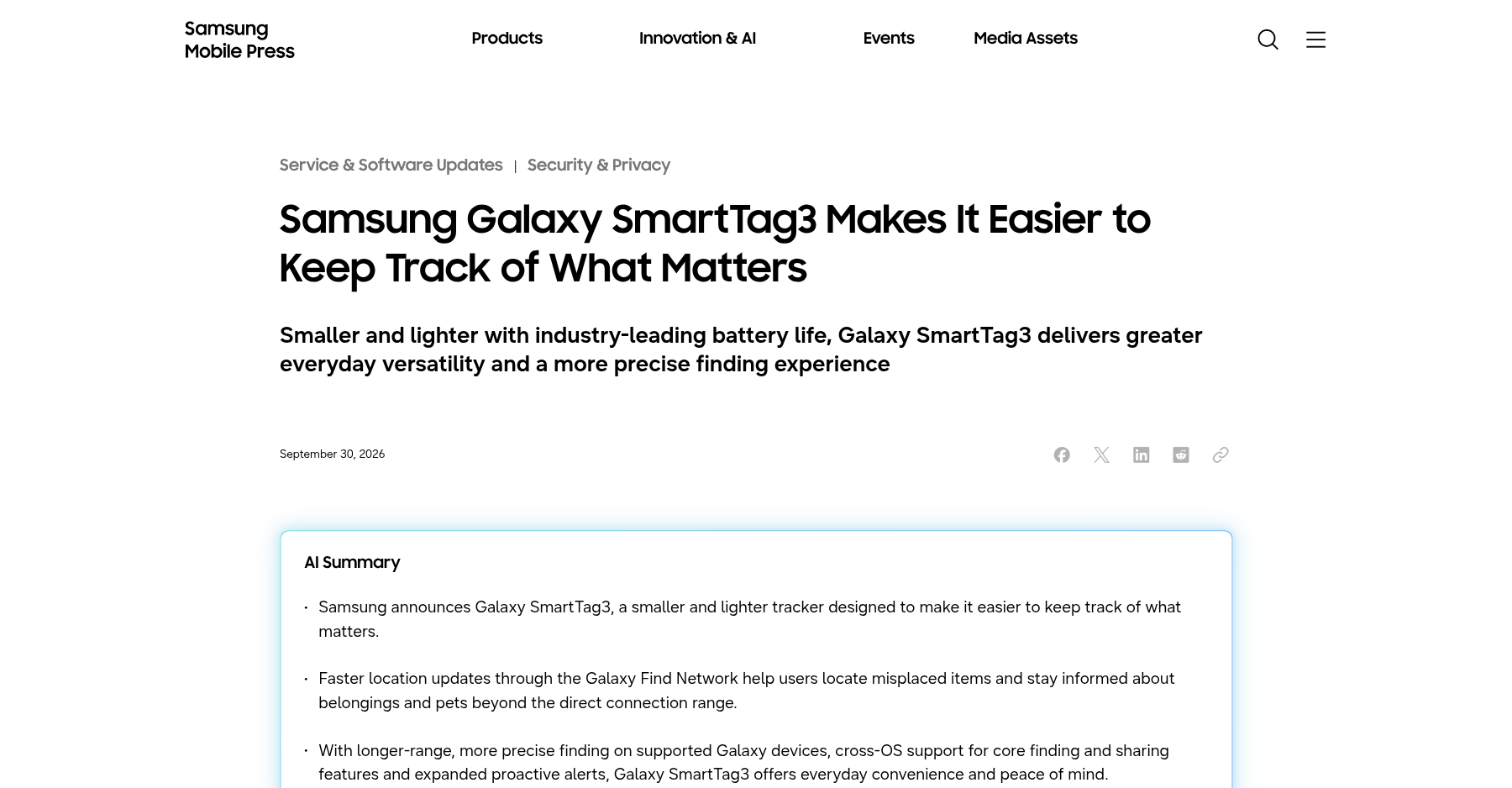
Samsung unveiled the third-generation item tracker Galaxy SmartTag 3 on September 30, 2026. Korean starting price is 44,000 KRW; US pricing is $29.99 per tag or $99.99 for a four-pack. Compared with the previous generation, it is ~35% smaller and ~33% lighter, with battery life extended to 550 days in standard mode (790 in saver mode), and — for the first time — basic Find My functionality opened to iPhone. The specs look restrained, but real-world use reveals a product that is “complete only on Samsung’s latest flagship; half-broken for everyone else.”
Strengths and Weaknesses
What Works
- Size and battery are class-leading: Rounded design with a metallic accent button fits smaller key rings, pet collars or carry-on luggage. CR2032 replaceable coin cell; 550-day battery is first-tier in the tracker category.
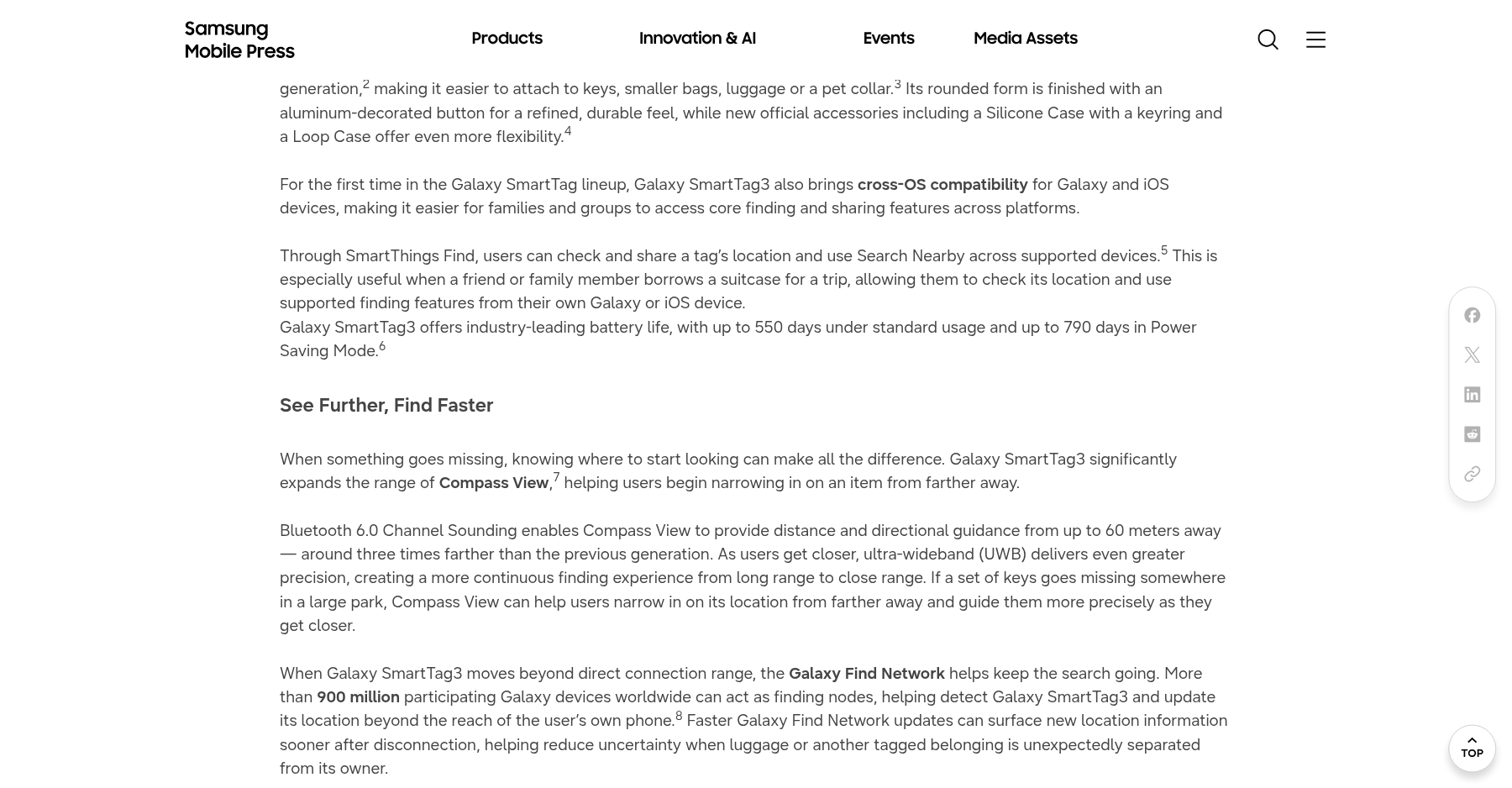
- Compass View extended to 60 m: Thanks to Bluetooth 6.0 Channel Sounding, directional guidance range is ~3x the previous generation, with UWB taking over precision as you approach.
- Cross-platform is a real step: iPhone users can finally view tag location and share via the SmartThings web/app — mixed-phone households are no longer a dead end.
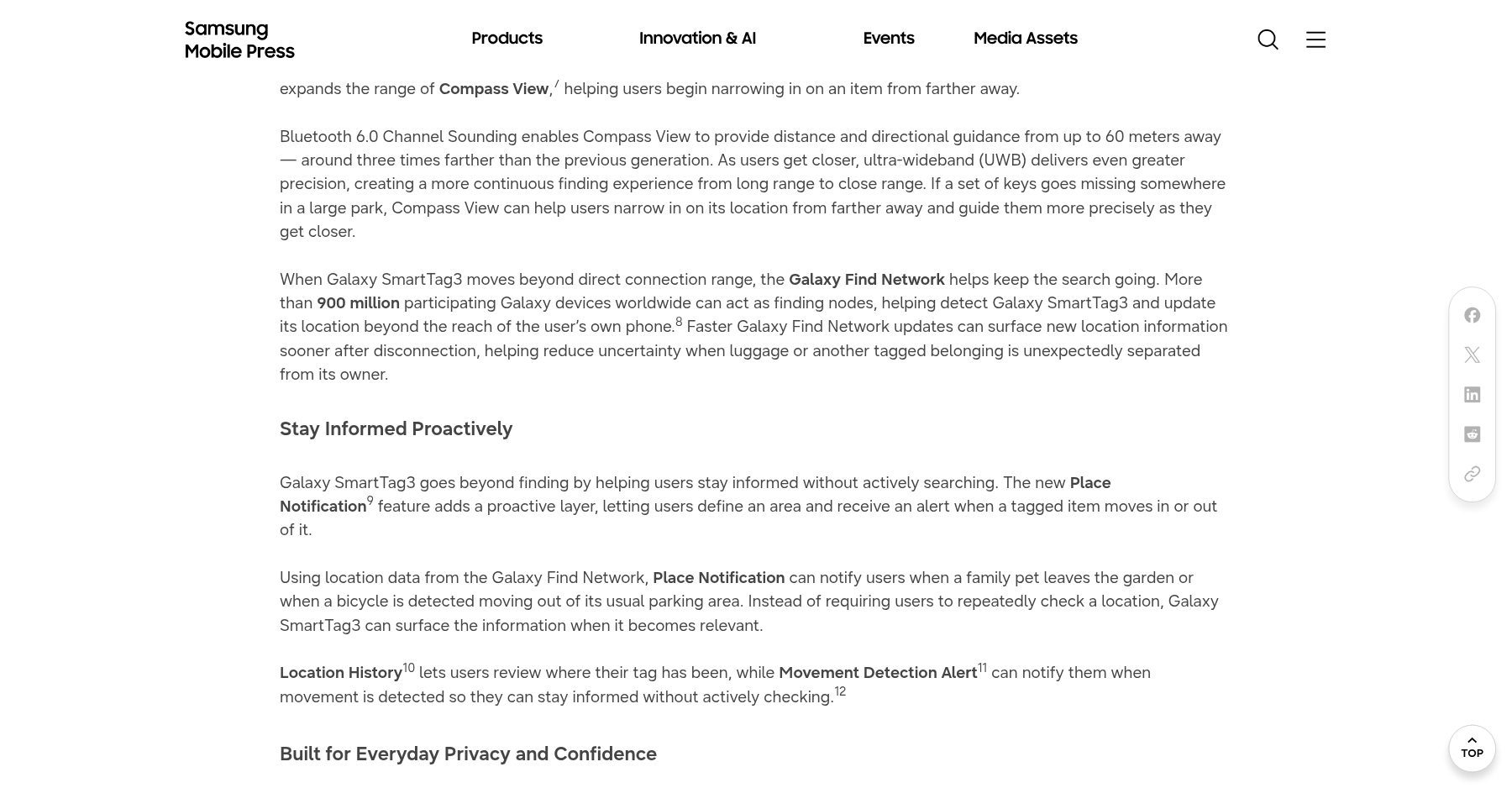
- Proactive alerts are systematic: Place Notification (geofence entry/exit), Movement Detection Alert and 7-day Location History form a “know without checking” layer.
The Real Traps
- “Complete experience” locks four Samsung phones: Bluetooth 6.0 Channel Sounding currently works only on the Galaxy Z Fold8 Ultra, Z Fold8, S26 Ultra and S26 Plus — the four 2026 flagships. Even if you hold a 2025 S25 Ultra, you cannot use 60 m Compass View.
- Non-Samsung Android users are officially cut off: After initial ambiguity, Samsung corrected on Oct 5 — SmartTag 3 works only on Galaxy devices. Pixel, OnePlus and Xiaomi users cannot even pair. This is a bare-faced walled garden.
- iPhone users get a “crippled” version: Compass View, Ring Phone (making the tag ring to find your phone) and Left Behind Alert are all unavailable on iOS — only location viewing and sharing remain.
- Place Notification is still labeled “trial”: Location triggers may be delayed or missed; Samsung itself does not treat it as a formal feature.
- History stored only 7 days: Compared with dedicated pet trackers keeping 30–90 days, this length is basically “see yesterday’s route after the fact.”
- “For pets” marketing with its own choking warning: Samsung’s footnote explicitly says the tag may detach and be swallowed by pets or young children, posing choking/internal injury risk. Hanging it on a pet collar is inherently a hazard.
- Accessories sold separately: Silicone keyring cases and Loop Cases are sold separately; no key ring is included in the box.
- Saver mode cuts Compass View: To hit 790 days, you give up close-range precision guidance.
Competitive Landscape: An Unequal Siege
On the shelf, the SmartTag 3 is not competing with one product but with three different philosophies. The Apple AirTag (2nd gen, launched Jan 2026) remains the default for iPhone users: Precision Finding range is 50% longer than the previous generation, backed by the Find My network of ~2 billion Apple devices worldwide — smoothness unmatched. Samsung’s move to pull iPhone in effectively concedes it cannot win on Apple’s home turf and can only make a “mixed-household compromise tag.” But if your whole household uses iPhones, the AirTag is still more accurate and smoother; the SmartTag 3 has no reason to win.
The other direction is the true open camp. Motorola trackers are priced at $20 each / $70 for four, explicitly compatible with all Android phones regardless of brand. Chipolo connects to both Apple’s Find My network and its own Android app, at similar prices with no “only works on one flagship” restriction. When Samsung closes the door on Pixel users with “only works on Galaxy,” Motorola and Chipolo are picking up the alienated customers. Tile is old-school and subscription-based, but wins on years of cross-platform support and a full product line.
Further afield, the real “pet AI tracking” category is held by cellular trackers beyond Tractive and AirTag pet use — they have GPS and eSIM, subscription-based real-time location, and do not depend on nearby phones. Samsung markets pets as a use case, but has no cellular module and no real-time reporting; it is essentially a “Bluetooth beacon.” In open countryside or overseas, with no Galaxy phone nearby, it is silent plastic. That is the hardest gap between it and true pet trackers.
Who Should Buy, Who Should Detour
Recommended for: You already use a Galaxy S26 Ultra/Plus or Z Fold8 series, and have iPhone-using family members who need to share keys/luggage location; you need a smaller, longer-lasting, IP67 splash-resistant tag to replace your SmartTag 2; you mainly live in Korea, the US or Western European metro areas where Galaxy Find Network node density is sufficient.
Strongly recommended to detour:
- Pixel / OnePlus / Xiaomi and other non-Samsung Android users: This product cannot even pair with your phone — do not waste money.
- Pure iPhone households: You get a crippled version without Precision Finding or Left Behind Alert; the AirTag 2 is the rational choice.
- Those who truly want to track pets: No GPS, no cellular, 7-day history, and Samsung’s own swallowing warning. Choose a dedicated pet tracker with eSIM.
- Users outside North America / markets launching in 2027: Samsung explicitly says more markets wait until 2027; importing now means sacrificing warranty.
- Price-sensitive buyers: Motorola’s equivalent specs are ~1/3 cheaper and do not pick a phone brand.
Two final notes: IP67 resists only fresh water for 30 minutes — pool and seaside use is not recommended. The US launch date is listed only as “early November 2026,” with the exact date TBD — importers should not reverse-engineer from a single courier estimate.