
As Sony’s first foray into the consumer-grade portable motion capture market, Mocopi targets the lightweight motion capture needs of VTubers, short-video creators, and casual gamers by highlighting its lack of spatial constraints, lightweight wearable design, and smartphone-based control. Contrasting sharply with traditional optical motion capture systems—which are expensive, bulky, and have high barriers to entry—Mocopi was marketed as a “game-changer for accessible motion capture,” promising a solution that anyone could use anytime, anywhere.

However, after extensive testing, multi-scenario recording, live streaming trials, and comparative analysis with competitors, it becomes clear that this device—priced at over 2,000 RMB—suffers from a series of structural flaws, including poor tracking accuracy, algorithmic defects, stripped-down functionality, and limited compatibility. It is capable of only the most basic human movement simulation; it falls far short of professional creative standards and is even outperformed by several affordable domestic alternatives. This article focuses on the product’s shortcomings, objectively dissecting its pros and cons and comparing it with industry rivals to provide consumers with a comprehensive guide to avoiding a bad purchase.
I. Breakdown of Real Pros and Cons: Extremely Limited Advantages, Critical Flaws
(I) The Sole Core Advantage: Lowering the Barrier to Entry for Motion Capture
- Ultra-portable with no spatial constraints
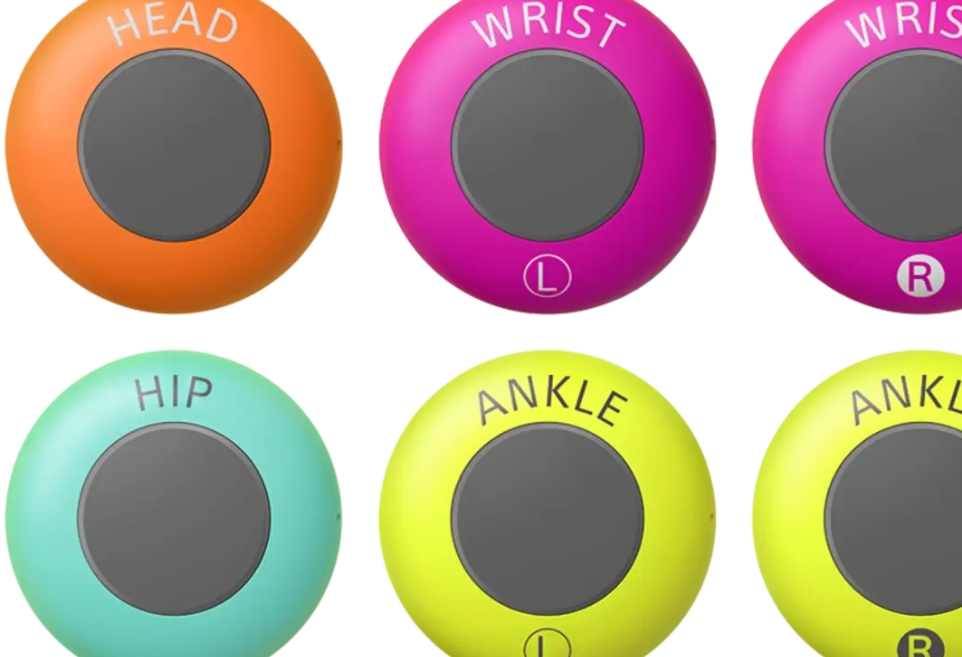
The complete Mocopi system consists of six lightweight sensors (8g each) worn on the head, wrists, waist, and ankles. Compact and easy to wear, the system requires no professional motion capture studio, optical cameras, or tight-fitting bodysuits; users can record while wearing everyday clothing. It supports use in both indoor and outdoor environments, completely breaking the spatial limitations of traditional motion capture equipment and making it one of the most accessible full-body motion capture systems available. - Minimalist operation, beginner-friendly
The device requires no complex setup; users can quickly start capturing data by connecting via Bluetooth to the smartphone app. It supports real-time avatar driving, motion recording, and video generation. Even users with no prior experience can get started after a brief learning period, making it ideal for individuals looking to quickly produce short videos featuring virtual avatars or simple motion-captured content for live streams. Additionally, each sensor offers up to 10 hours of battery life, meeting the needs of a full day of light usage. 3. Wireless freedom, unrestricted movement
Utilizing Bluetooth 5.2 wireless transmission with a 10-meter effective range, the system eliminates cable constraints during recording, allowing for large-scale physical movements such as walking, jumping, and turning. This offers significantly greater flexibility compared to wired motion capture equipment, making it well-suited for casual, everyday creative scenarios.
(II) Critical Flaw: Structural defects that cannot be fixed via OTA updates
- Inherent flaws in inertial motion capture: poor dynamic accuracy and severe motion distortion
This is Mocopi’s most fundamental and intractable weakness. The product relies solely on inertial sensors for capture without optical calibration assistance, resulting in extremely poor adaptability to varying movement speeds. Real-world testing reveals stuttering and latency during slow arm raises or subtle limb adjustments; conversely, rapid running, jumping, or sharp turns lead to issues such as limb misalignment, skeletal distortion, motion drift, and shifts in the center of gravity. The manufacturer has publicly acknowledged that the device cannot handle overly fast or slow, intricate movements, making it entirely unsuitable for creative scenarios requiring fluid, precise motion.
Furthermore, the device lacks absolute spatial positioning; positional drift inevitably occurs during extended recording sessions, necessitating frequent manual recalibration. This disrupts the creative flow and results in a very poor real-time streaming experience. - Severely limited joint capture; complete lack of hand detail
The six-sensor hardware configuration can only capture the general movements of the torso and limbs. - Subpar algorithm optimization; frequent errors in pose recognition
Testing reveals recognition errors in many standard movements: a cross-legged sitting pose may be registered as standing; bending over often causes torso distortion; walking with crossed legs leads to skeletal clipping; and turning in place frequently results in limbs shifting in the wrong direction. Even after multiple OTA updates, fundamental issues with pose recognition remain unresolved, and the algorithm’s maturity lags far behind domestic competitors in the same price range. - Limited ecosystem compatibility; disconnected from professional creative workflows
Mobile support is restricted to basic short-video recording and simple VR avatar control, with very poor overall compatibility. The PC-side functionality is incomplete; compatibility with mainstream professional animation software and live-streaming platforms is poor; and the limited motion data export formats prevent seamless integration with industry-standard tools like Maya and Blender. For professional creators, the recorded motion data offers little value for post-processing or editing, making it unsuitable for commercial-grade animation, film, or game production. - Weak interference resistance and poor stability
Bluetooth transmission lacks robust interference resistance; the presence of nearby wireless devices, routers, or other Bluetooth equipment leads to data disconnection, dropped frames, and visual stuttering. Furthermore, the sensors rely on straps for attachment, making them prone to slight shifting during vigorous movement—directly causing data distortion. Both the physical stability of the wearable and the stability of the data output are severely lacking. - Excessive price markup; extremely poor value for money
Priced at over 2,000 RMB, it offers only basic, coarse full-body motion capture while lacking hand tracking, high-precision algorithms, and professional software compatibility. The hardware specifications and functionality fail to justify the price tag—a classic case where the “Sony brand premium” far outweighs the actual product capability.
II. Comparative Analysis: Thoroughly Outclassed by Domestic Competitors in the Same Price Range
The consumer-grade portable motion capture market is now mature. Compared to mainstream domestic devices, Sony Mocopi offers no advantages other than portability; its overall product performance is completely eclipsed.
- Comparison with NOLO Full-Body Motion Capture and Rokid Motion Capture Kits
Domestic portable motion capture devices in the same price range typically feature optimized inertial algorithms, resulting in smoother motion capture, reduced drift, and higher pose recognition accuracy. Some models even support basic finger tracking, enabling a wider range of interactive live-streaming scenarios. Additionally, domestic devices are deeply optimized for local live-streaming platforms and editing software, offering far superior ecosystem compatibility. They also provide better after-sales support and localized tutorials, delivering a comprehensively superior user experience. - Comparison with Professional-Grade Motion Capture (High-end Optical Systems, Mocopi Pro)
Sony’s own Mocopi Pro features 12 sensors and supports granular tracking of thighs and forearms, offering significantly higher precision suitable for light professional work. In contrast, the standard Mocopi has half the number of sensors and weaker hardware specifications, effectively serving as a stripped-down entry-level version. Compared to optical motion capture systems costing tens of thousands of yuan, the standard version of Mocopi falls leagues behind in terms of accuracy, stability, detail capture, and professional compatibility; it is entirely unsuitable for commercial or professional production. - Its inertial motion capture architecture—which lacks inherent optical calibration—means it cannot resolve issues like dynamic distortion or long-term drift. Even with continuous OTA updates, hardware limitations cannot be overcome, and accuracy will never meet professional standards for fluidity.
- Casual users on a budget seeking good value should not buy it blindly.
For purely recreational purposes, one can easily choose domestic alternatives costing only hundreds or a thousand yuan. Paying double the price merely for the Sony brand and portability results in extremely low practicality and a massive price premium. - Essential considerations for those who decide to buy
If you insist on purchasing it for occasional short-video entertainment or light VR leisure, be aware of the following: you must ensure an environment free from wireless interference, manually reset your pose every 3–5 minutes, avoid rapid, large-scale movements, stick to recording smooth, standard limb motions, and—crucially—manage your expectations regarding capture accuracy and detail fidelity.
IV. Final Verdict: A Niche Entertainment Toy, Not a Professional Motion Capture Tool
The sole core value of Sony Mocopi is that it lowers the barrier to entry for full-body motion capture to the point where anyone can use it, allowing average users to experience basic motion capture without professional equipment or studio space. However, aside from its portability and ease of use, the product falls short across the board in terms of accuracy, detail, algorithms, ecosystem, and value for money.
It is essentially an entry-level, entertainment-focused “work-in-progress” product, suitable only for a tiny subset of users who prioritize extreme portability, light entertainment, or simply want to try out the technology without prior experience. For professional creators, streamers, and industry practitioners, Mocopi is completely inadequate for the job; it not only wastes the budget but also severely hampers creative efficiency and content quality. If you have the same budget, prioritize high-precision, portable motion capture devices from domestic brands; the user experience will be vastly superior.