
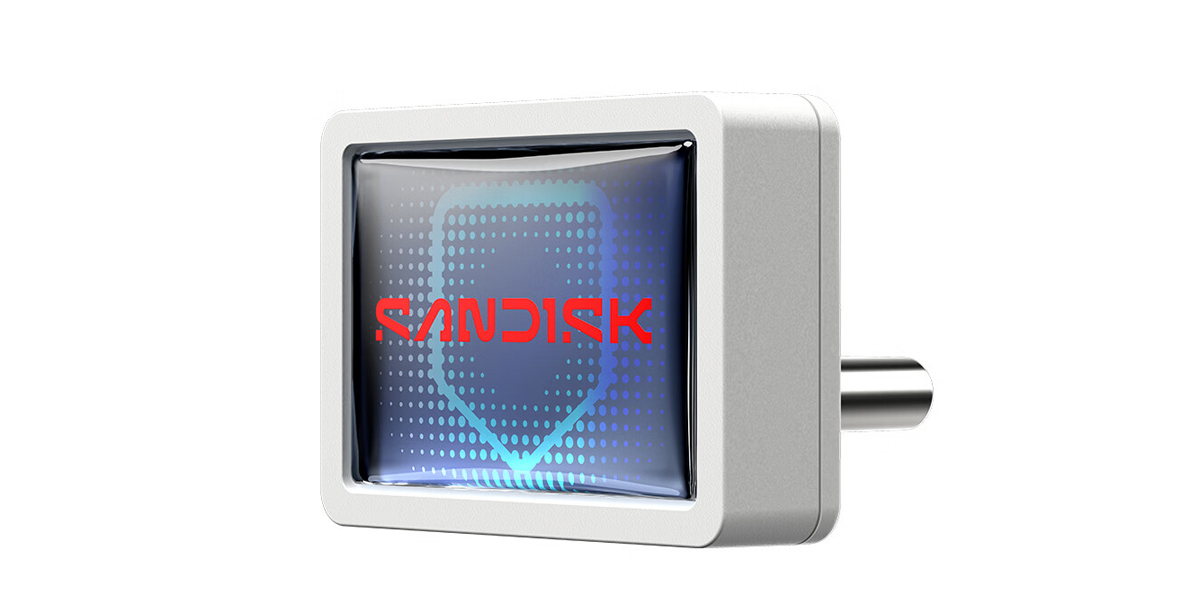
It was just after six in the morning when the owner of a black electric sedan found a deep scratch running along the passenger side door of the vehicle, parked overnight in an open-air commercial lot a kilometer from his apartment. There were no cameras on the lampposts, no witness, no note tucked under the wiper. What there was, instead, was a three-gram plastic rectangle tucked into a USB-C port near the car’s center console — a stick no larger than the tip of his thumb, white on its edges, with a dark blue face that glowed faintly with a shield outline and the word SANDISK in red. That stick had been awake all night. When the owner plugged it into his laptop over breakfast, the footage showed a silver hatchback pulling alongside at 2:14 a.m., a door swinging open, a glancing contact, and then the hatchback rolling away. A license plate, faintly legible in the compensation exposure, was enough to file an insurance claim that would otherwise have been written off as one of those parking-lot mysteries that simply vanish.
The device that made that possible is the SanDisk CZ53C, a new member of the SanDisk flash-drive family that the company quietly began selling in China in the opening days of October 2026. On paper it is a modest object: a USB-C flash drive, the same category of product that has been a $5 afterthought at checkout counters for two decades. In the business narrative underneath it, the CZ53C is something more — a deliberate, purpose-built answer to a problem that barely existed five years ago and has now, thanks to the spread of AI-equipped cars, become a permanent 24-hour-a-day data-accumulation chore. Its arrival on the market is a small but revealing data point in the larger story of how the automobile, long a mechanical object, became a storage-device host that writes video continuously, whether you are driving it, sitting in it, or fast asleep in your bed a kilometer away.
This review was written on the day the product went on sale. That timing has consequences. The CZ53C is not yet available outside China, there is no long-term road-test fleet of them in the field, and SanDisk has not published a full datasheet in the Western markets where the brand’s reviews are usually written. What follows is therefore built on the specifications the company has confirmed, on the publicly reported launch details from Chinese retail and technology press on October 12, 2026, and on the well-understood engineering context of SanDisk’s broader high-endurance flash family. Where a figure is specific to the CZ53C, it is reported as such. Where a behavior — temperature tolerance, wear leveling, recovery software, the economics of NAND endurance — is a property of the wider SanDisk automotive-grade approach rather than a number printed on this exact box, that distinction is kept explicit.
It is worth saying plainly what the launch documentation does and does not tell us, because the whole product rests on a single number. SanDisk confirms the capacities, the dimensions and weight, the USB 3.2 Gen 1 interface, the 400MB/s read figure, the operating and storage temperature ranges, the tiered warranty, the Chinese retail prices, and the 40,000-hour loop-recording rating on the 1TB model. It has not, as of launch, published the sustained write throughput, the total terabytes written (TBW) endurance figure in the conventional datasheet form, a rating for waterproofing or shock beyond the implicit robustness of a sealed USB stick, or a Mil-Spec drop specification. A reader who wants a complete, every-box-ticked datasheet will not find one on day one; the company has chosen to lead with the use case rather than the spreadsheet. That is a marketing judgment, and it is a fair one for a consumer product sold on a store shelf, but it is also the reason this review leans on the engineering context rather than pretending every parameter has been independently verified.
What It Actually Is
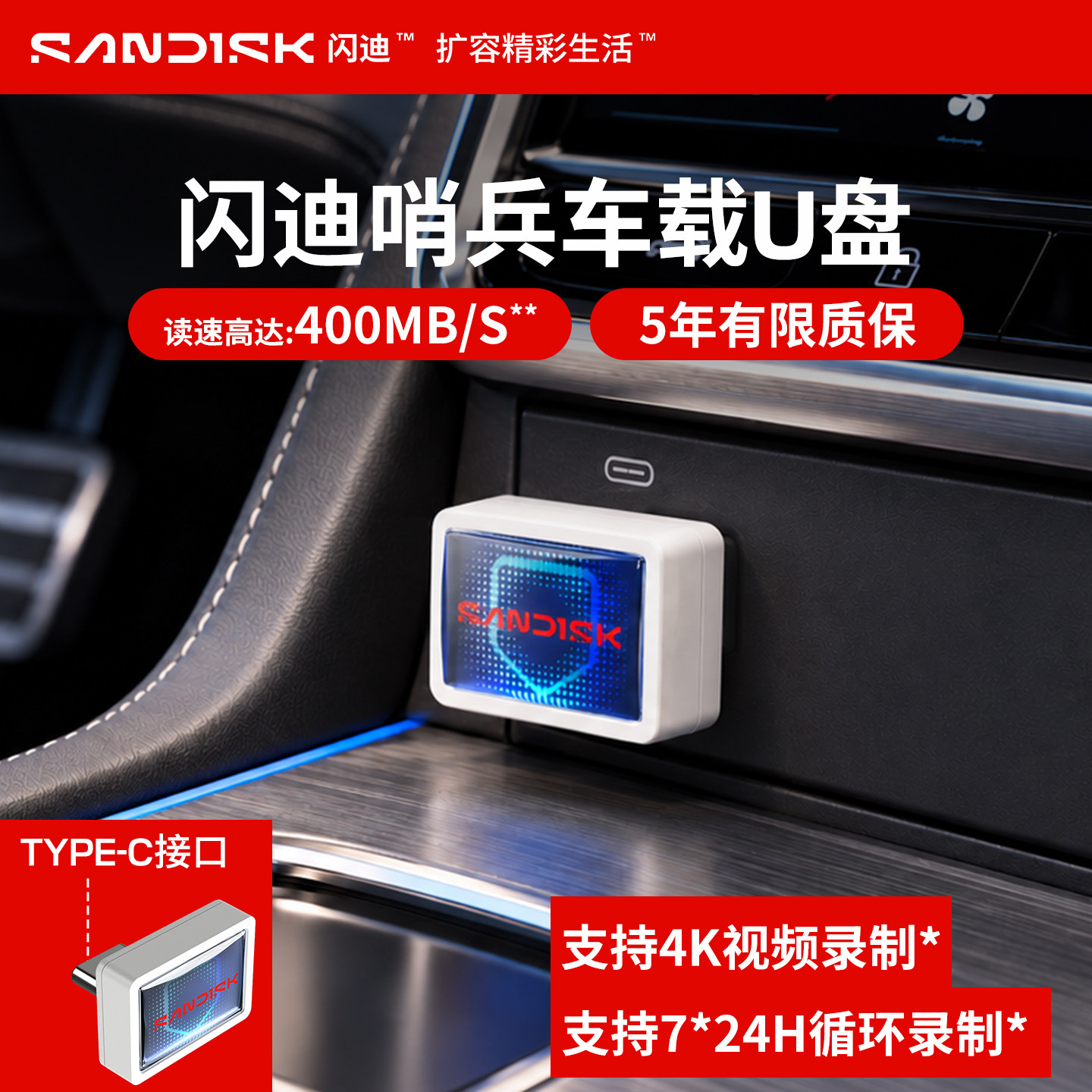
The CZ53C, formally marketed as the “Sentinel Mode dedicated” USB flash drive, is a compact USB-C stick designed to live, more or less permanently, in the data port of a modern connected or electric vehicle. SanDisk lists it for two overlapping jobs: recording the continuous video feed from a car’s built-in dashcam while the engine or drivetrain is running, and — the more distinctive of the two — continuing to record the world around the parked car while the vehicle itself is off, a feature most associated with Tesla’s Sentry Mode but increasingly adopted, under one trade name or another, by Chinese EV makers, Korean luxury brands, and a growing list of connected vehicles.
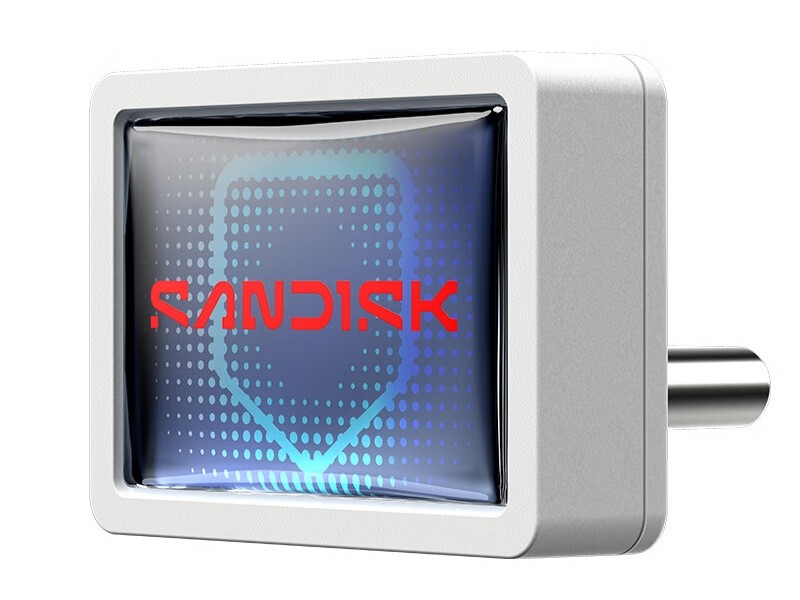
The physical object is deliberately unobtrusive. SanDisk quotes dimensions of 18.5 by 13.6 by 16 millimeters and a weight of roughly three grams. Once inserted into a recessed USB-C data port, the company says it protrudes only about ten millimeters — short enough, the product photography argues, that it disappears into the black plastic of a center console rather than sticking out to be knocked by an elbow or caught on a charging cable. That is a more important design constraint than it sounds: a flash drive that juts out conspicuously is one a car owner will eventually bump, and a flash drive that gets bumped out of its port at 2 a.m. is, for the purpose of a Sentry recording, a witness that looked away.
Inside the connector the drive uses USB 3.2 Gen 1, the 5-gigabit-per-second standard more often called USB 3.0 in casual conversation, with SanDisk advertising sequential read performance of up to 400 megabytes per second. Read speed, not write speed, is the number SanDisk chose to headline — a telling choice, and one worth dwelling on in a moment. Write throughput for the CZ53C has not been publicly disclosed at launch, which is not unusual for a dashcam-oriented drive, where the continuous write rate required by compressed video is modest and the marketing priority is instead the speed at which you can pull an incident clip off the device and onto your phone or laptop when something actually happens.
The design language itself telegraphs what the product is for. The stick is finished in matte white, the color of a discreet accessory rather than a flashy one, and its face is a dark, translucent panel printed with a faint dotted outline of a shield — the “sentinel” — behind a small, bright red SanDisk wordmark. It is not a neutral design; it is a small, deliberate badge, telling anyone who glances at the center console that this port is occupied by something that is watching the car. That visual restraint is part of the value. A drive that looks like an obvious, expensive accessory invites curiosity and, in a serviced car wash or a valet lot, the occasional probing hand; a drive that disappears into the console invites nothing at all. SanDisk has chosen the vanishing act over the declaration, and in doing so it has built the product around the single most important property of a security recorder: that it is taken for granted until the moment it matters.
SanDisk sells the CZ53C in four capacities that are actually on retail shelves — 128GB, 256GB, 512GB, and 1TB — with a 64GB variant listed in the product family but not yet stocked. The endurance claim that anchors the entire product, and that dominated every news report about the launch, is this: the 1TB version is rated by SanDisk to support up to 40,000 hours of continuous, overwriting, 24/7 loop recording. Forty thousand hours is a useful number to translate. It is just over four and a half years of nonstop running, hour after hour, with the oldest footage being erased and overwritten as the drive fills. SanDisk is not promising that the drive will hold 40,000 hours of footage — no drive the size of a thumb could. It is promising that the flash memory itself is engineered to survive being written, and rewritten, and rewritten again, for that long, without failing.
Product Market Analysis
To understand why a three-gram USB drive is worth a six-thousand-word review, you have to understand the market that produced it.
For most of the history of the automobile, the car generated almost no data that needed to be stored. It generated motion, heat, noise, and a finite set of diagnostic codes, all of which lived on ephemeral memory chips inside an engine-control unit and were overwritten on the next drive cycle. That world ended, gradually at first and then very quickly, once cars began to carry cameras. A dashcam — a camera aimed at the road, recording continuously to a memory card — moved from a niche gadget used by taxi fleets and driving enthusiasts to a near-universal accessory. Then, around 2019, Tesla introduced Sentry Mode, which repurposed the car’s external cameras as a security system for the parked vehicle, and the storage problem changed in kind as well as degree.
A moving dashcam writes, at most, while the car is moving. A Sentry system writes while the car is parked. It records on a loop in a low-power standby, wakes to higher resolution when it detects a threat near the vehicle, and keeps the last ten minutes of footage locked away when an event triggers it. Multiply that by a modern EV with eight to twelve cameras, by a car that sits in an unattended parking structure for ten hours a night and eight hours a workday, and by a vehicle that owners now expect to act as an alarm system, a dashcam, a neighbor-watcher, and a witness all at once, and you arrive at a device that is writing video to storage not for minutes a day but for the large majority of the hours in a year.
That demand lands on a part of the supply chain that was not designed for it. A conventional consumer USB flash drive, the kind sold two-for-one at electronics chains, is engineered for the pattern of use humans actually have with them: copy a few files, unplug it, leave it in a drawer for six months, copy a few more. The NAND flash inside such a drive is rated for a finite number of program-erase cycles per memory cell, and the controller firmware inside is tuned for sporadic, bursty writes, not a low-but-never-ending drip of video data. Run a generic consumer drive in a parked-car Sentry loop, and two failure modes follow. The first is gradual: the drive fills up, the controller’s garbage collection falls behind, frame drops appear, and the recording stutters or stops at exactly the moment a two-second clip would have captured a license plate. The second is abrupt: the memory cells wear out ahead of the controller’s expectation, the drive throws a read-only error, and it silently stops recording altogether. By the time a troublemaker slams a shopping cart into the door, the witness has been dead for weeks.
The economics behind that failure are worth understanding, because they are the economics the CZ53C is priced against. Every cell of NAND flash can be written and erased only a finite number of times before it can no longer hold a charge reliably; that budget is a hard property of the silicon, set at the factory, and it is expressed in datasheets as a total number of program-erase cycles. Two further factors decide how fast that budget is spent. The first is write amplification: every byte the car asks the drive to record may, because of how flash memory erases in blocks rather than bytes, cost several bytes of actual writes once the controller moves data around to keep the drive healthy. The second is the controller’s wear-leveling intelligence, which spreads writes evenly across every cell so that no single corner of the drive burns out first. A dashcam loop is, by good fortune, a relatively write-friendly workload — the video bitrate is modest and the writes are continuous rather than random — but it is unforgiving in duration. A drive built for occasional file copies has neither the margin of spare cells to absorb write amplification nor the firmware maturity to balance years of nightly recording against a budget designed for weekend photo transfers. SanDisk’s 40,000-hour figure is, underneath the marketing, a promise that the cell budget, the spare-area overprovisioning, and the controller tuning have all been chosen with this workload in mind.
The market response to that failure has arrived in waves. First came endurance-rated microSD cards — SanDisk’s own High Endurance line, Samsung’s PRO Endurance, Kingston’s High Endurance — sold into dashcams that had an SD slot. Then came purpose-built automotive SSDs, sold as upgrades to the early Teslas whose onboard flash filled up within months of Sentry Mode’s introduction, after which Tesla itself sold its own branded drive. Now, with the CZ53C, SanDisk is going a step further upstream of the aftermarket: a flash-drive — the cheapest, simplest, most universal storage form factor there is — re-engineered from the silicon up to behave like an automotive component.
The commercial logic is not hard to see. China, where the CZ53C launched, is the world’s largest and most competitive EV market, crowded with brands that compete on software, screens, and, crucially, on the surveillance and convenience features that differentiate a connected car. Sentry-mode-style parking surveillance is no longer a Tesla exclusive; it is a table-stakes feature across most new EVs sold in China in 2026, and it is spreading through the lineup of nearly every global maker. Every one of those cars ships with at least one USB data port, and increasingly it is a USB-C port. Every one of those cars, therefore, is a potential customer for a three-gram drive that is purpose-built to sit in it. SanDisk — the consumer brand of Western Digital, one of a shrinking handful of NAND-flash manufacturers that actually makes its own memory rather than buying it in — is positioned to capture that demand at the moment it is broad enough to be worth a dedicated product line rather than a footnote in a spec sheet.
It is not as though this demand arrived out of nowhere. The early years of Tesla’s dashcam and Sentry features are a useful cautionary tale, and one that frames the entire category. When those features launched, owners plugged in whatever USB drive they happened to own — the same drives they used to move vacation photos between computers. Within months, a conspicuous number of those drives wore out, filled up, or failed mid-recording, and a predictable wave of forum complaints followed. The upshot was that Tesla itself began selling an official, pre-formatted storage upgrade for the cars, and the broader industry quietly learned a lesson: the storage device was now part of the safety and convenience system, and it could not be left to the cheapest possible option at the bottom of the accessory drawer. The CZ53C is the mature end of that learning curve. Where an early Tesla owner had to improvise, a 2026 car owner can now buy a drive that the flash manufacturer itself has built, from the NAND upward, for exactly the job the car is asking it to do. The broader market implication is that automotive storage is shifting from an aftermarket improvisation to a specified, branded component — and that the specification is being written, increasingly, by the memory makers rather than the car companies.
The deeper tailwind is the rise of “AI” in the car, and what that does to write volumes. A vehicle that merely records video is a modest consumer of storage; even a 4K feed at a steady bitrate fills space slowly. But an AI-equipped car that simultaneously records, buffers, and increasingly caches sensor data — camera streams intended for later offline analysis, short clips retained for driver-assistance refinement, event logs tied to autonomous-driving development — writes more, more often, and more unpredictably. The CZ53C’s headline 40,000-hour figure is, in this sense, a hedge against a future in which the car’s storage workload looks less like a dashcam and more like a small, always-on data server. SanDisk is selling not merely a flash drive but an endurance warranty expressed in units of time.
Competitor Product Analysis
The flash drive that lives in a car did not exist as a category six months ago, but the alternatives a buyer will weigh against it are well established. They fall into four families, and each has a different argument.
The most direct competitor on price and familiarity is the Samsung USB flash drive family, of which the Fit Plus and the BAR Plus are the best-known in global retail. Samsung, like SanDisk, is a vertically integrated NAND maker, so the engineering competence is not in question. A Samsung BAR Plus is a rugged metal-cased USB-A drive, and the Fit Plus is a compact USB-C stick in the same physical neighborhood as the CZ53C, sold for roughly a quarter of the CZ53C’s price in equivalent capacity. The catch is that these are general-purpose drives. They carry no automotive temperature rating, no Sentry-specific endurance figure, and no marketing language about 24/7 loop recording. A buyer who reaches for a Samsung Fit Plus to save money is buying the same flash NAND in a consumer chassis — fine for a dashcam that records only while driving, a calculated gamble for one that records around the clock, and a poor fit if the goal is a witness that never blinks. Samsung’s own endurance answer exists, but it lives in the microSD High Endurance line rather than in the USB drives on the retail shelf; the CZ53C is notable precisely because SanDisk has chosen to bring the endurance ethos to the USB-C port where Samsung’s mainstream drives still play.
The second familiar name is Kingston, whose DataTraveler line has been the default office-supply USB drive for two decades. Kingston makes endurance products — its High Endurance microSD and its industrial-grade USB drives exist precisely for continuous-write environments — but those are positioned for embedded and industrial customers, sold in different channels, and rarely advertised to the person buying an accessory for their passenger car. A mainstream DataTraveler, bought off the shelf, is in the same position as the Samsung drive: competent silicon, generic firmware priorities, no automotive envelope. Where Kingston matters in this story is as a reminder that “endurance USB” is not a new idea in industrial markets — SanDisk’s contribution is to take that industrial idea, wrap it in a thumb-sized consumer package, and price it for the owner of an electric sedan rather than a factory automation integrator.
The third competitor is Lexar, a brand that has, in recent years, concentrated heavily on the dashcam and action-camera memory market with its High-Endurance microSD cards and, increasingly, compact USB-C drives aimed at mobile and in-car use. Lexar’s pitch to the car owner is similar in spirit to SanDisk’s: continuous-write durability, an emphasis on recording hours rather than on transfer speed, and a price point below the premium brands. The difference between Lexar and SanDisk in this particular product is one of branding and trust rather than engineering; a Lexar endurance card will do a credible job, but SanDisk is the brand most associated, in the mind of the car-owning public, with the microSD and flash that sits in a dashcam. The CZ53C is, among other things, SanDisk trying to own the USB-C port the way it has long owned the SD card slot.
The fourth and most consequential set of alternatives is not another flash drive at all. It is the endurance microSD card and the automotive SSD. A dashcam that has an SD slot, rather than a USB port, can take a SanDisk High Endurance or Samsung PRO Endurance microSD — cards explicitly rated for years of continuous recording, often advertised in units like “up to 20,000 hours” or a specified TBW. Those cards are the honest, proven incumbent for dedicated dashcams, and for a pure dashcam user they remain the rational choice. Where they fall short is in a car’s built-in Sentry system, which, following Tesla’s lead, writes to a USB storage device rather than an internal card slot, and which a driver needs to plug into a computer to export clips. The automotive SSD — a small solid-state drive in an enclosure, sold as a Tesla upgrade — is the other incumbent: higher capacity, faster, and more durable than any USB flash drive, but also physically larger, more expensive, and visible in the console. The CZ53C is the product that slots between them: smaller than an SSD, more purpose-built than a generic flash drive, and matched to the USB-C port that nearly every new connected car now ships with.
The honest summary of the competitive field is that the CZ53C is not beating a market of identical automotive flash drives, because that market barely exists yet. It is competing against the owner’s instinct to buy the cheapest USB drive that fits, and against the older habit of using an endurance microSD in a slot that no longer exists. SanDisk is, in effect, defining the product as it ships it.
Pros and Cons
The case for the CZ53C is strongest when it is argued on its own terms. The first advantage is the engineering credibility that comes from being made by an integrated NAND manufacturer rather than a brand that resells someone else’s memory. The 40,000-hour endurance rating on the 1TB model is a claim that can be made only by a company comfortable standing behind the wear behavior of its own silicon, and it directly addresses the single most common failure mode of consumer drives in parked-car recording. The second advantage is physical: a 3-gram stick that protrudes only ten millimeters is the correct answer to the in-car environment, where a drive that sticks out is a drive that gets knocked loose, and a drive that is knocked loose is a drive that misses the incident. The third is the read speed — up to 400 megabytes per second — which matters precisely at the moment that matters, when you pull the stick out of the car at breakfast and want the night’s footage on your laptop before you leave for work. A slow drive would mean staring at a progress bar during the one hour of the day you have free. The fourth advantage is the tiered warranty, which — as SanDisk has confirmed at launch — runs two years on the 128GB and 256GB models, three years on the 512GB, and five years on the 1TB. That ladder is itself a statement: the company expects the largest, most endurance-rated model to outlast the smallest one, and it prices and warrants accordingly.
The disadvantages are the same facts, viewed from the other side. The price is the loudest of them. At launch in China, the 128GB model costs 499 yuan, the 256GB 799, the 512GB 1,399, and the 1TB 2,599. Translated loosely, the 1TB model runs the equivalent of well over three hundred U.S. dollars for a thumb drive — several times what a buyer would pay for a generic consumer USB-C drive of the same capacity. That premium buys the endurance rating, the temperature envelope, and the brand warranty, and a buyer has to decide whether their parking-lot peace of mind is worth it. The second limitation is the temperature range. SanDisk lists an operating temperature of 0 to 60 degrees Celsius and a storage range of minus 10 to 70. That is meaningfully broader than a consumer USB drive, which is usually rated 0 to 45, but it is not the deep automotive envelope — minus 40 to 85 — that defines a true automotive-grade component, and it will not guarantee flawless operation in a car parked for hours in a desert sun or a deep-winter open lot. The third limitation is that the write speed is not disclosed, which means the buyer cannot independently verify the continuous-write ceiling against the bitrate of their particular car’s cameras. The fourth is geographic: at launch the CZ53C is a China-market product, with no announced availability, pricing, or warranty terms in North America, Europe, or other markets. And the fifth is the category’s inherent fragility: a USB-C stick, however well engineered, is still a removable connector exposed to a console’s dust and heat, and it will never be as sealed away as the internal storage of a car designed around it.
Consumer Buying Considerations
For a buyer deciding whether the CZ53C belongs in their car, five questions do most of the work.
The first is capacity against loop time. A loop-recording drive does not need to hold months of footage; it needs to hold as many hours as you are willing to replay before the oldest clips are overwritten. SanDisk’s 40,000-hour figure is an endurance number — how long the memory lasts — not a storage number, and the two are easily confused. A 128GB drive, for instance, will only hold a finite number of hours of 4K footage before it begins overwriting, even though the underlying memory is rated to survive years of that overwriting. A buyer should choose capacity based on how long they want a clip to survive before it is cycled out — a few hours of buffer for daily driving, a longer buffer for a car that sits unattended for days — rather than on the headline endurance number. The 1TB model is for the owner who wants the longest buffer and the longest rated life; the 128GB model is for the owner who only needs a modest, reliable loop and would rather pay less.
The second question is the temperature envelope of the place the car actually lives in. A car parked in a climate-controlled garage sees a narrow, benign temperature range, and the CZ53C’s 0-to-60 operating range is comfortably adequate. A car parked in direct sun in a subtropical summer, where a dashboard can exceed the surface temperature of a roasting oven, or in a northern winter where the interior sits well below freezing overnight, is a harder case. SanDisk’s rating is a real improvement over a generic drive, but a buyer in an extreme climate should buy a console that is shaded, or position the drive so it is not baking in a sunbeam, rather than assuming any flash drive is immune.
The third question is what separates this drive from the ordinary USB drive they might otherwise buy. The difference is not the read speed — many consumer drives are fast enough to export a clip — but the combination of continuous-write endurance, a controller tuned for an unending loop rather than a bursty copy, and a warranty that assumes years of unattended operation. A generic drive bought for ten dollars will probably work for a while; the bet the CZ53C makes is that “probably” is not good enough for a witness you cannot schedule.
The fourth question is the USB interface. The CZ53C is USB-C and USB 3.2 Gen 1, which matches the data ports on virtually every new connected and electric vehicle sold in the last few years, and the 400MB/s read speed is meaningful only when the port and the cable support it. A car with only an older USB-A port, or a USB-C port that is wired for power rather than data, will not use the drive’s full capability — and in the worst case will not recognize it for recording at all. Checking whether the car’s port is a data port, not merely a charging port, is the single most useful pre-purchase check an owner can do.
A related and surprisingly common point of failure is the file system and the folder structure the car expects. Cars with built-in Sentry and dashcam systems generally look for a specific directory on the drive before they will write to it, and they are picky about the file system format — typically expecting an exFAT or FAT32 structure rather than a drive that has been formatted on a phone or a recent operating system with a defaults the car does not understand. A brand-new CZ53C will, in most cases, be ready to accept the car’s formatting routine out of the box, but an owner who has already used the drive for something else should let the car reformat it rather than copying files onto it from a computer. This is the kind of mundane detail that separates a drive that records on the first night from one that shows a “no storage detected” warning on the dashboard, and it is worth ten minutes of the owner’s attention rather than a week of wondering why the witness has been silent.
The fifth question is data recovery and warranty, and here the consideration is less about the drive’s hardware and more about the ecosystem around it. SanDisk products have long shipped with access to the company’s recovery software, and the broader SanDisk rescue-recovery offering is a meaningful part of the value proposition for a drive whose entire purpose is to hold footage you may need to recover rather than merely read. A deleted Sentry clip is, in a real sense, the product; the software that undoes an accidental delete is part of what justifies the premium price. The tiered warranty — two, three, and five years by capacity — should also be weighed: the larger drives carry the longer guarantee, which is SanDisk’s way of saying it trusts the larger models in the most demanding use.
A final practical note, specific to the launch: because the CZ53C went on sale in China on the day this review was written, a buyer elsewhere in the world will, for the foreseeable future, be choosing between importing the drive and waiting for a Western-market release. Until that release arrives, the honest alternative for a non-Chinese owner is an endurance microSD card in a dashcam slot, or an automotive-grade USB drive with a comparable temperature and endurance story — while watching for the CZ53C to be localized.
The cost-benefit arithmetic is worth doing in the open. A generic USB-C drive of the same capacity costs a fraction of the CZ53C’s price, and for a driver who only ever records while the car is moving, that generic drive is probably adequate. The premium SanDisk charges buys three things that the generic drive does not: the confidence that the recording will not silently die after a few months of overnight use, a temperature envelope broad enough for the realities of a parked car, and a warranty and recovery ecosystem behind the footage. Whether those are worth, say, the difference between a cheap drive and a 1TB CZ53C comes down to how much the owner cares about the ten-minute window around an incident that, on any given night, will never happen — and on the rare morning when it does, how much they will wish the cheap drive had been built better. For owners of cars whose Sentry feature is already in daily use, for fleet and ride-hailing vehicles that record around the clock, and for anyone who has ever come back to a parked car and found a mystery scratch, the premium is not really a price at all; it is the cost of having a witness you can actually trust.
Market Summary and Product Summary
The market the CZ53C arrives in is one in which the car has quietly become a 24-hour recording device, and the storage industry is only now catching up to what that means. For a century, automotive innovation was measured in horsepower, aerodynamics, and crash structure. Increasingly, it is measured in how long a small, cheap component can keep recording faithfully after the driver has walked away. Sentry-mode surveillance, built-in dashcams, and the slow creep of AI-driven sensor logging have converted the parking lot from a place of vulnerability into a continuous-data environment. Someone has to supply the memory that absorbs that data, and SanDisk — sitting atop the NAND supply chain as one of the last integrated manufacturers standing — is well placed to do it. The CZ53C is, in that light, a symptom as much as a product: evidence that the demand for in-car endurance storage has grown large enough to warrant a dedicated, branded, premium-priced line rather than a footnote on a spec sheet.
The business read on the launch is quietly significant. For decades, the flash-drive business was a commodity market: razor-thin margins, endless price competition, a product distinguished mostly by capacity and price. A premium, purpose-built automotive drive, sold at several multiples of the commodity price and warrantied by the hour rather than by the year, is SanDisk’s attempt to climb out of that trap — to turn a disposable accessory into a specified component with a trust premium attached. If the bet works, it will not stop with the CZ53C. The same logic extends to the microSD endurance line, to automotive SSDs, and eventually to the embedded storage that future cars will carry as a matter of course. The CZ53C is the consumer-facing beachhead for that larger strategy, and the reason it is worth watching even for a reader who has no immediate intention of buying a thumb drive.
As a product, the CZ53C is a narrow, well-executed answer to a narrow, well-defined problem. It is a three-gram USB-C stick, rated for 400MB/s reads, available from 128GB to 1TB, with the 1TB model rated to endure 40,000 hours of continuous loop recording, an operating range of 0 to 60 degrees Celsius, and a warranty that scales from two to five years with capacity. Its virtues are exactly the virtues a parked-car witness needs: it is small enough not to be knocked loose, fast enough to export a clip before breakfast, durable enough to keep writing while the car sleeps, and backed by a manufacturer whose name is on the memory chips themselves. Its costs are equally plain: a price several times that of a generic drive, a temperature envelope that is improved but not extreme, an undisclosed write speed that leaves the buyer trusting the rating rather than verifying it, and a launch that is, for now, confined to the Chinese market.
The morning scratch on the passenger door, the dashcam clip exported over coffee, the ten minutes of locked footage that precedes a threat — these are not dramatic events in the life of a car. They are the small, unglamorous reason a piece of flash storage exists. The SanDisk CZ53C is the rare product built around the assumption that the recording should never stop, even when the car itself has. Whether that assumption is worth its premium price is, in the end, a judgment each owner makes about how much they value having a witness that, unlike the rest of us, was paying attention all along.