
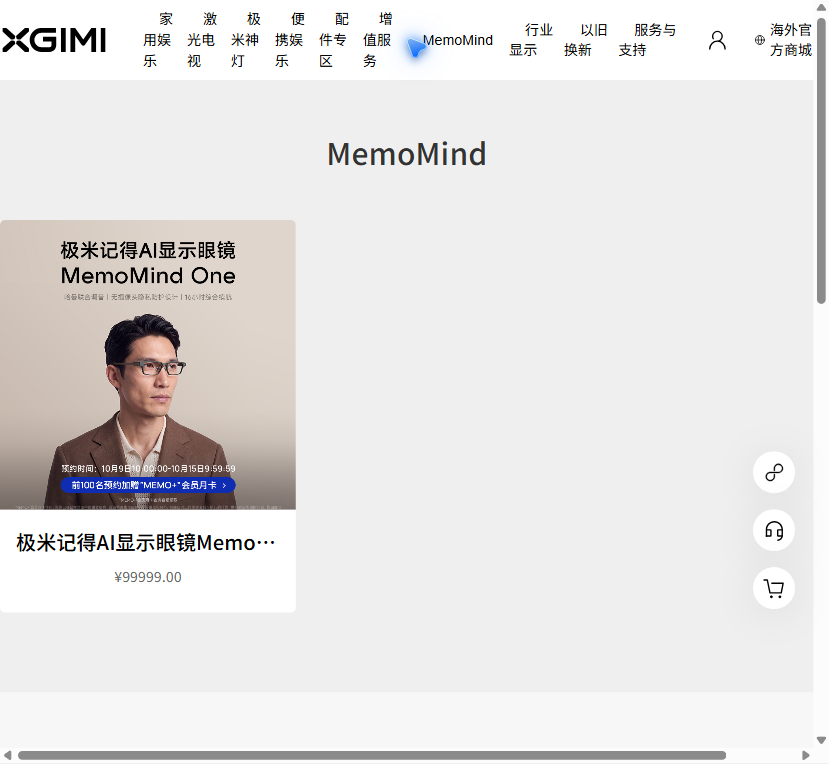
XGIMI, the Chinese projector maker, has decided your face is the next screen. Its newly incubated wearable brand, MemoMind, opened domestic presales for the Memo One around October 10, 2026, after a Kickstarter that pulled in over a million dollars. The Standard Edition starts at $599, with prescription lenses pushing it to $699; the Custom Edition begins at $749. On paper, it is a 46.6g pair of glasses with a dual-eye micro-LED waveguide display, Harman-tuned open-ear speakers, 26-language translation, a teleprompter, AI meeting notes, and 16 hours of claimed battery. It is also completely camera-free. That choice is the entire pitch — and the entire problem.
The Weaknesses
1. The display is monochrome green and low-resolution. The Memo One uses a 640×350 monochrome green micro-LED waveguide. That is 2022-era display technology on a $599 device in 2026. There is no color, no video, no image overlay — only text, notifications, and navigation prompts in green. Compare to Ray-Ban Meta Gen 2, which has no display at all but costs $200 less, or the XREAL AURA with full-color Micro-OLED. The Memo One display is a deliberate step back.
2. The no-camera design strips out the most useful AI features. The selling point is privacy, but removing the camera means no visual AI: no real-time translation of signs or menus, no visual search, no object recognition, no first-person photos or video. The AI can only listen and speak. It is an earpiece with a text display, not an AI wearable in the 2026 sense.
3. Prescription support is single-vision only. XGIMI only supports single-vision prescription lenses. Progressive and bifocal wearers are out of luck. The custom edition starts at $749, and prescription lens add-ons push it well past $800. At that price, you are competing with Ray-Ban Meta plus a separate pair of prescription glasses.
4. It is phone-dependent for everything meaningful. The glasses have no standalone cellular or Wi-Fi. All AI processing, translation, and meeting notes happen on your connected phone over Bluetooth. If your phone dies, the glasses become an expensive paperweight. Battery life is claimed at 16 hours but depends on what your phone is doing in the background.
5. Crowdfunding maturity risk. The Memo One started on Kickstarter. While XGIMI is an established projector company, the wearable division is new. Firmware updates, customer support in international markets, and long-term software support are all unproven. You are buying a v1.0 product from a company that has never made wearables.
Competitor Analysis
The Ray-Ban Meta Gen 2 ($379-$499) costs $100-$200 less and has a 12MP camera, Meta AI, 4 hours of battery, and looks like ordinary sunglasses. It has no display, but the Memo One green text display is not a display you would choose over a camera. For most people, the camera is the killer AI glasses feature, and MemoMind deliberately removed it.
The Qwen AI Glasses N1 (from ~$265) from Alibaba include a 50MP camera, deep LLM integration, and translation — at half the price. The Qwen has no display either, but at $265, you get more AI capability for less money. The Memo One display premium buys you glanceable text, but at the cost of a camera and $300 extra.
The INMO Go 2 ($299) offers a similar display-only AI glasses form factor at half the price. It has a smaller display but includes a camera option and a more mature app ecosystem. The MemoOne XGIMI pedigree and Harman audio are nice, but not enough to justify double the price.
Pros and Cons
Pros:
- 46.6g is featherweight and comfortable for all-day wear
- Monochrome display means excellent battery life (~16 hours claimed)
- No camera means privacy-friendly and socially acceptable
- Harman-tuned open-ear speakers are credible for audio
- XGIMI projector pedigree brings waveguide display supply-chain knowledge
Cons:
- 640×350 green monochrome display is 2022-era tech
- No camera = no visual AI, no photos, no visual translation
- Single-vision prescriptions only; no progressives
- Phone-dependent; no standalone connectivity
- $599+ is expensive for a text-only display
- Unproven wearable brand with unknown software support
Buyer Guide
- Decide if you want a camera. The no-camera design is the main selling point, but it also means the least useful AI features. If you want visual AI, look elsewhere.
- Check prescription options. If you wear progressives, the Memo One will not work for you.
- Wait for the color display version. XGIMI will almost certainly ship a color display model within a year. The green monochrome display will look dated quickly.
Conclusion
The MemoMind Memo One is a beautifully engineered pair of glasses with a deliberately limited feature set. It is right for a specific buyer: the privacy-conscious knowledge worker who already wears single-vision glasses and wants glanceable text. It is the wrong product for anyone who expects AI glasses to see, shoot, or overlay color information. Wait for the color display — or the camera version — before you spend $599.