
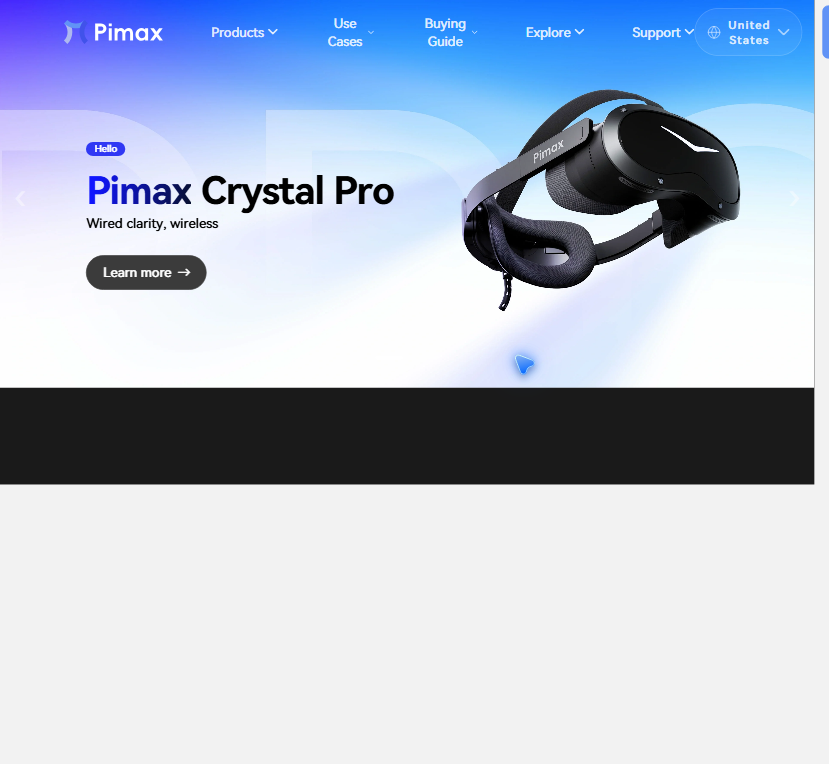
On October 6, 2026, Pimax unveiled the Crystal Pro — a wireless PCVR headset priced at $1,399 (headset only) or $1,899 bundled with the 60G AirLink kit. The headline feature is Native Foveated Streaming: eye-tracked 60GHz wireless at up to 6 Gbps with under 2ms latency. It ships with QLCD panels at 2880×2880 per eye, miniLED local dimming with 576 zones, 110-degree FOV, and an external 16,000mAh battery. It sounds like a new high-water mark for PCVR. But dig into the configuration and pricing, and there are structural problems.
The Weaknesses
1. The killer feature is paywalled behind a $599 upgrade. Native Foveated Streaming only works with the optional 60G AirLink Gen 3 kit. The $1,399 base ships with standard Wi-Fi 6E streaming. To get the uncompressed, eye-tracked streaming, you must buy the $1,899 bundle or add the $599 kit separately. The flagship costs nearly $2,000 before the price of a gaming PC.
2. No built-in battery means you are still tethered. Despite marketing as wireless, there is no battery in the headset. Power comes from an external 16,000mAh pack clipped to your waist. If it dies, your session dies. Compare to the Meta Quest 3, which has a built-in battery and truly untethered use.
3. Brightness is surprisingly low. The QLCD panels deliver 200 nits. The Meta Quest 3 is around 500 nits. With only 200 nits peak, HDR content will look dim and bright virtual screens will glow gray rather than white.
4. The FOV is a step back for Pimax. Pimax built its brand on ultra-wide FOV — the original Crystal reached 127 degrees. The Crystal Pro comes in at 110 degrees, which is average, not category-leading. The HTC VIVE Focus Vision reaches 120 degrees.
5. 60GHz wireless is fragile. 60GHz signals do not penetrate walls, furniture, or even your body. If you walk behind a couch or turn your back to the antennas, the signal degrades. You need to mount two antennas and stay in a defined zone.
6. Modular means more future expenses. Swappable front faces, rear straps, audio, and lens inserts are all sold separately. The DMAS-2.0 earbuds are optional. The modular design is a list of paid upgrades pushing the total well past $2,000.
7. Ship date is a mystery. Pimax opened reservations for $1, but actual shipping dates are all listed as to be announced. Real reviewers have not tested it, and real users have not validated the foveated streaming claims.
Competitor Analysis
The Valve Steam Frame ($1,059-$1,299) is Pimax most direct competitor and undercuts it on price. Valve headset runs native SteamOS with 16GB RAM and benefits from deep SteamVR integration. Pimax wins on raw resolution and the 60GHz trick, but loses on software maturity, comfort, and controller reliability. For most Steam players, the Steam Frame is the safer buy.
The Meta Quest 3 ($499-$649) is half the price and works standalone. It runs a huge library of native VR games and can stream PCVR over Wi-Fi. Its resolution and FOV are lower, but for the majority of consumers, the Quest 3 is a complete product out of the box.
The HTC VIVE Focus Vision (~$800) offers 2448×2448 per eye, up to 120-degree FOV, and both standalone and PCVR modes. It is cheaper with a larger FOV. For most PCVR gamers, the Wi-Fi streaming difference is not worth a $600 premium plus two mounted antennas.
Pros and Cons
Pros:
- 2880×2880 QLCD per eye is exceptional resolution
- miniLED local dimming with 576 zones per eye
- Eye tracking and foveated streaming are technically ambitious
- Modular design allows future upgrades
Cons:
- Best features locked behind $599 60G kit
- No built-in battery — external power brick required
- Only 200 nits brightness is low for a flagship
- 110-degree FOV is narrower than Pimax own prior gen
- 60GHz requires line-of-sight and mounted antennas
- Modular accessories all cost extra
- No confirmed shipping date
Buyer Guide
- Price out the full bundle. The $1,399 base does not include the foveated streaming kit. You are likely looking at $1,899 minimum.
- Check your PC. This is a PCVR headset. You need a high-end GPU to drive 2880×2880 per eye.
- Wait for shipping confirmation. Reservations are open but units have not shipped. Do not expect delivery in 2026.
Conclusion
The Pimax Crystal Pro is technically ambitious but does everything at a hidden cost. It is for hardcore simulation enthusiasts who already own a powerful PC and want the sharpest image. It is not for casual VR buyers (buy a Quest 3), not for Steam purists (buy the Valve Steam Frame), and not for anyone who wants to use it before 2027. Wait for independent reviews and confirm the shipping date.