
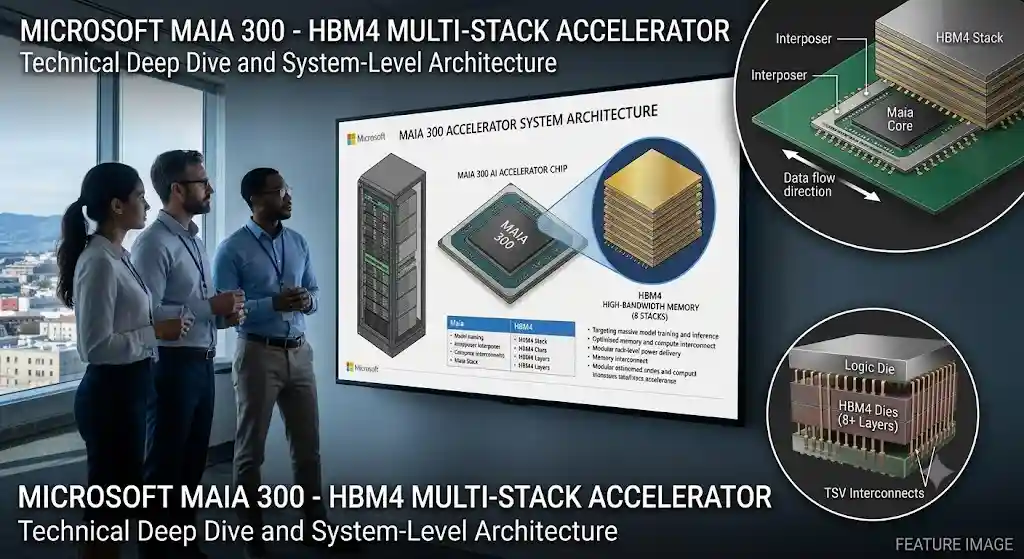
Microsoft took the wraps off its third-generation in-house AI accelerator, the Azure Maia 300, at the Open Compute Project Global Summit on October 12, 2026. The headline numbers are eye-catching: 288 GB of HBM4 memory, 18 TB/s of memory bandwidth, a 950-watt TDP, and a 96-accelerator rack that pushes 167 kilowatts through a single cabinet. Reuters reported that Microsoft plans to deploy more than one million of these chips in 2027, making Maia the primary inference engine behind Copilot, GitHub Copilot, Microsoft Foundry, and the company’s internal MAI model team.
But before anyone writes NVIDIA’s obituary, a closer look reveals a product that is as much a supply-chain hedge as it is a technical breakthrough. Here is what the launch really means.
Market Analysis
The market for AI inference silicon is exploding, and Microsoft sits at its center. As the largest commercial cloud partner of OpenAI, Microsoft has been spending tens of billions of dollars on NVIDIA GPUs every quarter, and the bill has become impossible to ignore. Every token generated by Copilot or GitHub Copilot costs real electricity and real silicon amortization, and when inference traffic scales millions of requests per second, even small efficiency gains compound into billions of dollars in operating expense.
Maia 300 is Microsoft’s answer to that math. The company frames it as an inference-first architecture optimized specifically for long-context reasoning, latency-sensitive conversational AI, and multi-step agentic workloads, the exact workloads that dominate modern Copilot traffic. The design prioritizes memory capacity and bandwidth over raw floating-point throughput, which makes sense for decode-heavy inference where the KV cache, not tensor math, is the bottleneck.
However, the market context is sobering. Microsoft is not launching a product it sells. Maia 300 will never appear on a retailer’s shelf or in a server vendor’s catalog. It exists only inside Microsoft’s own Azure datacenters, delivered to customers as cloud instances. The company has been explicit that it will continue buying massive volumes of NVIDIA and AMD GPUs alongside its own silicon. This is a diversification play, not a revolution. The >1 million unit figure reported by Reuters is a deployment target for internal Azure capacity, not an external sales number.
The timing also matters. Maia 300 enters production deployment in 2027, over a year away. By then, NVIDIA’s next-generation Rubin architecture will already be in volume production, and AMD’s MI400 series will be well established. Microsoft is announcing a chip today that will compete against hardware its competitors have not even finished designing yet. The Maia lineage itself is young: Maia 100 was a 2023 prototype, Maia 200 only entered production earlier in 2026.
Competitor Analysis
The most natural comparison is NVIDIA, which currently dominates every meaningful AI workload. The NVIDIA H100, launched in 2022, remains the volume workhorse of AI infrastructure, and the newer B200 delivers roughly four times the inference throughput of H100 on common models. Microsoft claims Maia 300 delivers 40% more tokens per megawatt than leading GPU-based systems, but the company has not specified which GPU, which model, or which software stack that comparison uses. Third-party benchmarks do not exist. The 950-watt TDP of Maia 300 also sits uncomfortably close to the B200’s 1000-watt envelope, undercutting the efficiency-play narrative.
Against Google’s TPU, the comparison is more nuanced. Google has shipped seven generations of TPUs, and its latest Trillium is a mature, purpose-built inference engine available externally through Google Cloud. Google has a decade of experience running custom AI silicon at planetary scale. Microsoft, by contrast, only shipped its first production Maia 200 chips earlier in 2026. The ecosystem gap is not just real, it is generational. Peak specs have a funny way of evaporating once you add operating-system overhead, scheduling, and real model complexity.
Amazon Web Services offers the most direct parallel. AWS has been shipping Trainium and Inferentia chips since 2023, and Trainium2 is already a mature product with external customers. AWS has proven that a hyperscaler can build a viable custom inference business, but it has also shown how long it takes: three years of iteration before external workloads meaningfully moved off NVIDIA. Microsoft is at the starting line of that race, and Maia 300’s 2027 deployment date means it will still be in first gear when AWS is already shipping its next generation.
Pros and Cons
What works: The memory subsystem is genuinely impressive. 288 GB of HBM4 with 18 TB/s of bandwidth is class-leading for a single accelerator, and the 96-chip rack configuration (27.6 TB of aggregate HBM, 1.7 PB/s bandwidth) is designed specifically for the long-context and agentic workloads eating modern inference budgets. The chiplet architecture on TSMC’s N2P process is the right engineering call for yield and cost flexibility. Microsoft’s claim of 40% better tokens-per-megawatt, if it holds up under independent testing, would be a meaningful operational advantage at gigawatt scale.
What does not: Start with the software. Microsoft’s Maia software stack is, by any reasonable measure, immature. Maia 200 only entered production for Copilot this year. There is no equivalent of CUDA, the software gorilla that makes NVIDIA chips easy to program, optimize, and port to. External Azure customers cannot even choose Maia instances yet. The claim that Maia 300 delivers up to 7x the rack-scale token throughput of Maia 200 sounds impressive until you realize that Maia 200 was itself a first-generation production part with well-documented efficiency gaps. Benchmarking your new chip against your own weak predecessor is not a competitive claim; it is a confession about how far behind you started.
Supply chain risk is another elephant in the room. TSMC’s N2P process is brand new, and every leading-edge chip company on the planet is competing for the same capacity. Stacked HBM4 memory is even more constrained. A million-unit deployment target for 2027 assumes Microsoft secures both the wafer allocation and the HBM supply, and neither is guaranteed. The 950-watt TDP per chip, multiplied across 96 chips per rack, demands liquid cooling infrastructure that most datacenters do not yet have.
Finally, there is the strategic ambiguity. Microsoft continues to invest billions in NVIDIA and AMD GPU capacity. OpenAI still runs primarily on NVIDIA hardware. Maia is explicitly described as a complement, not a replacement. If Microsoft scales back its custom silicon program, the software ecosystem investment becomes stranded. The chip is inference-only, meaning it cannot handle training workloads, limiting its utility.
Buyer’s Guide / Things to Watch Before You Buy
To be clear: no enterprise is walking into a store to buy a Maia 300. The relevant buyer here is an Azure architect deciding whether to build workloads on Microsoft’s custom silicon roadmap. Wait for independent benchmarks. Microsoft’s efficiency claims are self-reported and model-unspecified. Before routing production inference traffic to Maia instances, insist on third-party comparisons against NVIDIA B200 and AWS Trainium2 on your specific model architecture, precision, and batch size.
Watch the software stack maturity through 2027. Track whether Microsoft delivers day-zero model support with the same parity NVIDIA provides. If Maia 300 launch day requires manual kernel optimization for your model, the efficiency advantage disappears. Track supply and deployment signals. Watch for datacenter commissioning announcements, liquid-cooling deployment, and any slippage from the 2027 target. Do not bet your architecture on a single internal platform. The smart play is heterogeneous: keep portable CUDA-compatible paths and treat Microsoft’s custom-chip roadmap as one option in a multi-cloud strategy. Paper specs, a 950-watt power draw, and a software stack that has not yet survived a real-world traffic spike are not enough to bet your infrastructure on.
Related reading: dynabook 2026 AI Business Laptop Lineup Review · Microsoft Project Solara Deep Dive · NVIDIA RTX Spark