
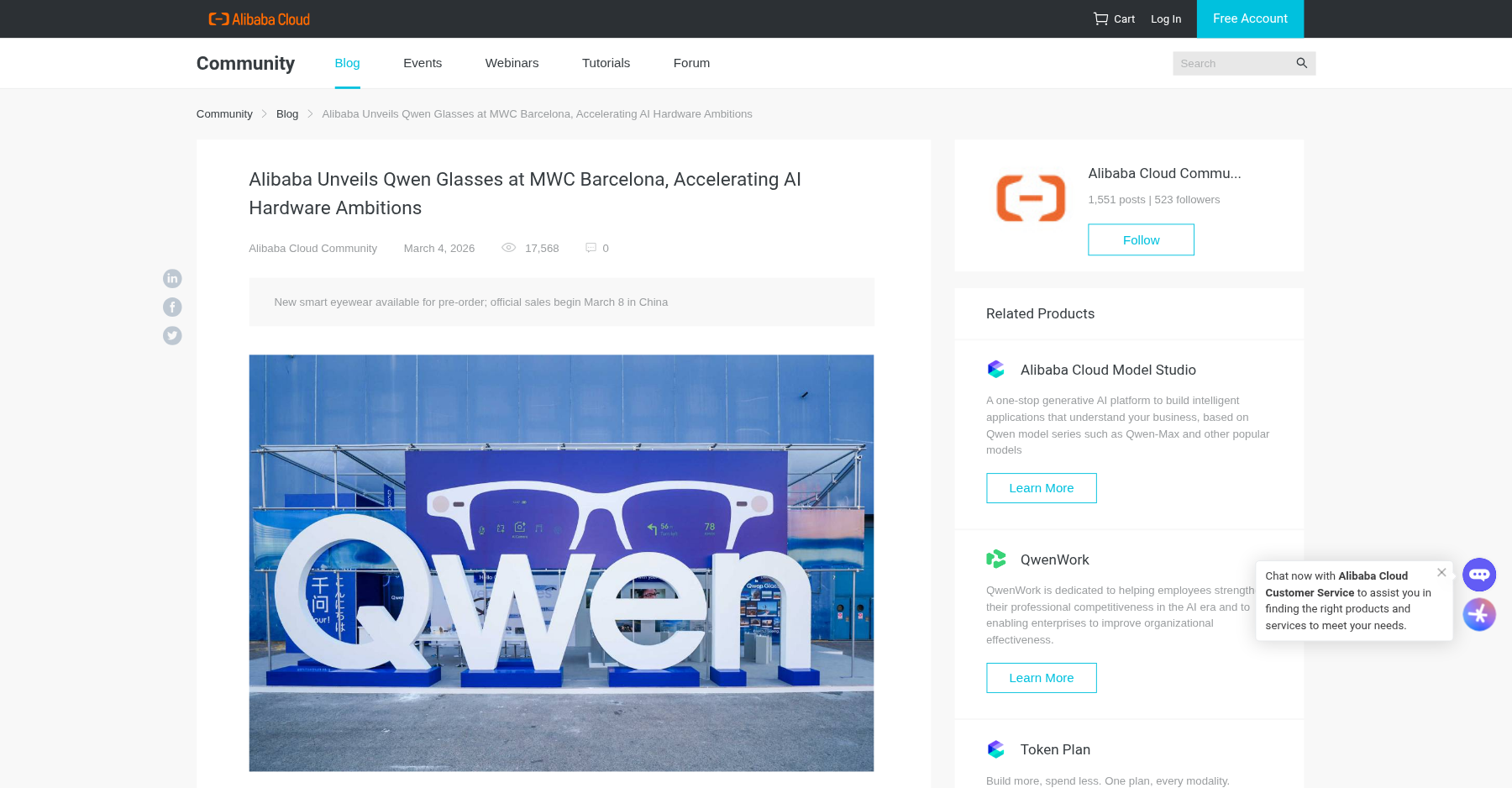
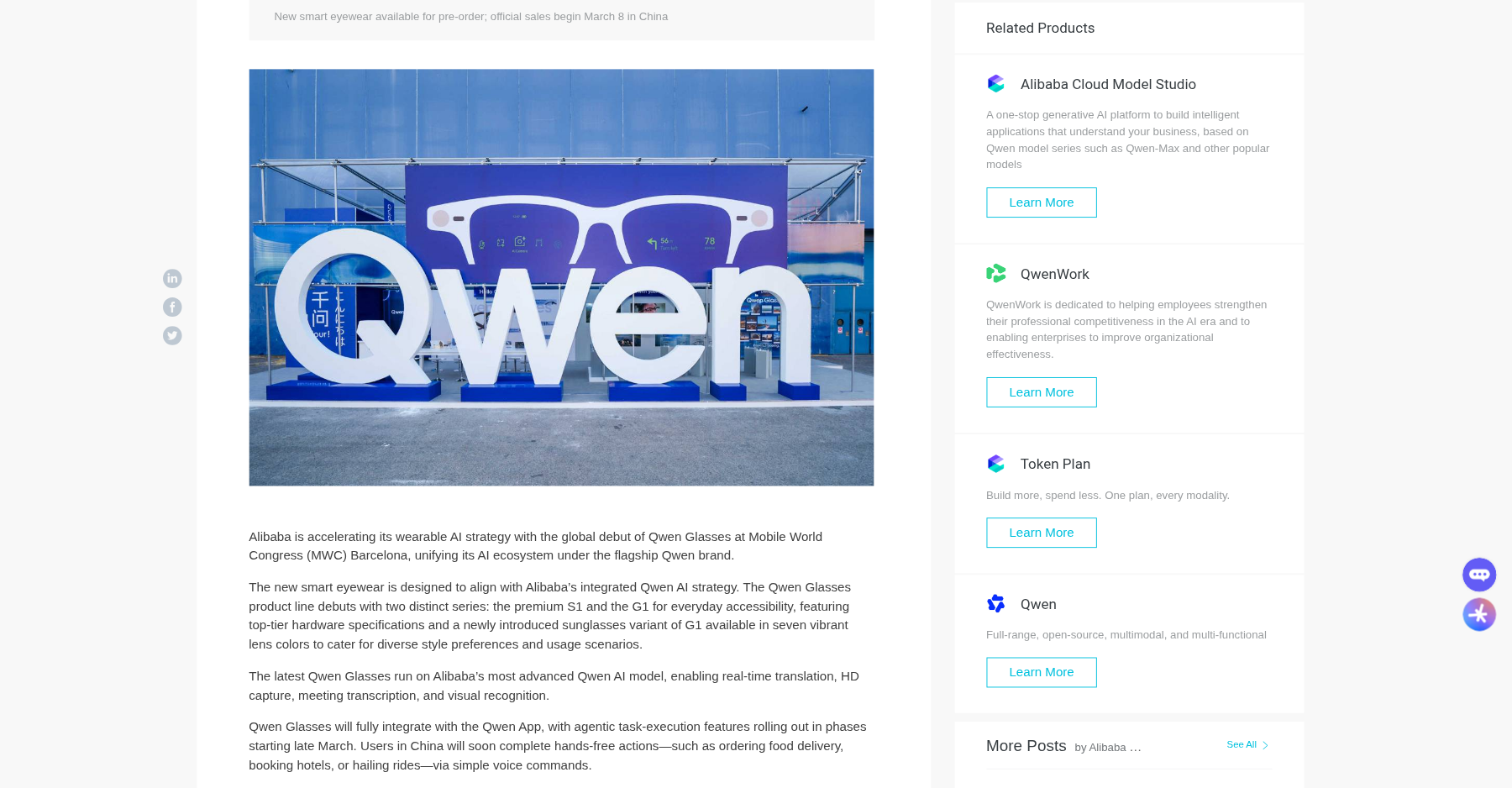
On September 22, 2026, at the Apsara Conference in Hangzhou, Alibaba unveiled the Qwen AI Glasses N1 and N1 Pro. For the first time, a pair of everyday frames packs a 50 MP first-person 4K camera, high-precision eye tracking, and iris payment co-developed with Alipay. The glasses go on sale October 13. The spec sheet looks impressive, but whether an always-on wearable becomes a productivity tool or a gimmick is never decided on a keynote slide.
Strengths and Weaknesses: The Highlights and the Soft Spots
What Works
First, a generational imaging leap. The N1 series uses a 50 MP sensor with 4K video, Live Photos and multi-axis stabilization — a massive upgrade over the predecessor S1’s 12 MP. Second, the interaction paradigm is ahead of its time: the N1 Pro adds eye tracking and iris payment. You look at an exhibit in a store and ask about it; the AI follows your gaze to know which item you mean. Payment is a glance away — “gaze as cursor” is a first in consumer eyewear. Third, the three-chip setup (Qualcomm Snapdragon AR1 + Bes BES2800 + low-power sensing chip) makes always-on environmental awareness feasible, with swappable temple batteries. Fourth, deep integration with Taobao, Amap and Alipay, plus AI-cloned simultaneous interpretation, makes it a natural fit for heavy Alibaba-ecosystem users.
What You Must Know Before Buying
Price is opaque and likely steep. As of writing, Alibaba has not published separate prices for N1 and N1 Pro (expected Oct 13). The S1 launched at ~3,999 RMB and the G1 at 2,899 RMB. With added eye-tracking IR modules and iris hardware, the N1 Pro will likely land in the 4,000–6,000 RMB range. Whether that buys you a necessity or a party trick is an open question.
Eye tracking and iris payment — killer feature or walled garden? Iris payment is deeply tied to Alipay. Switch to WeChat Pay, cash, or overseas spending, and the financial-grade verification simply stops working. Eye-tracking Q&A is fun in museums but slow for everyday tasks like ordering food or texting — voice is still faster than “stare then speak.” The N1 Pro’s extra health sensors (heart rate, SpO2, HRV, stress, temperature) are also novelty-tier; medical-grade accuracy has not been independently validated.
Weight and comfort are the hidden cost. Three chips + eye-tracking module + dual light engines + a 50 MP camera mean thick temples — already visible in hands-on videos. The G1 was ~41 g and the S1 measured 43–52 g. The N1 Pro, with added IR and iris cameras, will likely exceed 50 g, making nose pressure more noticeable than the ~49 g Meta Ray-Ban. “All-day wear” presumes you accept a battery hanging off your nose bridge.
Display and battery are “good enough but not impressive.” The S1 used monochrome Micro-LED waveguides peaking at 4,000 nits — not full color. Whether the N1 upgrades to color display is unconfirmed. The swappable battery is a workaround: a single temple cell is small, and “all-day” means carrying spares, while the always-on low-power sensor chip also drains charge.
Privacy and repairability are two overlooked long-term costs. Eye-tracking data reveals reading habits and preferences. The iris is a biometric that cannot be reset or changed — if compromised, you cannot simply change a password. The always-on 4K camera, microphone and IR eye tracker will make bystanders uncomfortable in offices and cafes. Waveguide lenses and dual light engines are fragile, and the swappable battery adds a mechanical failure point. Official repair pricing and spare-parts policy have not been announced.
Competitive Landscape: Where the N1 Sits in the Glasses Wars
Meta Ray-Ban remains the benchmark for style and capture — co-designed frames, mature camera tuning, a restrained ~$299 price — but it has no display at all, relies on Meta’s own AI (largely unusable in China), and offers neither eye tracking nor iris payment. Xiaomi AI Glasses push the price to ~2,000 RMB with a lightweight body and solid Mijia integration, but are also “no display, no eye tracking” — pure voice + capture, a different technical tier from the N1 Pro. Huawei Smart Glasses take another path: open-ear audio, great call quality, feather-light, but they dropped the camera and display entirely — essentially “Bluetooth earbuds with AI,” a different species.
Among more aggressive players, Rokid takes an open route — switching between ChatGPT, Gemini, Qwen, DeepSeek and Doubao depending on region. RayNeo X3 Pro and Shanji push AR display further with a genuinely floating screen. Against all of these, the Qwen N1’s differentiation is clear: it is the first consumer glasses to mass-produce eye tracking + iris payment in everyday frames, deeply stitched into China’s payment, maps and shopping ecosystem. The trade-offs are equally clear — heavier than Meta Ray-Ban, pricier than Xiaomi, more closed than Rokid, more restrained in display than RayNeo. The N1 Pro bets on the Alibaba service ecosystem, not generic hardware specs. Buying it is essentially buying a ticket into Alibaba’s digital lifestyle.
Five Things to Decide Before You Buy
First, wait for the official price. Separate N1/N1 Pro pricing and national-subsidy landing prices arrive October 13. “Zero-yuan pre-order” is not the final price — don’t get swept up in launch hype. Second, ask if you are an Alibaba power user. If your daily life runs on WeChat Pay, Baidu Maps and Apple’s ecosystem, the N1 Pro’s iris payment and proactive services lose most of their value. If Taobao, Amap and Alipay are your daily drivers, you capture the most upside. Third, try them on in person. Temple thickness, nose-pad pressure and weight distribution determine whether you can wear them for two hours. Fourth, accept the privacy trade-off. The iris is non-resettable and eye-tracking data is sensitive. Before long public wear, confirm you are comfortable with continuous collection. Fifth, ask about repair and spare-parts policy. Waveguides, light engines and swappable batteries are high-failure components. Warranty scope, spare-battery pricing and frame-replacement cost should be confirmed before payment — the long-term cost of a glasses product hides in the after-sales terms.
Overall, the Qwen N1 / N1 Pro is a device with the right direction but still in need of polish: it plants eye tracking and iris payment — two seeds of future interaction — into consumer glasses early, with imaging and ecosystem in China’s top tier. But until price, weight, display, privacy and repair costs are truly transparent, it suits early adopters who live deep in the Alibaba ecosystem. For most consumers, waiting for the October 13 official pricing and first real-world reviews is the rational move.