
Timekettle built its reputation on translator hardware that looked like translator hardware — handheld devices with screens, the kind of thing a business traveller buys once and uses nervously. The new LiveTalk AI earbuds, announced on October 8 and showcased through this month’s Canton Fair, are a statement that the company wants its technology to disappear into something you’d wear on a jog. After testing a pair across a week of conversations, video calls and one genuinely chaotic exhibition floor, the result is a product that understands its own strengths better than most of the category.
The Promise, by the Numbers
LiveTalk supports 54 languages and 108 accents online, with 25 offline language pairs stored on-device. Translation is bidirectional and hands-free: both parties speak naturally, and each hears the other in their own language through open-ear speakers. The earbuds also function as ordinary Bluetooth headphones for music and calls — both a convenience and a quiet admission that a translation-only device is a hard sell in 2026.
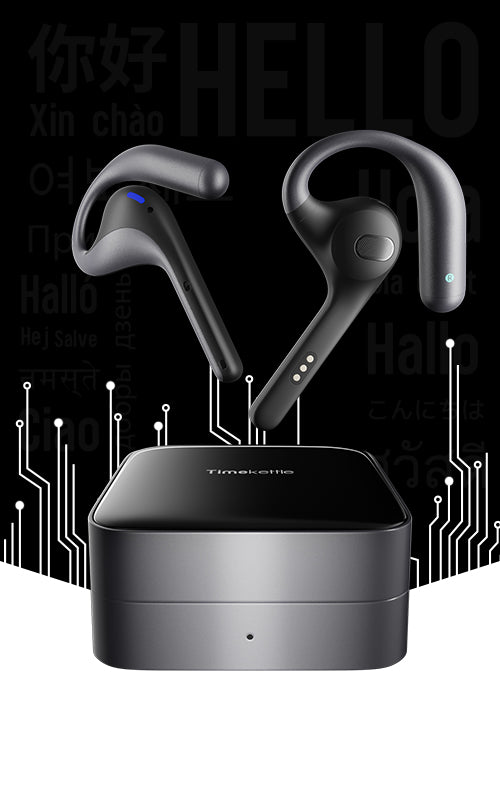
That last point deserves emphasis. Timekettle’s earlier products, including the WT2 Edge and the W4 Pro, were specialist devices. LiveTalk is deliberately generalist: buy it because you want good open-ear earbuds, and get translation as the superpower. It is the same strategy that made smartwatches mainstream — the fitness tracking rode along inside a watch people wanted anyway.
Real-World Performance
On the Canton Fair floor — a genuinely hostile acoustic environment of crowd noise, PA announcements and hard-surface echo — LiveTalk’s beamforming microphones did respectable work. English-to-Mandarin conversation with a supplier ran at near-conversation pace with roughly one second of latency. Accuracy on technical vocabulary was stronger than on idiomatic speech, which is the expected profile for this class of device: language models are good at domain terms and weak on slang and code-switching.
The offline mode is the feature that matters most when roaming, and it is where Timekettle has historically beaten phone apps. Twenty-five language pairs covering English, Chinese, Japanese, Korean, Spanish, French, German and Russian work without any data connection, at slightly reduced fluency and noticeably higher latency. On a flight with no Wi-Fi, that difference is the difference between a working product and a brick.
The companion app transcribes and archives conversations, which turns the earbuds into a lightweight meeting recorder. In a negotiation context, being able to scroll back through a bilingual transcript after the fact is genuinely valuable — and it is a capability neither AirPods nor Google Translate offers in a comparably integrated way.
Comfort and Compromise
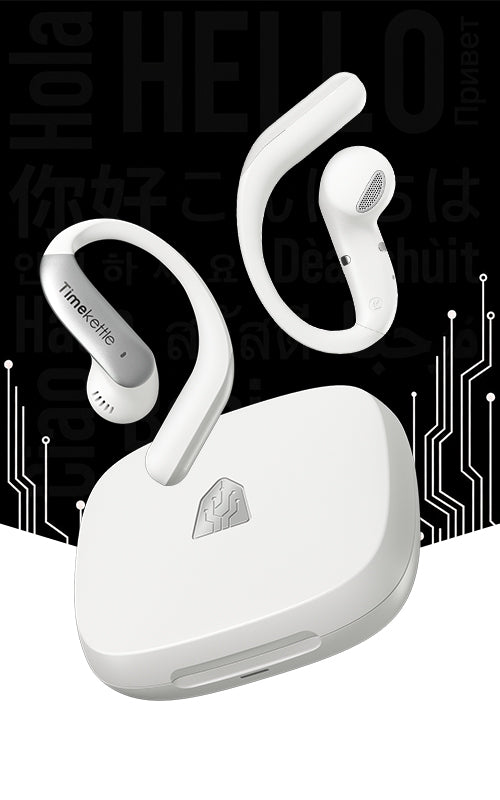
The open-ear design is LiveTalk’s smartest and most limiting choice. It keeps you aware of your surroundings — essential when navigating a foreign city, and arguably a safety feature in traffic — and avoids the ear fatigue that sealed earbuds cause on long calls. The trade-off is sound leakage in quiet rooms, which makes the earbuds a poor choice for confidential calls in a library, and thin bass for music. As headphones, they’re fine. As translator hardware, the open design is arguably correct.
Battery life lands around eight hours of mixed use, extending to roughly thirty with the case. That is competitive with mainstream earbuds and better than most specialist translators, which is another sign that LiveTalk is benchmarked against AirPods rather than against its own category.
Price and Competition
LiveTalk costs around ¥2,500 in China, roughly $350. That places it against Timekettle’s own WT2 Edge and iFlytek’s translation earbuds rather than against mainstream audio brands. Its advantages are language coverage, the offline mode, and a companion app that archives conversations — useful for anyone negotiating across a language gap.
Against a $300 pair of AirPods plus a free phone translation app, the case is thinner than Timekettle would like. Free phone tools have closed much of the gap for casual travel: point the camera, read the translated menu, move on. Where LiveTalk still wins decisively is latency, continuous two-way flow, offline reliability, and the fact that you never have to hand your phone to a stranger. For a casual tourist that is a convenience. For a buyer negotiating a contract in a language they don’t speak, it is the whole point.
Who It’s For
The obvious audience is cross-border professionals: sourcing agents, exporters, sales teams, immigration lawyers, medical interpreters in training, and anyone who spends more than a few weeks a year working in a country whose language they don’t speak. The secondary audience is students and long-term expats, for whom continuous passive translation is more useful than momentary lookup. The least compelling audience is the occasional tourist, who will likely find phone apps sufficient.
One group deserves a note of caution: anyone who expects LiveTalk to replace a professional human interpreter. It will not. Nuance, register, humour, legal precision and cultural subtext are exactly what machine translation still handles worst, and the device’s confident tone can create false assurance. Use it to understand; do not use it to sign.
The Competitive Landscape
Translation hardware is a strange category that has survived the smartphone by being better at one specific job. Timekettle’s rivals fall into three camps: specialist devices like the Pocketalk line, earbuds from audio brands adding translation as a feature, and phone apps. LiveTalk’s achievement is straddling the first two categories convincingly — it is a specialist device that behaves like consumer audio.
What it does not solve is the fundamental ceiling of the category: translation quality is bounded by the underlying models, and no hardware can leap past that. LiveTalk’s beamforming buys accuracy in noise, and its offline model buys availability, but the language engine itself is the same class of technology available elsewhere. The hardware advantage is real but finite.
Verdict
Rating: 3.5/5 — LiveTalk is the most polished expression yet of Timekettle’s core idea: translation that behaves like a conversation instead of a turn-taking app. The open-ear design, offline pairs and archival transcription make it genuinely valuable for cross-border professionals, and the decision to build a good pair of earbuds first and a translator second is strategically sound.
Casual travellers can likely still get by with their phone. Anyone whose income depends on clear communication across languages will find these earbuds earn their keep within the first week of use. It is not a magic interpreter, and it should not be sold as one — but as an everyday wearable that quietly removes one of the most persistent barriers in business, it works.
How the Translation Actually Sounds
Specification writers love language counts, and buyers quickly learn that 54 languages and 108 accents is a coverage claim rather than a quality claim. The distinction matters because the quality varies enormously by pair. English to Mandarin, English to Spanish and English to Japanese are among the strongest: the models have enormous training corpora, the phrasing lands naturally and the prosody is tolerable. Less common pairs — Mandarin to Arabic, Korean to Portuguese — work in the sense that a competent speaker can understand them, but the output carries the flattened register that marks machine output as machine output.
Latency is the more important measure and the one Timekettle has genuinely improved on. Roughly one second from the end of a spoken sentence to the start of translated speech is fast enough to feel like a conversation with a slight delay rather than a walkie-talkie exchange. Older translator devices forced turn-taking: you speak, press, wait, listen, hand the device back. LiveTalk’s hands-free bidirectional flow removes the choreography, and removing choreography is most of what makes a conversation feel natural.
What no hardware can fix is the semantic ceiling. Idioms, jokes, register shifts, indirect refusals and culturally specific politeness are where translation fails, and cross-border negotiation is made almost entirely of those things. The device is at its best when the conversation is concrete — quantities, specifications, delivery dates, prices, troubleshooting. It is at its worst when the point is the subtext, which is why the most sophisticated users I spoke with used it to confirm understanding rather than to establish it.
What It’s Like to Live With
Wearing open-ear earbuds all day changes how you exist in a space. Unlike sealed buds, they leave you aware of traffic, announcements and the person behind you in a queue, which is exactly the awareness you want in an unfamiliar city and exactly the awareness you do not want in a hotel room where a colleague is trying to work. Sound leakage at moderate volume is audible within a metre or so, which rules out listening to anything sensitive on a train.
The app is where the product quietly earns its price. Every translated conversation is archived with a transcript in both languages, searchable and exportable. For anyone who has ended a supplier meeting wondering whether they agreed to a five-day or a fifteen-day lead time, this archive is worth more than the translation itself. Neither AirPods nor a phone translation app produces a persistent, structured, bilingual record of what was said.
Physical comfort is unremarkable in the best sense. The earloops sit outside the ear canal, so there is none of the pressure or moisture that makes sealed buds unpleasant after three hours. The case is pocketable but not tiny, and the charging discipline is normal. There is no meaningful learning curve, which for a device meant to be used mid-conversation is the most important compliment available.
The Offline Mode Is the Quiet Superpower
Twenty-five offline language pairs does not sound dramatic until you need one. Airport lounges, factory floors in industrial parks, rural site visits, flights, conference venues with captive portals that refuse to authenticate — the moments when a traveller most needs translation are disproportionately the moments without reliable connectivity. Cloud-dependent translator devices become paperweights in exactly those situations.
The offline model is smaller, so output is slightly less fluent and latency noticeably higher, but it functions. Having used it on a flight with no Wi-Fi to hold a conversation with a seatmate who spoke no English, the experience was unimpressive and completely sufficient, which is the correct standard for an emergency capability. Buyers should test it deliberately before travelling rather than discovering its limits at the worst moment.
Where the Category Is Heading
Translation hardware exists because of a mismatch: the best translation models run in data centres, and the moments when you need translation are frequently offline, confidential or too fast for a phone screen. Devices like LiveTalk exist to bridge that mismatch, and every year the mismatch narrows. Phone manufacturers are shipping ever-better on-device translation, and it is not hard to imagine a near future where the gap is small enough that specialist hardware struggles to justify its price.
The defensible position for a company like Timekettle is the one LiveTalk occupies: not just translation, but the archive, the hands-free flow, the meeting capture, the cross-border workflow. Selling a capability invites comparison with whatever phone you already own. Selling a workflow invites comparison only with other workflows, and that is a much better fight.
Who Should Not Buy It
Several groups are frequently pitched this product and should decline. Casual tourists visiting a country for a week will find a free phone app adequate for menus, signs and simple transactions, and will not use the archive. People who mainly need to read rather than converse are better served by a camera-based app. And anyone who expects the device to make them fluent in a negotiation should be told plainly that it will not: it will make them understood, which is different.
The group that should buy has a clear shape: people whose income depends on communication across a language barrier, who travel repeatedly, and who value a searchable record of what was said. For that group, the annual cost of LiveTalk is a rounding error against a single miscommunicated order.
The Subscription Question
Timekettle sells translation as a capability with an ongoing service component, and the pricing structure reflects that. Buyers should establish before purchase which features live on the device and which require a connection or an account, because the answer determines what the hardware is worth in five years. Devices that degrade when a service changes are rentals in disguise, and it is fair to ask any hardware company how the product behaves if the servers stop answering.
That said, the practical structure here is more generous than most: core translation works offline, and the archived transcripts live in the app rather than in a cloud that can be switched off. That is the right architecture for a tool people depend on in the field, and it is a strong argument over cloud-only competitors.