
The HUAWEI FreeClip 2 S packs an onboard NPU and Bluetooth 6.0 into Huawei’s signature open-ear C-bridge cuff, yet at ¥32,780 in Japan it still asks buyers to trade isolation for awareness.
On October 17, 2026, Huawei Japan moved the FreeClip 2 S from crowdfunding to general retail. The ear-cuff earbuds had run a Makuake campaign beginning July 30 that ASCII reported raised more than ¥100 million in support from 3,970 backers. Now available through ordinary Japanese channels at ¥32,780 including tax, the FreeClip 2 S is a flagship AI music device built for the Japanese market by Huawei Japan; Huawei’s headquarters remain in Shenzhen, China, and this is a Japan-localized launch rather than a simultaneous worldwide debut.
Product market analysis
The open-ear ear-cuff segment sits between in-ear true wireless buds and bone-conduction sports headsets: nothing enters the canal, so ambient sound stays audible while a driver beside the opening plays audio. That suits office desks, city running, and commuting where hearing traffic or colleagues matters, but it structurally rules out passive isolation and active noise cancellation (ANC). The FreeClip 2 S enters this niche as Huawei’s second-generation cuff, pitching an onboard AI processor rather than sealed acoustics as the upgrade path.
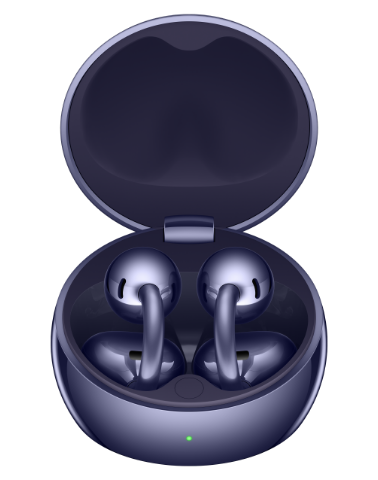
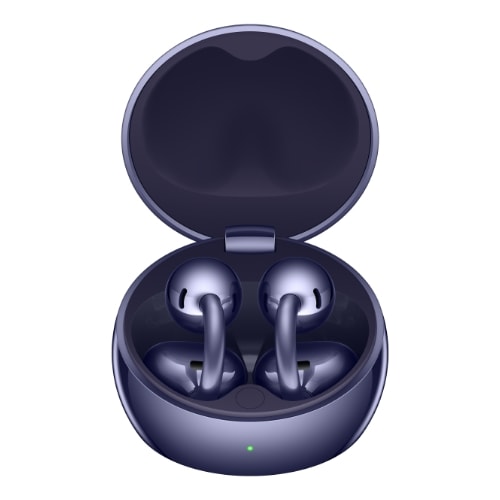
Japan’s market already holds closed ANC flagships and cheaper open-ear sports buds, so ¥32,780 positions the FreeClip 2 S as a fashion-forward premium play. Huawei leans on jewelry framing: a mirror-finish round case built through more than 100 steps, a softer liquid-silicone C-bridge, and Deep Sea Blue or Pearl Silver finishes. The NPU claim and long-press assistant place it in the AI-wearable bucket. Skepticism is warranted: Huawei Japan’s own footnote states the buds support waking the voice assistant, while subsequent actions and available functions depend entirely on the paired smartphone. The chip accelerates audio and voice processing; it is not a standalone large-language-model brain.
Specs at a glance
| Form factor | Open-ear C-bridge ear-cuff; 5.1 g per earbud; 39.4 g charging case |
| Driver | 10.8 mm dual-diaphragm dynamic driver; 20 Hz–20 kHz frequency response |
| AI silicon | Advanced NPU AI processor; Huawei claims 10x compute vs. first-generation FreeClip; long-press wakes voice assistant |
| Calling | Triple-mic call noise cancellation with multi-channel DNN; auto volume adjustment (beta, off by default); auto voice pickup |
| Spatial audio | 360° spatial audio with dynamic head tracking; requires an OTA update |
| Wireless | Bluetooth 6.0; multipoint up to two devices; HUAWEI Audio Connect app (iOS 13+, Android 8+) |
| Battery | 9 h music / 38 h with case; 6 h calls / 25 h; 10-minute charge for 3 h playback; USB-C wired, 3 W wireless; no cable in box |
| Durability | IP57 earbuds; IP54 charging case; not rated for swimming or high-pressure showers |
| Colors | Deep Sea Blue, Pearl Silver |
| Price (Japan) | ¥32,780 incl. tax, per ASCII launch coverage |
What works
Comfort remains the cuff’s core promise. At roughly 5.1 g per earbud, the FreeClip 2 S is light enough for all-day wear; Huawei says the C-bridge uses liquid silicone about 25% softer than the previous generation, refined against more than 10,000 ear measurements. Left/right auto-identification and single-ear playback let users take calls on one cuff while keeping the other ear free, fitting hybrid workdays. The find-device feature addresses the classic risk of dropping small open-ear buds around desks and bags.
Battery numbers are competitive. Huawei lab testing lists 9 hours of music per charge and 38 hours with the case, alongside 6 hours of calls and 25 hours on calls with the case. A 10-minute quick charge returns 3 hours of playback, useful before an outing. Charging covers USB-C wired and a 3 W wireless pad, though wireless charging takes about 150 minutes for the case alone.
Call engineering looks serious on paper. Three microphones combine with a multi-channel DNN algorithm to separate speech from noise, while auto voice pickup amplifies talk or podcast content in busy environments. A reverse sound-wave system aims to minimize leakage, and volume drops automatically in quiet settings. The 10.8 mm dual-diaphragm driver is said to double bass and volume output versus the original FreeClip, meaningful for an open-ear design that otherwise struggles to project low frequencies.
Connectivity and customization are broadly covered. Bluetooth 6.0 and multipoint with up to two devices let a phone and laptop share the buds, and the HUAWEI Audio Connect app offers a 10-band equalizer, cross-iOS/Android switching, and gesture customization. IP57 on the earbuds handles sweat and sudden rain, and the mirror case reads as an accessory rather than a gadget.
What doesn’t
There is no isolation and no ANC, by design. Open-ear cuffs never seal the canal, so subway rumble, office chatter, and street traffic compete directly with the music. Bystanders can also hear playback at higher volumes, the format’s standing trade-off. Bass remains fundamentally limited by air projection even with the dual-diaphragm driver, and Huawei’s +100% bass figure compares against the first FreeClip in Huawei’s own lab, not sealed ANC rivals.
The AI assistant is wake-only, not autonomous. The official footnote makes clear the earbuds launch the phone’s assistant; search, timers, reminders, and memos then execute on the paired handset, and feature availability depends on that phone. Outside a Huawei device, the experience is only as capable as the phone’s own assistant. The “NPU with 10x compute” claim measures audio/voice processing uplift against the first-generation FreeClip under Huawei lab conditions; independent benchmarking and real-world audio quality are TBD pending hands-on review.
Spatial audio is not finished at launch. Dynamic head-tracked 360° spatial audio requires an OTA update, and the timing of that update is TBD. Buyers on day one do not receive the feature marketed alongside the product.
Ecosystem seams are visible. Pop-up pairing is compatible only with EMUI Huawei phones and tablets; generic Bluetooth pairing works elsewhere but loses that shortcut. Auto volume adjustment is experimental, off by default, and must be enabled in the app’s experimental-features section. Head-nod-to-answer and head-shake-to-reject gestures are also off by default. The box ships no USB-C cable, the case is only IP54, and Huawei’s 9/38-hour figures were measured at 50% volume with AAC on a Mate 80 Pro, so real-world mileage varies.
Who it’s for
The FreeClip 2 S suits desk workers who take frequent calls while staying aware of colleagues, runners and cyclists who need traffic audible, and Makuake backers who already trusted the concept. Huawei phone users in Japan gain the smoothest pairing. It fits poorly for noisy commuters who want music to disappear into, bass-first listeners, or buyers expecting a self-contained AI assistant that answers without a phone.
Verdict
The FreeClip 2 S is a polished, light, long-lasting open-ear cuff with credible call processing and an honest comfort story, but the AI framing overstates what the hardware does. The assistant relies on the paired phone, spatial audio waits on an OTA, and the open-ear format permanently surrenders isolation. At ¥32,780 in Japan, it earns a conditional recommendation: buy it if cuff comfort and awareness are the priority and you already live near Huawei’s ecosystem; wait if you expected on-device AI intelligence or launch-day spatial audio.
Related reads
Frequently asked questions
Does the FreeClip 2 S have active noise cancellation?
No. It is an open-ear C-bridge design that keeps ambient awareness; there is no ANC mode, and isolation depends on the physical C-bridge fit.
What does Huawei’s tenfold NPU claim mean?
Huawei compares the new NPU’s compute to the first-generation FreeClip in its lab tests; independent audio and AI-assistant benchmarks are not yet available at launch.
What is the price and battery life?
Japanese launch price is Y32,780 incl. tax; 9h music / 38h with case, IP57 earbuds, Bluetooth 6.0, and 360-degree head-tracked spatial audio arrives via a later OTA update.
Sources
- HUAWEI FreeClip 2 S official product page (Huawei Japan)
- HUAWEI FreeClip 2 S official specifications (Huawei Japan)
- ASCII.jp English: Huawei Begins General Sales of FreeClip 2 S (Oct 17, 2026)