
Amazon’s acquisition of Bee last year raised an obvious question: would the small startup’s always-listening AI wearable survive contact with a trillion-dollar parent? Plenty of acquired hardware startups have been quietly absorbed into a roadmap and never heard from again. The answer arrived this week in the form of two new devices — the Bee Frontier ($74.99, available now) and the Bee Eclipse ($99.99, shipping soon) — and the surprise is how much of Bee’s original identity survived the acquisition.
Two Form Factors, One Idea
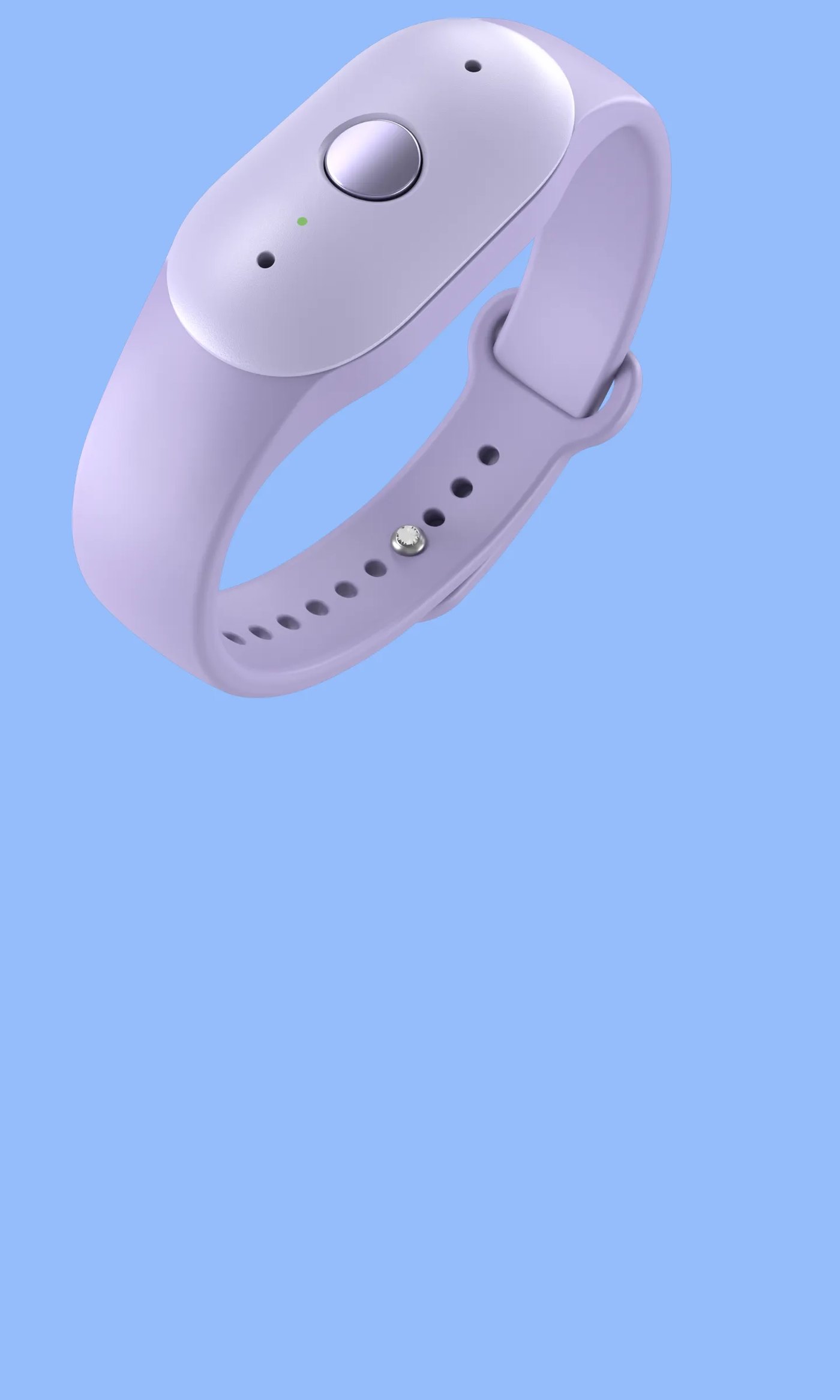
The Frontier is a soft wristband, or a pin you can clip to clothing, with dual microphones, IP67 water resistance, a USB-C port and a claimed seven-day battery. A single button handles power and summarization, and an indicator light tells you when the device is actively thinking about your conversation. The Eclipse is a credit-card-sized slab that magnetically attaches to the back of your phone — a form factor that puts Bee in direct competition with Plaud Note and Pocket AI.

Both do the same job: passively record the conversations around you all day, transcribe them, and surface summaries, action items and insights in a redesigned companion app. Neither has a screen. Neither attempts to be a watch. The design thesis is that the most valuable AI hardware is the kind you forget you’re wearing, and after a week with the Frontier on my wrist, that thesis mostly holds.

The Daily Experience
Transcription is fast and surprisingly accurate across accents. Wearing the Frontier through a day of meetings, phone calls and coffee-shop conversations, I found the daily digest — a structured summary of who I spoke with, what I promised, and what I should do next — to be the closest thing to a memory prosthetic I’ve tested. It correctly extracted a dinner plan mentioned in passing, a delivery-window promise from a courier, and three distinct to-dos from a meandering ninety-minute work call.
The magic is in the extraction rather than the transcription. Raw transcripts are commodity these days; deciding which of forty thousand words uttered in a day actually matter is not. Bee’s summarization consistently prioritized the commitments and the names, and its suggested to-dos were actionable enough that I completed several without remembering how they got onto my list. The integration with Gmail, Google Calendar and Microsoft Outlook means those items land in the tools you already use rather than in another silo.
The weak spots are familiar. The app occasionally buries a genuinely important summary under low-priority insights, and the lack of a screen means you cannot quickly check whether something was captured without pulling out your phone. In noisy environments the dual microphones occasionally assign speech to the wrong speaker, which matters for anyone who relies on accurate attribution in meeting records.
The Privacy Architecture Deserves Scrutiny — and Gets It
Always-on microphones sold by Amazon will trigger alarms, and Bee’s team clearly knows it. The architecture is worth spelling out because it is more rigorous than the category norm. Raw audio is processed in real time and then deleted rather than stored. Conversation transcripts are encrypted using keys created and controlled directly by the device. According to Amazon, those files cannot be accessed by anyone else — including Amazon employees — unless the user manually and intentionally shares them. A hardware indicator light shows when summarization is active.
This is the right shape of answer: minimize stored data, put keys in the user’s hands, make recording state visible. But two structural questions remain. First, the encryption architecture is only as good as the app’s update discipline; a single firmware change could alter what leaves the device, and buyers should watch release notes rather than press releases. Second, “keys controlled by the device” still relies on Amazon’s implementation of that promise. The company has committed publicly, which creates accountability — but commitments are not audits.
For anyone in a jurisdiction with two-party consent laws, the practical guidance is unchanged from earlier Bee devices: the person wearing the recorder is responsible for disclosure. That is a social problem the hardware cannot solve, and Bee’s onboarding does at least mention it.
The Subscription Is the Real Price
The free tier covers conversation summaries, recaps and fourteen days of memory. Bee Pro, at $11.99 per month, unlocks unlimited conversation history, integrations with Amazon.com and Alexa+, third-party application connections, suggested to-dos, daily memories, a personal chat assistant and conversation templates. Over two years, a $74.99 Frontier costs roughly $360 with the subscription — nearly five times its sticker price.
That is not a scam; it is the business model that every ambient-AI company has converged on. But it reframes the purchase decision. The Frontier is not a $75 gadget; it is a $12-per-month memory service with a $75 entry fee. Compared with a $20-per-month ChatGPT Plus subscription plus a $200 recorder, that is competitive. Compared with just using your phone’s free transcription, it is not.
Where It Falls Short
Battery life, advertised at seven days, landed closer to five in my testing with heavy transcription and daily digest generation. The Frontier’s lack of a speaker means everything routes through your phone, which is fine at a desk and awkward while walking. The Eclipse’s magnetic phone attachment, while clever, roughly doubles the thickness of a slim case and interferes with wireless charging on some models. And the seven-day battery claim, like most wearable claims, assumes a particular usage pattern that heavy users will exceed.
There is also a subtler issue: the more faithfully Bee remembers, the more it expects to be consulted. After a week, I found myself checking the digest out of habit rather than need. Ambient AI creates ambient obligation. Bee handles this better than most — its summaries are skimmable — but the psychological weight of a device that never forgets is worth naming.
How It Compares
Against Plaud Note and Pocket AI, Bee wins on price and ecosystem integration, and loses slightly on audio quality for long recordings. Against Meta’s camera glasses, it wins on discretion — nobody notices a wristband — and loses the visual context that makes glasses useful in unfamiliar environments. Against simply using a phone recording app, it wins on battery, wearability and automatic structuring, and loses on cost.
The strategic read is that Amazon is not really selling a recorder. Panos Panay’s TechCrunch Disrupt framing — that the future of personal AI is ambient computing rather than app-driven prompts — describes exactly what Frontier and Eclipse are for. They are sensors for an assistant that is supposed to know what you need before you ask. Whether Alexa+ becomes that assistant is the bet every Frontier buyer is implicitly making.
Verdict
Rating: 3.5/5 — Bee Frontier and Eclipse are the most credible execution yet of ambient conversational AI: genuinely useful memory capture, a privacy architecture that is auditable rather than aspirational, and an entry price designed for impulse adoption. The subscription economics, moderate battery life and a handful of software rough edges keep it from a full recommendation for skeptics. For anyone who has ever wished their phone remembered what they said — and who is comfortable with a device listening — the Frontier is the cheapest and least intrusive ticket in town.
Eclipse: A Different Bet Entirely
The Eclipse is the more interesting product and the harder one to love. A credit-card-sized slab that magnetically snaps to the back of a phone is a solution to a problem most people do not know they have: you want continuous capture, but you do not want to wear anything. Attaching it to the phone means it is always with you, always charged enough, and always recording from roughly the position where a conversation is happening.
The cost is weight and thickness. A magnet strong enough to hold a slab through a pocket is a magnet strong enough to interfere with wireless charging, and the accessory effectively doubles the thickness of a slim phone. Anyone who has optimised their carry for minimalism will find the Eclipse fights that instinct. It is also a product defined by its relationship to another product: attach it and you gain continuous capture, but you also gain a visible lump on your phone that invites the exact question — “what is that?” — that discreet wearables are designed to avoid.
That question is not incidental. The entire value proposition of ambient AI rests on social acceptance, and a device that announces itself will change how people behave around you. A wristband can pass as a fitness tracker; a slab on a phone reads as a recorder. Buyers should choose between the two form factors on social grounds as much as on technical ones.
What the Summaries Actually Get Right
Having used the daily digest for a week, the most impressive quality is not accuracy but prioritisation. Speech-to-text is solved well enough that transcription quality no longer differentiates products; what differentiates them is the judgement about which sentences were commitments and which were noise. In a ninety-minute call that produced three real action items, the digest surfaced exactly those three, plus one flagged decision and one open question. It did not list the jokes, the tangents or the logistics chatter.
Where it struggles is with ambiguity. When a colleague said “let’s try to get that over by Friday, no promises,” the system recorded a soft deadline without capturing the hedge, which is the part that matters. Nuance, hedging, sarcasm and politeness filters are exactly where summarisation is weakest, and exactly where a misread causes a real problem. Users should treat summaries as a first draft for their own review, not as a system of record.
Speaker attribution is the other soft spot. In a two-person conversation the device is reliable. In a five-person meeting in a reverberant room it is not, and misattributed quotes are worse than no quotes. For team meetings, a table-mounted microphone array still produces better structured notes; for one-to-one conversations in reasonably quiet places, the wearable is more convenient and now accurate enough.
The Integration Question
Bee’s fortune now depends less on the hardware than on the integrations. A memory layer that only lives inside its own app is a curiosity; a memory layer that places items directly into your calendar, your task manager and your inbox is infrastructure. The Pro tier’s connection to Gmail, Google Calendar, Microsoft Outlook and Alexa+ is therefore the most consequential feature in the product, not a bullet point on a pricing page.
That dependency is also a vulnerability. Integrations break, and when an integration breaks the device’s usefulness degrades in a way the user notices within a day. Anyone considering the subscription should think of it as subscribing to a service that happens to include hardware, with all the outage risk that implies.
Who Should Buy the Frontier
Three profiles fit. Consultants, salespeople and account managers whose income depends on remembering what was promised in dozens of conversations. Founders and operators running on too many parallel threads. And anyone with a genuine memory difficulty, for whom a passive capture layer is closer to assistive technology than to gadgetry. In all three cases the subscription pays for itself quickly.
Two profiles should skip it. Anyone in a workplace where recording requires disclosure and where colleagues would object — no hardware solves a social problem. And anyone who wants a general assistant; Bee is a recorder with good recall, not a proactive agent, and buyers expecting it to think ahead of them will be disappointed.
What Comes Next for Ambient AI
The strategic picture is worth stating plainly: Amazon now owns the leading independent ambient-capture hardware company, has a voice assistant that needs continuous context to be useful, and has a retail channel that can put a $75 device in front of hundreds of millions of people. Whether that combination produces a genuinely useful everyday assistant or another Alexa skill graveyard depends entirely on whether the summarisation models keep improving faster than user patience expires.
What Bee has achieved already is proof that the category’s premise is sound. People will wear a device that listens, if it is cheap, comfortable and visibly careful about privacy. That is a much more valuable result than it sounds, because it turns an open question into an engineering problem, and engineering problems are the kind that get solved.